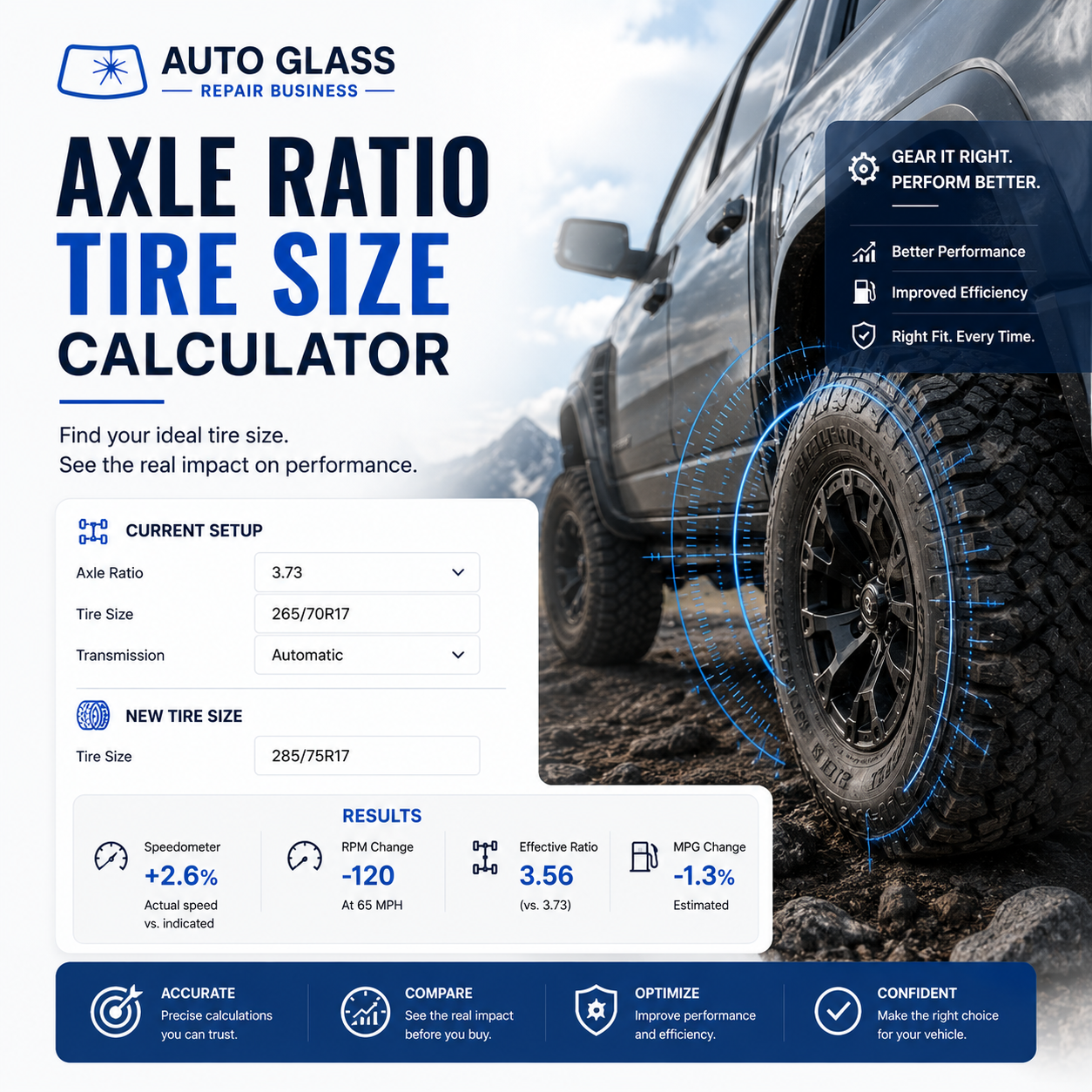
The Axle Ratio Tire Size Calculator connects three things that all move together whenever you change tire size: your engine’s RPM at a given speed, the axle (differential) ratio needed to keep your gearing where it was before the tire swap, and how far off your speedometer will read afterward. Bigger tires turn slower for the same road speed, which drops RPM and can leave an engine feeling sluggish and lugging — this tool does the math so you can pick a compensating axle ratio instead of guessing.
Use the Tire Size & RPM tab to calculate tire diameter from a metric size code and your engine RPM at speed, the Re-Gear Calculator tab to find the axle ratio needed after a tire size change, or the Speedometer Error tab to see how far off your speedometer will read — instantly.
Table of Contents
- Axle Ratio Tire Size Calculator (Free Tool)
- Calculating Tire Diameter From a Metric Size Code
- The RPM at Speed Formula, Explained
- Why Bigger Tires Need a Numerically Higher Axle Ratio
- How Tire Size Changes Affect Speedometer Accuracy
- Choosing the Right Axle Ratio When Upsizing Tires
- Frequently Asked Questions
Axle Ratio Tire Size Calculator
Select a tab below to calculate tire diameter and RPM at speed, the axle ratio needed after a tire size change, or resulting speedometer error. Tire sizes use the standard metric code (e.g., 265/75R16).
Calculating Tire Diameter From a Metric Size Code
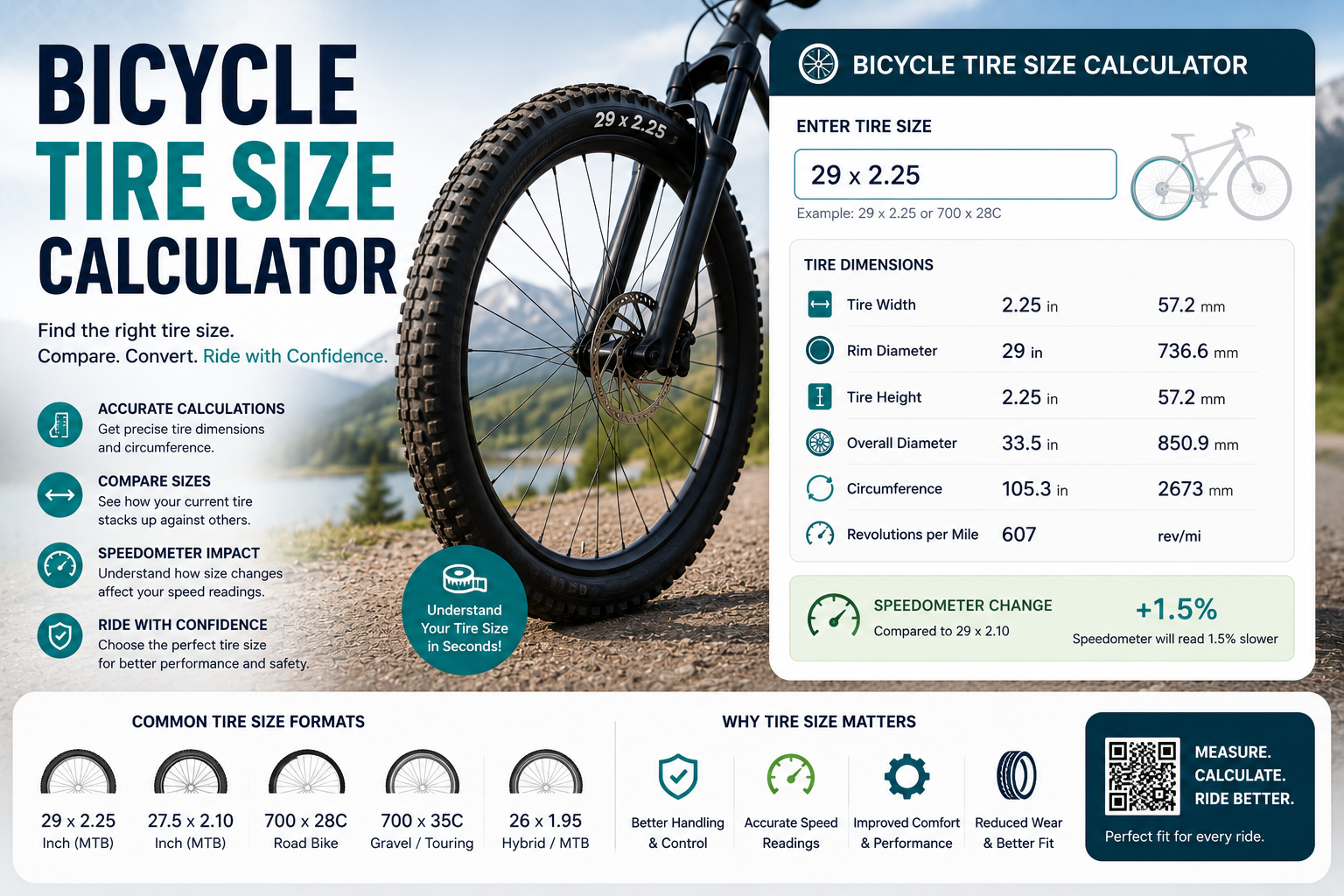
A standard tire size like 265/75R16 encodes everything needed to calculate overall diameter: 265 is the tire’s width in millimeters, 75 is the aspect ratio (sidewall height as a percentage of width), and 16 is the rim diameter in inches.
Sidewall Height (in) = Width (mm) × (Aspect Ratio ÷ 100) ÷ 25.4
Overall Diameter (in) = Rim Diameter + (2 × Sidewall Height)
For a 265/75R16: sidewall = 265 × 0.75 ÷ 25.4 ≈ 7.82in; overall diameter = 16 + (2 × 7.82) ≈ 31.6 inches — which is why that size is commonly nicknamed a “31-inch tire” in casual conversation, even though the exact math lands slightly above 31.
The RPM at Speed Formula, Explained
Engine RPM = (Speed in MPH × Axle Ratio × Transmission Gear Ratio × 336) ÷ Tire Diameter (inches)
The constant 336 comes from unit conversion: it converts miles-per-hour and tire diameter into wheel revolutions per minute (336 ≈ 1,056 ÷ π, where 1,056 converts miles-per-hour into inches-per-minute). Multiplying wheel RPM by the axle ratio and transmission gear ratio gives engine RPM, since power flows from the engine through the transmission and axle down to the wheels — each ratio represents how many times the upstream component spins per revolution of the next component down the chain.
This formula is the backbone of gear ratio selection for towing, off-roading, and highway cruising — too low an RPM at cruising speed can mean sluggish throttle response and poor towing performance; too high an RPM means excess engine wear, noise, and reduced fuel economy on the highway.
Why Bigger Tires Need a Numerically Higher Axle Ratio
A bigger tire covers more ground per revolution, which means the engine and transmission turn fewer times to cover the same distance — effectively taller overall gearing, even though nothing in the drivetrain itself changed. This shows up as reduced RPM at any given speed, sluggish acceleration, and reduced ability to make power under load (towing, climbing grades, or off-road crawling).
Recommended New Axle Ratio = Current Axle Ratio × (New Tire Diameter ÷ Original Tire Diameter)
Since axle ratios are typically expressed as the number of driveshaft turns per one wheel turn, a higher number represents a numerically “lower” gear (more mechanical advantage, more RPM per wheel turn) — which is exactly what compensates for a bigger tire’s taller effective gearing. This is why off-roaders who install significantly larger tires almost always re-gear their axles to a higher numerical ratio (e.g., 3.55 up to 4.10 or 4.56) to restore the acceleration and towing characteristics the vehicle had on its stock tire size.
How Tire Size Changes Affect Speedometer Accuracy
A speedometer doesn’t measure road speed directly — it counts wheel (or driveshaft) rotations and converts that count to a speed using the vehicle’s factory tire size. Change the tire diameter without recalibrating, and that conversion becomes wrong:
Actual Speed = Indicated Speed × (New Tire Diameter ÷ Original Tire Diameter)
Larger tires mean your true speed is higher than what the speedometer shows (each wheel revolution now covers more ground than the speedometer assumes) — a meaningful concern for both safe driving and avoiding speeding tickets you didn’t realize you were risking. Smaller tires cause the opposite error, with the speedometer over-reading your actual speed. The same error propagates to your odometer, trip computer fuel economy readouts, and cruise control accuracy.
Choosing the Right Axle Ratio When Upsizing Tires
- Calculate your exact tire diameter change using the Tire Size & RPM tab, since the recommended axle ratio scales directly with the diameter ratio.
- Run the Re-Gear Calculator to get your theoretically ideal new axle ratio.
- Round to a commercially available ratio — axle ring-and-pinion gear sets are manufactured in fixed increments (commonly 3.21, 3.55, 3.73, 3.92, 4.10, 4.30, 4.56, 4.88, 5.13, and similar), not arbitrary decimals, so pick whichever standard ratio lands closest to your calculated target.
- Verify RPM at your typical cruising and towing speeds using the Tire Size & RPM tab with your chosen ratio, to confirm it lands in a comfortable range for your engine rather than just matching the stock ratio’s math exactly.
- Consider whether both axles need matching gears on a 4WD/AWD vehicle — mismatched front and rear axle ratios can cause drivetrain binding and damage in four-wheel-drive mode.
Frequently Asked Questions
Do I really need to re-gear after installing bigger tires?
It depends on how much bigger the tires are and how sensitive you are to the change. A modest increase (a couple inches of diameter) is often tolerable without re-gearing, especially on a vehicle with plenty of power to spare. A larger increase — common with serious off-road tire upgrades — noticeably hurts acceleration, towing capacity, and can put extra strain on the transmission and torque converter from constantly working harder to compensate for the effectively taller gearing.
What transmission gear ratio should I use in the RPM calculator?
Use 1.00 for a transmission’s direct-drive top gear (common on many manual transmissions and some automatics), or your actual overdrive ratio if your top gear is an overdrive — commonly somewhere in the 0.65–0.80 range, though it varies by transmission. Check your vehicle’s specific transmission gear ratio chart, often available from the manufacturer or enthusiast forums for your model.
How much speedometer error is actually a problem?
Errors under about 2-3% are often considered minor and within the range many factory speedometers already carry from the factory. Errors beyond about 5% — common with tire diameter changes of 2+ inches — are generally worth correcting, both for accurate speed awareness and because significant errors can also affect ABS, traction control, and other systems that reference wheel speed sensors on some vehicles.
Can I fix speedometer error without re-gearing the axle?
Yes — many vehicles can have their speedometer recalibrated electronically (through the ECU/instrument cluster programming) to account for a new tire size without any mechanical axle changes. This corrects the speedometer and odometer reading but does nothing for the RPM, acceleration, and towing effects of the taller effective gearing — those require an actual axle re-gear to address.
Why isn’t my calculated axle ratio a “standard” number?
The formula gives you the mathematically ideal ratio, but ring-and-pinion gear sets are manufactured in fixed standard increments. Round your calculated result to the nearest commonly available ratio for your vehicle’s axle — going slightly higher (numerically) is generally preferable to going lower if you’re choosing between two close options and prioritize acceleration and towing over outright fuel economy.