The Amp to Horsepower Calculator converts electrical current into mechanical horsepower for DC, single-phase AC, and three-phase AC motors — and works in reverse to tell you the full-load amps (FLA) a motor will draw at a given voltage, which is what actually determines your wire gauge and breaker size. The math depends heavily on voltage, power factor, and motor efficiency, which is exactly why a flat “amps × volts” estimate is usually wrong by a meaningful margin.
Use the DC / Single-Phase tab to convert amps to horsepower for DC or single-phase AC circuits, the Three-Phase AC tab for three-phase motors, or the HP to Amps tab to reverse the calculation and see required amperage across standard voltages — instantly.
Table of Contents
- Amp to Horsepower Calculator (Free Tool)
- What Is the Relationship Between Amps and Horsepower?
- The Amps to Horsepower Formulas
- Why Efficiency and Power Factor Matter
- Common Motor Voltages Explained
- Using HP to Amps for Wire and Breaker Sizing
- Frequently Asked Questions
Amp to Horsepower Calculator
Select a tab below to convert amps to horsepower for a DC or single-phase circuit, a three-phase circuit, or to reverse the calculation and find required amps for a target horsepower.
| Voltage | Required Amps | vs. Current Voltage |
|---|
What Is the Relationship Between Amps and Horsepower?
Horsepower measures mechanical power output — the rate at which a motor does work. Amps measure electrical current — the rate at which charge flows into the motor. The bridge between them is power, measured in watts: electrical power in equals watts, and 746 watts of useful mechanical output equals 1 horsepower.
The catch is that not all the electrical power flowing in comes out as mechanical power. Two factors eat into the conversion: power factor (for AC circuits, the portion of apparent power that’s actually doing real work) and motor efficiency (the portion of real input power that becomes mechanical output rather than heat, friction, and other losses). Skip either one and an amps-to-horsepower estimate can be off by 15-30% or more — which is exactly why a bare “watts ÷ 746” calculation using raw volts × amps overstates horsepower for any real-world AC motor.
The Amps to Horsepower Formulas
The exact formula depends on whether the circuit is DC, single-phase AC, or three-phase AC:
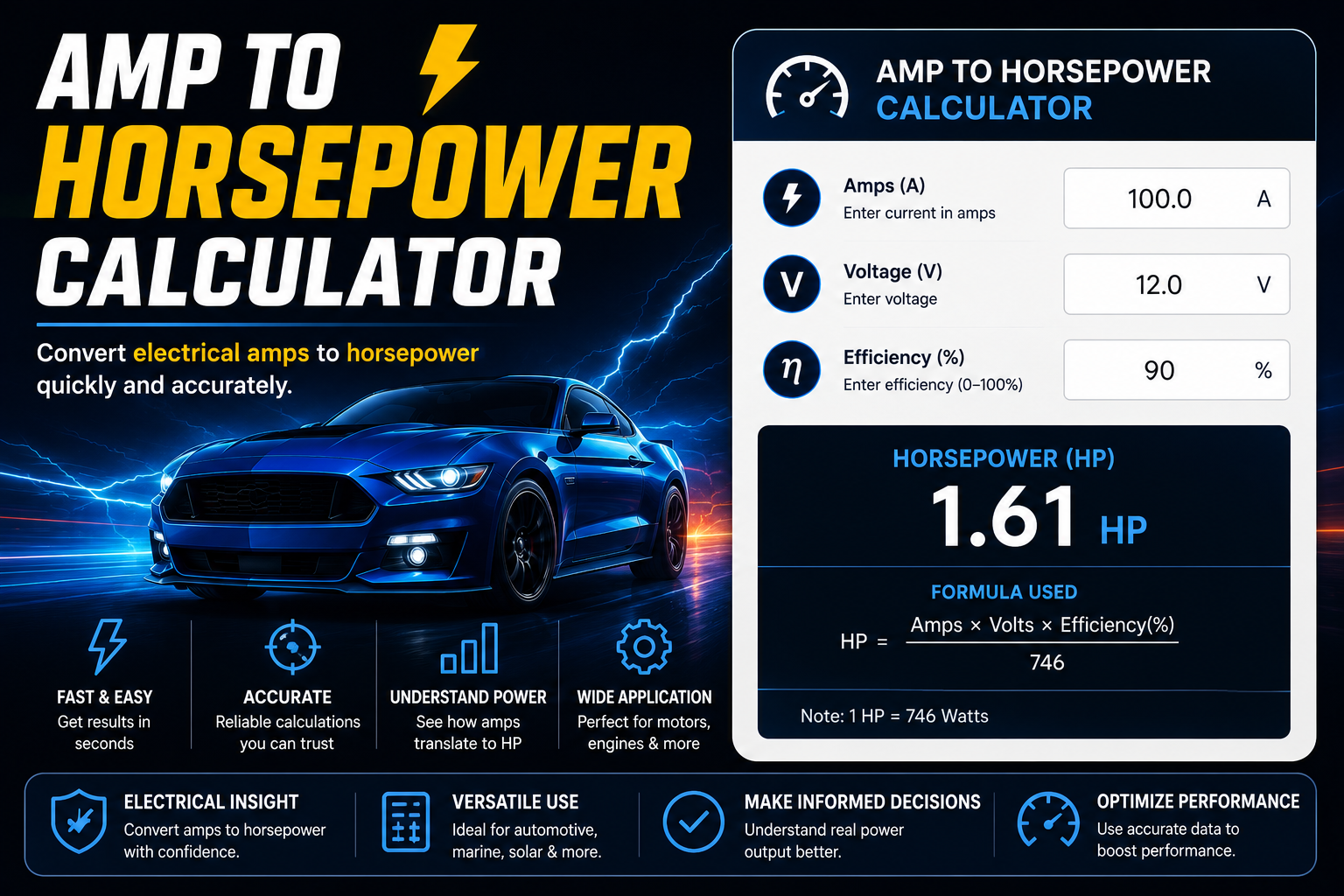
- DC: HP = (Volts × Amps × Efficiency) ÷ 746
- AC Single-Phase: HP = (Volts × Amps × Power Factor × Efficiency) ÷ 746
- AC Three-Phase: HP = (√3 × Volts × Amps × Power Factor × Efficiency) ÷ 746
For example, a three-phase motor pulling 15A on a 460V line at 0.87 power factor and 90% efficiency: HP = (1.732 × 460 × 15 × 0.87 × 0.90) ÷ 746 ≈ 13.3 HP. Use the Three-Phase AC tab above to run this with your own readings.
To go the other direction — finding the amps a motor will draw for a known horsepower rating, which is what you actually need for wire and breaker sizing — the formula rearranges to:
- DC / Single-Phase: Amps = (HP × 746) ÷ (Volts × Power Factor × Efficiency)
- Three-Phase: Amps = (HP × 746) ÷ (√3 × Volts × Power Factor × Efficiency)
Why Efficiency and Power Factor Matter
Motor Efficiency
Efficiency is the ratio of mechanical output power to electrical input power — the rest is lost as heat in windings, friction in bearings, and other losses. Standard-efficiency motors typically run 80-88%, while premium/NEMA-Premium efficiency motors reach 90-96%. This figure is printed on the motor’s nameplate and should always be used over a generic guess when precision matters, since a 10-point efficiency difference measurably changes both the horsepower-from-amps and amps-from-horsepower results.
Power Factor
In AC circuits, voltage and current aren’t always perfectly in sync — inductive loads like motor windings cause current to lag voltage, and only the “in-phase” portion of the current does real work. Power factor (a number from 0 to 1) captures that portion. Induction motors typically run a power factor of 0.80-0.90 at full load, dropping lower at partial load — which is why power factor isn’t a fixed constant for a given motor, but shifts with how hard the motor is working. DC circuits have no phase relationship to worry about, so power factor is always exactly 1.0.
Common Motor Voltages Explained
- 115/120V: Standard single-phase residential/light-commercial outlet voltage, typically limited to small motors (fractional HP up to roughly 1-2 HP) due to the high amperage larger motors would require.
- 208/230/240V: Common for medium single-phase and light three-phase equipment — shop tools, HVAC compressors, and small industrial motors, balancing manageable amperage with widely available service.
- 460/480V: The standard three-phase industrial voltage in North America, used for the large majority of commercial and industrial motors from a few horsepower up to several hundred, since higher voltage keeps amperage — and therefore wire size and losses — manageable.
- 575V: Common three-phase standard in Canada and some industrial applications, offering a further step down in amperage for very large motors.
The core relationship driving these voltage choices: for a fixed horsepower, doubling the voltage roughly halves the required amperage. Larger motors are run at higher voltage specifically to keep amperage — and the wire gauge and switchgear needed to carry it — from becoming impractically large. Use the HP to Amps tab above to see this effect directly across standard voltage options.
Using HP to Amps for Wire and Breaker Sizing
Electricians and engineers size conductors and overcurrent protection off a motor’s Full-Load Amps (FLA) — the current it draws at rated horsepower under rated load. In practice, this figure comes from two places, in order of authority:
- The motor’s nameplate: The manufacturer-tested FLA specific to that exact motor — always the most accurate source when available.
- National Electrical Code (NEC) Table 430.248/430.250: Standardized FLA values by horsepower and voltage, used for circuit design even before a specific motor is selected, and required by code for conductor and protection sizing regardless of what a nameplate or calculation shows.
The HP to Amps tab above is useful for early planning, budgeting, and sanity-checking — comparing rough amperage needs across voltage options before a specific motor is even chosen — but it should never substitute for nameplate data or code tables when it’s time to actually pull wire and set a breaker. NEC 430.22 also generally requires conductors sized for at least 125% of FLA to account for motor starting current and continuous-duty heating, a margin this calculator does not add automatically.
Frequently Asked Questions
How many amps does a 1 HP motor draw?
It depends entirely on voltage, power factor, and efficiency. As a rough single-phase example at 230V, 0.85 power factor, and 85% efficiency: Amps = (1 × 746) ÷ (230 × 0.85 × 0.85) ≈ 4.5A. At 115V under the same conditions, that roughly doubles to about 9A, since halving the voltage roughly doubles the current for the same power. Use the HP to Amps tab above with your specific voltage and motor specs for an accurate figure.
Why does my calculation not match the motor’s nameplate FLA?
Nameplate FLA is measured under controlled test conditions specific to that motor’s actual design, windings, and cooling — a generic formula using textbook efficiency and power factor assumptions will always be an approximation. Differences of 5-15% between a calculated estimate and nameplate FLA are normal; always use the nameplate value for actual installation and circuit sizing.
Do I use line current or phase current for three-phase calculations?
For the standard wye or delta three-phase motor connections used in nearly all industrial applications, line current and phase current are the same value in a balanced system (in a wye connection they’re always equal; in a typical delta-connected motor load as measured from the supply lines, the line current figure is what you clamp-meter and what the formula in this calculator expects).
Why is a 460V three-phase motor’s amperage so much lower than an equivalent single-phase motor?
Two effects stack: higher voltage alone reduces current for the same power, and the √3 factor in the three-phase formula means three-phase power delivery is inherently more current-efficient than single-phase for the same voltage and power level. This is exactly why larger motors are almost always specified as three-phase where available.
What power factor and efficiency should I use if I don’t know the actual motor specs?
For a rough planning estimate on a general-purpose induction motor, 0.85-0.87 power factor and 85-90% efficiency are reasonable placeholder assumptions at full load. For anything beyond planning-stage estimates — actual wire sizing, breaker selection, or circuit design — always use the specific motor’s nameplate values or the applicable code table instead of generic assumptions.