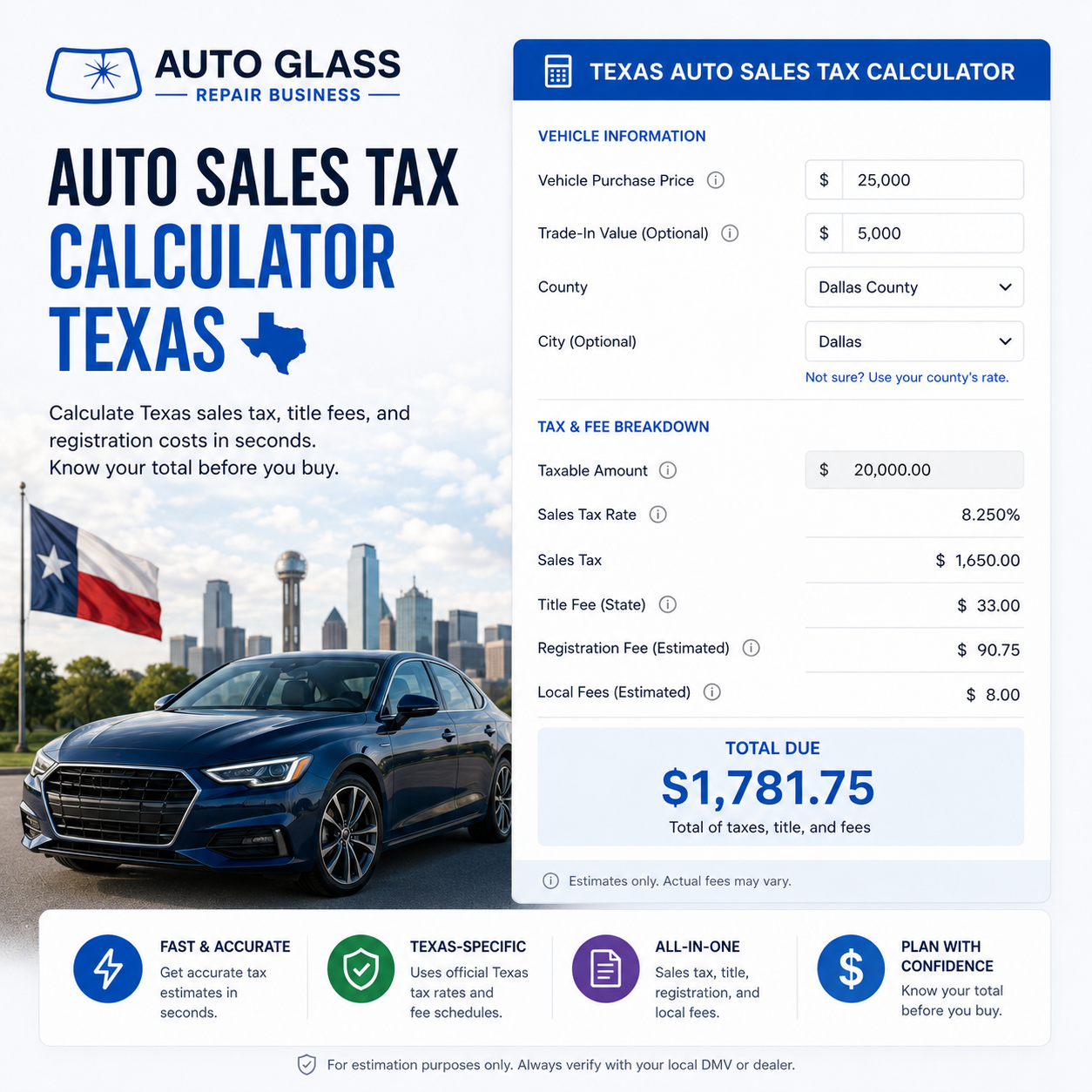
The Texas Auto Sales Tax Calculator estimates the motor vehicle sales tax due when you buy a car in Texas — whether from a dealer with a trade-in, from a private party (where Texas’s Standard Presumptive Value (SPV) rule can override your actual purchase price), or as a new Texas resident or gift recipient, both of which use flat fees instead of the standard rate. Texas’s motor vehicle tax is refreshingly simple in one respect: it’s a flat 6.25% state rate with no city, county, or local add-on — unlike Texas’s general sales tax, which does stack local rates on top.
Use the Dealer Purchase tab to estimate tax with trade-in credit, the Private-Party Sale tab to apply the SPV rule, or the New Resident / Gift tab for Texas’s special flat-fee transfer situations — instantly.
Table of Contents
- Texas Auto Sales Tax Calculator (Free Tool)
- Texas Motor Vehicle Sales Tax at a Glance
- How Trade-In Credit Works on a Dealer Purchase
- The Standard Presumptive Value (SPV) Rule for Private Sales
- The $90 New Resident Tax
- The $10 Gift Tax Between Qualifying Family Members
- Where and When Texas Vehicle Tax Is Paid
- Frequently Asked Questions
Texas Auto Sales Tax Calculator
Select a tab below to estimate tax on a dealer purchase, a private-party sale, or a new resident/gift transfer. All fields can be adjusted to your specific purchase.
Texas Motor Vehicle Sales Tax at a Glance
Texas charges motor vehicle sales and use tax at a flat 6.25% of the taxable sales price — the same rate whether you buy in a major metro area or a small rural county, and the same rate for new or used vehicles. This is a meaningful difference from Texas’s general sales tax, which combines the state rate with city, county, transit, and special-purpose district rates that can push the combined general rate up to 8.25% in some areas — motor vehicle tax skips all of that local stacking entirely.
The tax is collected by your county tax assessor-collector’s office when you title and register the vehicle, not necessarily by the dealer at the point of sale (though many dealers collect and remit it on your behalf as part of the transaction).
How Trade-In Credit Works on a Dealer Purchase
When you trade a vehicle in as part of a dealer purchase, Texas calculates tax on the difference between the new vehicle’s price and your trade-in allowance:
Taxable Amount = Purchase Price − Trade-In Allowance
For example, a $30,000 vehicle with a $5,000 trade-in is taxed on $25,000: $25,000 × 6.25% = $1,562.50, rather than $1,875 on the full price — a $312.50 savings purely from the trade-in credit. This credit applies to dealer transactions; it does not apply to private-party sales, which follow the SPV rule instead.
The Standard Presumptive Value (SPV) Rule for Private Sales
Buying a used vehicle from a private individual in Texas doesn’t let you set the taxable value simply by agreeing on a low bill-of-sale price with the seller. Texas calculates tax on the greater of your reported purchase price or 80% of the vehicle’s Standard Presumptive Value (SPV) — an average retail value the TxDMV maintains for most vehicles based on regional sales data:
Taxable Value = Greater of (Purchase Price) or (80% × SPV)
If your genuinely low purchase price reflects real condition issues, high mileage, or damage the SPV database doesn’t account for, Texas allows you to submit a certified appraisal from a licensed dealer or qualified appraiser to use that appraised value instead of the SPV-based figure — this is the standard path if you believe the SPV rule is overstating your vehicle’s actual value.
The $90 New Resident Tax
If you’re moving to Texas and bringing a vehicle that was already registered in your name in another state (or country), Texas charges a flat $90 new resident use tax instead of the standard 6.25% rate — a substantial simplification for anyone relocating with an existing vehicle rather than purchasing new upon arrival. You’ll generally need to provide proof of your prior out-of-state registration in your own name to qualify for this flat fee treatment rather than the standard percentage-based tax.
The $10 Gift Tax Between Qualifying Family Members
A vehicle genuinely transferred as a gift — with no payment, trade, or other consideration exchanged — between qualifying family members (generally including spouses, parents and children, and certain other close relationships defined under Texas rules) can qualify for a flat $10 gift tax instead of the standard 6.25% rate. Both parties typically complete a gift affidavit confirming the transfer meets the requirements; confirm the current list of qualifying relationships and required documentation with your county tax office, since misusing this provision for a transaction that isn’t a genuine gift can create problems later.
Where and When Texas Vehicle Tax Is Paid
Motor vehicle sales tax is generally due when you title and register the vehicle at your county tax assessor-collector’s office, typically within a set number of days of the purchase date (commonly cited as around 30 calendar days). Paying late generally triggers a penalty that increases the longer the payment is delayed, so it’s worth handling this promptly rather than letting it slide — confirm the exact current deadline and penalty schedule with your county tax office or the TxDMV, since these administrative details can be updated over time.
Frequently Asked Questions
What is the sales tax rate on a car in Texas?
6.25% of the taxable sales price, flat statewide — there is no additional city, county, or local rate added on top for motor vehicle purchases, unlike Texas’s general merchandise sales tax, which does stack local rates.
Can I just agree on a low price with a private seller to lower my tax?
Not effectively — Texas taxes private-party sales on the greater of your reported price or 80% of the vehicle’s Standard Presumptive Value (SPV). If your reported price is below that figure, the SPV-based value is used instead, regardless of what you and the seller actually agreed to pay.
What if my car is genuinely worth less than its SPV?
You can submit a certified appraisal from a licensed dealer or qualified appraiser documenting the vehicle’s actual condition-adjusted value, and Texas will generally use that appraised value instead of the SPV-based figure. This is the standard remedy for a vehicle with significant damage, high mileage, or other condition issues not reflected in the SPV database.
Do I pay the $90 new resident tax if I buy a car after moving to Texas?
No — the $90 flat rate only applies to a vehicle you already owned and had registered in your own name in another state before moving. If you purchase a vehicle after establishing Texas residency, that purchase is taxed under the standard rules (6.25% for a dealer purchase, or the SPV rule for a private-party purchase).
Who qualifies for the $10 gift tax?
Generally, close family relationships defined under Texas rules — commonly including spouses, parents, children, and certain other qualifying relatives — where the vehicle is transferred with no payment or other consideration. Confirm the current qualifying relationship list and required affidavit paperwork with your county tax assessor-collector’s office before assuming a specific transfer qualifies.
Does a manufacturer rebate reduce my Texas motor vehicle sales tax?
Generally, no — as in most states, Texas typically taxes the vehicle’s negotiated price before a manufacturer rebate is applied, since the rebate is treated as a form of payment toward the price rather than a reduction of the price itself. Confirm this treatment with your dealer’s finance office for your specific deal, since promotional structures can vary.