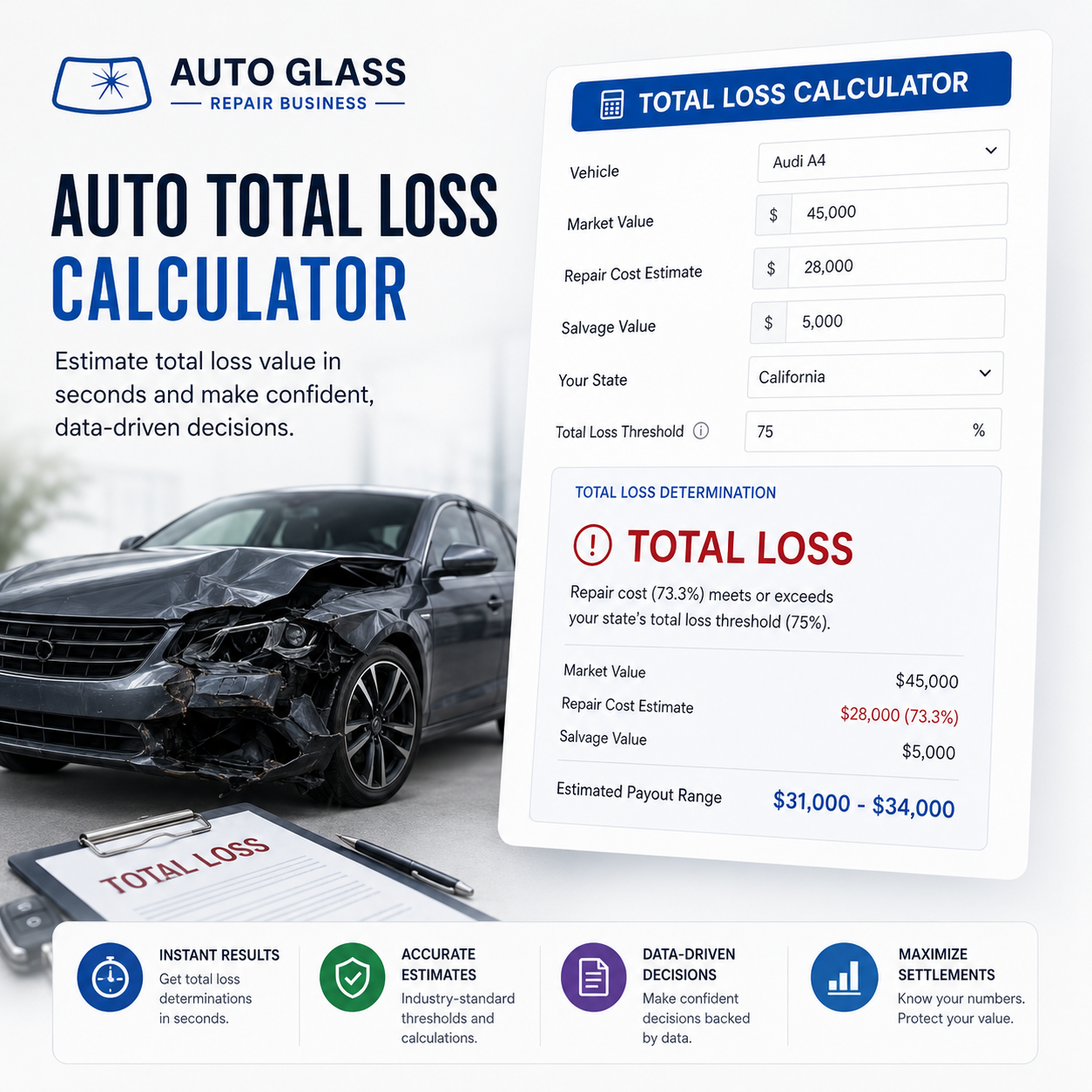
The Auto Total Loss Calculator answers the three questions that actually matter after a serious accident: is your car even a total loss in the first place, what will the insurance settlement payout look like, and — critically — will you still owe money on your loan after the payout. Total loss rules vary by state and by insurer, so this tool is built to be transparent about the method it’s using rather than hiding it behind a single black-box number.
Use the Is It a Total Loss? tab to check whether your vehicle meets your state’s threshold, the Settlement Payout tab to estimate what the insurer would actually pay, or the Loan Payoff Gap tab to see whether you’d owe money out of pocket after a total loss — instantly.
Table of Contents
- Auto Total Loss Calculator (Free Tool)
- What Makes a Car a “Total Loss”?
- Total Loss Threshold vs. Total Loss Formula
- How the Total Loss Settlement Payout Is Calculated
- The Loan Payoff Gap: Will You Still Owe Money?
- What Is Gap Insurance and Do You Need It?
- Can You Keep Your Totaled Car?
- What to Do If You Disagree With a Total Loss Determination
- Frequently Asked Questions
Auto Total Loss Calculator
Select a tab below to check whether your vehicle qualifies as a total loss, estimate your settlement payout, or check for a loan payoff gap. All fields can be adjusted to your specific situation.
What Makes a Car a “Total Loss”?
A vehicle is declared a total loss when an insurer determines it isn’t economically worthwhile to repair — either because the repair cost is too high relative to the car’s value, or because a formula combining repair and salvage costs exceeds that value. Once a vehicle is declared a total loss, the insurer stops paying for repairs and instead pays out the vehicle’s Actual Cash Value (ACV), adjusted by a handful of factors covered in the Settlement Payout section below.
This determination isn’t just a technicality — it changes everything about how the claim proceeds, including whether you get your car back, whether you owe anything further on a loan, and how quickly the claim resolves.
Total Loss Threshold vs. Total Loss Formula
States generally use one of two approaches (and some allow insurers discretion within a framework), which is why the Is It a Total Loss? tab above lets you choose between them:
- Total Loss Threshold (TLT): A percentage set by state law — if estimated repair cost reaches that percentage of the vehicle’s ACV, it’s automatically declared a total loss. Threshold percentages vary meaningfully across states, commonly somewhere between 50% and 100% of ACV.
- Total Loss Formula (TLF): Used in states without a fixed percentage threshold (or as a supplementary test) — if the repair cost plus the vehicle’s estimated salvage value meets or exceeds its ACV, it’s declared a total loss. This method accounts for the fact that a heavily damaged vehicle still has some value as salvage, which effectively lowers the repair-cost bar needed to trigger a total loss.
Because both the exact threshold percentage and which method applies are set by your specific state (and sometimes influenced by insurer policy within that framework), always confirm the correct method and figure with your insurer or state insurance department before treating either calculator result as final.
How the Total Loss Settlement Payout Is Calculated
Once a vehicle is confirmed as a total loss, the payout generally starts from ACV and adjusts from there:
- Start with ACV — the vehicle’s pre-loss market value, based on comparable local sales.
- Add sales tax and title/registration fee reimbursement where required, since replacing the vehicle would mean paying these again.
- Subtract your deductible for the applicable coverage (collision or comprehensive).
- Subtract salvage value if you choose to keep the totaled vehicle on a salvage title rather than let the insurer take possession of it.
If your ACV figure itself feels low, it’s worth pulling comparable listings for your specific year, make, model, mileage, and condition before accepting an offer — ACV is frequently the most negotiable number in this whole process.
The Loan Payoff Gap: Will You Still Owe Money?
This is the question that catches financed vehicle owners off guard the most: your insurance payout is based on the car’s current value, but your loan balance is based on what you originally financed — and those two numbers move at very different speeds. A vehicle depreciates the moment it’s driven off the lot, while a loan balance declines more slowly, especially early in the term or with a small down payment. The result is a common scenario where the insurance payout doesn’t fully cover what’s left on the loan.
This gap is most likely to appear when: you financed with little or no down payment, you’re early in the loan term, you rolled negative equity from a previous vehicle into this loan, or you chose a longer loan term that keeps the balance high for longer relative to the vehicle’s depreciation curve. Use the Loan Payoff Gap tab above to check your specific numbers.
What Is Gap Insurance and Do You Need It?
Guaranteed Asset Protection (GAP) insurance is a policy add-on specifically designed to cover the difference between your insurance payout and your remaining loan or lease balance after a total loss — exactly the shortfall calculated in the Loan Payoff Gap tab above. It’s typically inexpensive relative to the protection it offers, and is most valuable in precisely the situations described above: small down payments, longer loan terms, or rolled-over negative equity.
Without gap coverage, you’re generally responsible for paying any shortfall directly to your lender out of pocket — the loan doesn’t disappear just because the vehicle securing it does. If you’re currently shopping for a new loan or lease, checking whether gap coverage is bundled in, offered by your lender, or available separately through your auto insurer is worth the few minutes it takes.
Can You Keep Your Totaled Car?
In most cases, yes — subject to your state’s rules. If you keep the vehicle, the insurer deducts its salvage value from your payout (modeled in the Settlement Payout tab above), and the vehicle receives a salvage title, later eligible to become a rebuilt title if it’s repaired and passes a required safety/roadworthiness inspection. A salvage or rebuilt title significantly limits future resale value and can make financing or insuring the vehicle again more difficult, so this decision is worth weighing carefully against simply letting the insurer take the vehicle and using the payout toward a replacement.
What to Do If You Disagree With a Total Loss Determination
- Request the full valuation and repair estimate: Ask for the specific ACV comparables, repair estimate, and (if applicable) salvage value the insurer used, since any one of them being off can flip the total loss determination.
- Get an independent repair estimate: A second shop’s estimate can reveal whether the insurer’s repair figure was inflated or whether legitimate additional damage was missed.
- Challenge the ACV if it looks low: A lower ACV makes a total loss determination more likely under a percentage threshold and reduces your eventual payout either way, so this figure deserves scrutiny regardless of which way you want the determination to go.
- Understand you generally can’t force a repair over an insurer’s total loss decision if you want them to keep paying for it, though you may be able to keep the vehicle and repair it yourself using the salvage-adjusted payout.
- Consult a public adjuster or attorney for a significant, disputed valuation, particularly if the vehicle is unusual, modified, or otherwise harder to value with standard comparables.
Frequently Asked Questions
What percentage of damage makes a car a total loss?
It depends on your state’s total loss threshold, which commonly ranges from about 50% to 100% of the vehicle’s ACV, or on the Total Loss Formula (repair cost plus salvage value versus ACV) in states without a fixed percentage. There’s no single nationwide percentage — check the Is It a Total Loss? tab above with your state’s specific threshold, and confirm it with your insurer or state insurance department.
Will I still owe money on my car loan if it’s totaled?
Possibly — if your insurance payout is less than your remaining loan balance, you’re generally responsible for that shortfall unless you have gap insurance. This is common early in a loan term or with a small down payment. Use the Loan Payoff Gap tab above with your specific payout and loan balance to check.
Does gap insurance cover my deductible too?
Generally, no — gap insurance covers the difference between your loan balance and your insurance payout, not your collision/comprehensive deductible, which is a separate cost you typically still owe. Some gap policies offer a small deductible reimbursement as an add-on feature; check your specific policy’s terms.
Can I refuse to let my car be declared a total loss?
You can dispute the valuation, repair estimate, or salvage figure behind the determination, but if the numbers genuinely meet your state’s total loss standard, you generally can’t force the insurer to pay for repairs instead. You typically can choose to keep the vehicle (on a salvage title, with its value deducted from your payout) and repair it yourself if you prefer, rather than take the insurer’s total loss payout and walk away.
How long does a total loss claim usually take to settle?
This varies by insurer and by how contested the ACV or total loss determination is, but total loss claims are often resolved faster than a full repair claim once the determination is made, since there’s no repair timeline to manage. Disputes over valuation are the most common source of delay.