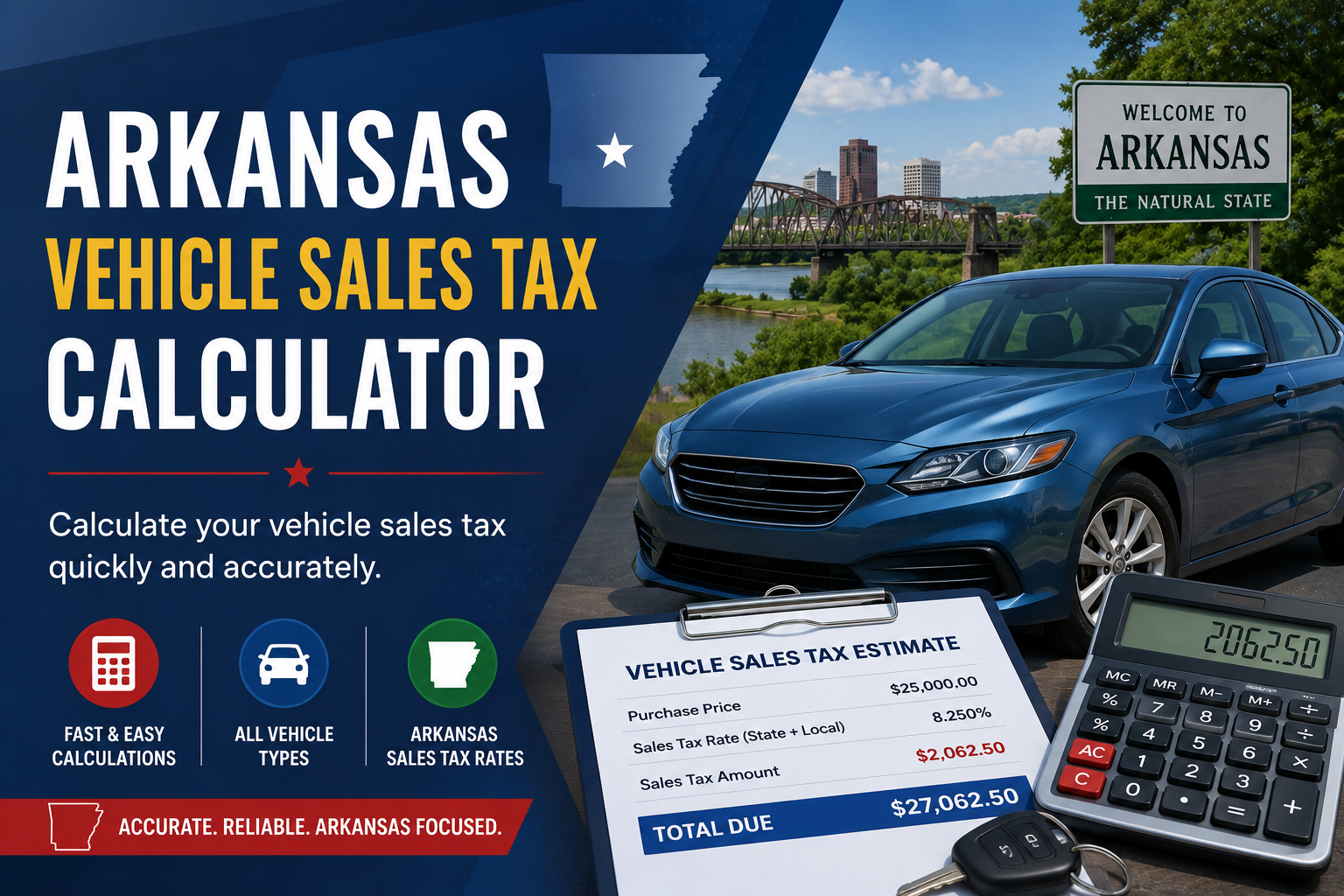
The Arkansas Vehicle Sales Tax Calculator helps you estimate the tax due when you buy a vehicle in Arkansas — whether from a dealer with a trade-in, or from a private seller. Arkansas taxes vehicles at the standard state sales tax rate plus local county and city tax, gives credit for a trade-in, and — unlike most states — exempts low-priced used vehicles from sales tax entirely below a set purchase price threshold, a detail that changes the math completely for budget vehicle purchases.
Use the Dealer Purchase tab to estimate tax with a trade-in and check the low-price exemption, the Private Sale tab to estimate tax on a purchase from an individual, or the Rate Comparison tab to see how your total tax changes across different combined county and city rates — instantly.
Table of Contents
- Arkansas Vehicle Sales Tax Calculator (Free Tool)
- What Is Arkansas Vehicle Sales Tax?
- Arkansas’s Low-Price Vehicle Sales Tax Exemption
- How Trade-In Credit Reduces Your Taxable Amount
- Local Sales Tax Rates Across Arkansas
- Sales Tax on Private Vehicle Sales
- How to Find Your County and City’s Rate
- Frequently Asked Questions
Arkansas Vehicle Sales Tax Calculator
Select a tab below to estimate tax on a dealer purchase, a private sale, or to compare total tax across different local rates. All fields can be adjusted to your specific purchase and county.
| Total Tax Rate | Total Tax | vs. Current |
|---|
What Is Arkansas Vehicle Sales Tax?
Arkansas charges sales tax on motor vehicle purchases at the standard state sales tax rate — unlike some states, Arkansas does not offer a special reduced rate for vehicles the way it does for groceries. Local county and city sales tax is added on top, and the combined rate is collected when the vehicle is titled and registered, generally through your county revenue office rather than at the point of sale.
The formula is: Taxable Amount × (State Rate + Local Rate). What makes Arkansas distinctive isn’t the rate structure — it’s two specific rules that can dramatically change the taxable amount: a full exemption for low-priced used vehicles, and trade-in credit for dealer purchases. Both are covered in detail below.
Arkansas’s Low-Price Vehicle Sales Tax Exemption
Arkansas exempts used vehicles sold below a set purchase price from sales tax entirely — currently $4,000, though this threshold has been raised by the legislature before (it was previously $2,500) and could change again. If a vehicle’s purchase price falls below the exemption threshold, no state or local sales tax is owed on that purchase at all, whether it’s bought from a dealer or a private individual.
This exemption is a meaningful factor for budget vehicle shoppers — a $3,900 used car pays zero sales tax, while a $4,100 car pays tax on the full amount, making the threshold itself worth shopping around. Because this figure is set by state law and has changed over time, always confirm the current exemption threshold with the Arkansas Department of Finance and Administration (DFA) before relying on it at the point of titling — the calculator above lets you adjust this threshold directly if it changes.
How Trade-In Credit Reduces Your Taxable Amount
When you trade a vehicle in as part of a dealer purchase, Arkansas calculates sales tax on the difference between the new vehicle’s price and your trade-in allowance, rather than the full purchase price:
Taxable Amount = Purchase Price − Trade-In Allowance
For example, buying an $18,000 vehicle with a $3,000 trade-in: taxable amount = $18,000 − $3,000 = $15,000, taxed at your combined state and local rate rather than the full $18,000. Trade-in credit rules and any applicable caps have been the subject of legislative changes in Arkansas in recent years, so if you’re trading in a high-value vehicle, confirm the current trade-in credit rules with your dealer’s finance office or the Arkansas DFA before finalizing your budget — this credit only applies to dealer transactions, not private-party sales.
Local Sales Tax Rates Across Arkansas
On top of the state rate, Arkansas counties and cities each set their own local sales tax, and both can apply to the same purchase — meaning your total combined rate depends on both your county and, if you’re inside city limits, your municipality. Local rates vary meaningfully across the state, so two buyers with identical purchase prices can owe noticeably different amounts in tax purely based on where the vehicle is registered.
Because of this variation, always use your specific registration address’s combined rate rather than a statewide average when budgeting for a purchase — the Rate Comparison tab above lets you model a range of combined rates side by side.
Sales Tax on Private Vehicle Sales
Buying a vehicle from a private individual in Arkansas doesn’t avoid sales tax — it’s still due at the same combined state and local rate, collected when you title the vehicle at your county revenue office rather than at the moment of sale. The same low-price exemption threshold applies to private-party purchases as well, so a low-priced private sale below the threshold is just as exempt as a low-priced dealer sale.
Unlike dealer purchases, private sales generally don’t carry a trade-in credit mechanism, since there’s no dealer transaction structure involved — the full reported purchase price (subject to the exemption threshold) is what gets taxed.
How to Find Your County and City’s Rate
- Ask your dealer’s finance office: Dealers calculate and disclose the combined state and local rate on every deal.
- Contact your county revenue office: Vehicle titling and tax collection in Arkansas is handled at the county level — the revenue office can confirm your exact combined rate.
- Check the Arkansas Department of Finance and Administration’s rate lookup resources: The DFA publishes local sales tax rate information by jurisdiction, along with current exemption thresholds and any trade-in credit rules in effect.
- Use your registration address, not the dealership’s: Combined local rates generally follow the address where the vehicle will be registered, not necessarily the dealership’s location.
Frequently Asked Questions
What is the sales tax rate on a vehicle in Arkansas?
Arkansas taxes vehicles at the standard state sales tax rate (6.5%) plus your local county and city rate, which varies by jurisdiction. There is no special reduced rate for vehicles in Arkansas the way some states offer — confirm your exact combined rate with your county revenue office or dealer’s finance office.
Do I really pay no sales tax if my car costs less than $4,000?
Under current Arkansas law, used vehicles purchased below the state’s low-price exemption threshold are exempt from sales tax entirely. This threshold has been raised by the legislature in the past (from $2,500 to $4,000) and could change again, so confirm the current figure with the Arkansas DFA before finalizing a purchase near the threshold.
Does trading in my old vehicle reduce my sales tax?
Yes, for dealer purchases — Arkansas calculates sales tax on the purchase price minus your trade-in allowance. Trade-in credit rules have been subject to legislative changes in recent years, so confirm current terms (including any cap) with your dealer or the Arkansas DFA, especially for a high-value trade-in.
Do I owe tax if I buy a car from a private individual in Arkansas?
Yes, at the same combined state and local rate as a dealer purchase, collected when you title the vehicle. The same low-price exemption threshold applies, so a private purchase below that threshold is exempt just like a qualifying dealer purchase.
Is the exemption based on the price before or after my trade-in?
The exemption is generally understood to apply to the vehicle’s purchase price. If you’re near the threshold and also trading in a vehicle, confirm with your dealer’s finance office or the Arkansas DFA exactly how the exemption interacts with a trade-in on your specific deal, since the calculator above applies the exemption check to the purchase price before trade-in is subtracted.
Where do I actually pay Arkansas vehicle sales tax?
Unlike states where a dealer collects sales tax at the point of sale, Arkansas generally collects vehicle sales tax when you title and register the vehicle at your county revenue office — plan to have the tax payment ready at that step, whether you bought from a dealer or a private seller.