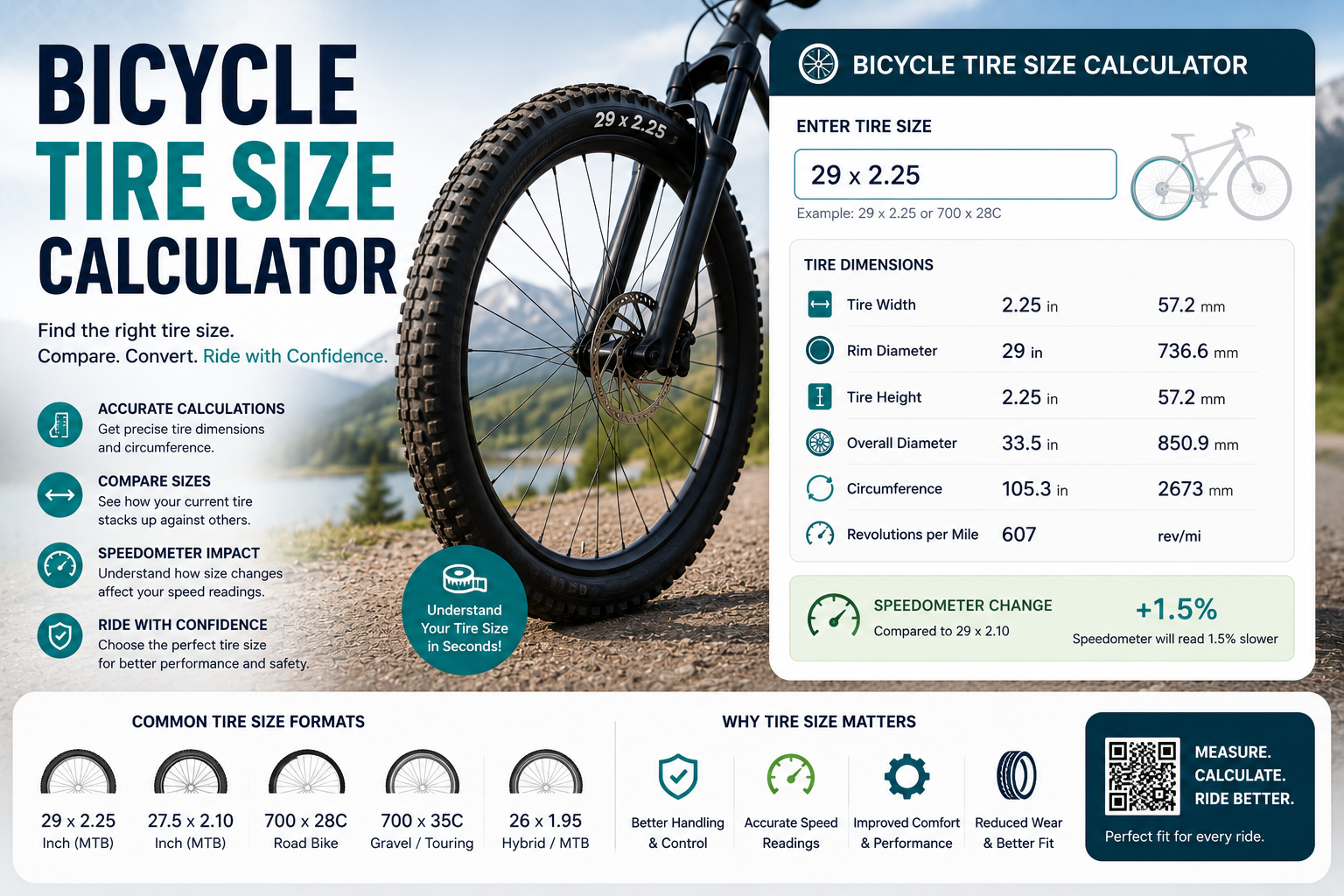
The Bicycle Tire Size Calculator untangles one of cycling’s most persistently confusing topics — wheel size naming — by converting between common marketing names (700c, 29er, 650b, 26″) and the actual, unambiguous ISO/ETRTO standard, calculating overall tire diameter and circumference, and helping you calibrate a bike computer using a real rollout test rather than guesswork.
Use the Size Converter tab to translate a common wheel size name into its ISO bead seat diameter, the Diameter & Circumference tab to calculate overall tire size from BSD and tire width, or the Bike Computer Calibration tab to get an accurate circumference from a real rollout measurement — instantly.
Table of Contents
- Bicycle Tire Size Calculator (Free Tool)
- Why Bicycle Tire Sizing Is So Confusing
- The ISO/ETRTO Standard, Explained
- Why Some Wheel Sizes Share the Same Bead Seat Diameter
- Calculating Overall Diameter and Circumference
- The Rollout Method for Accurate Bike Computer Calibration
- Frequently Asked Questions
Bicycle Tire Size Calculator
Select a tab below to convert a common wheel size to its ISO standard, calculate overall diameter and circumference, or calibrate a bike computer using a rollout measurement.
Why Bicycle Tire Sizing Is So Confusing
Bicycle wheel sizes accumulated their naming conventions over more than a century, across different countries and bike categories, without much coordination — the result is that names like “26 inch,” “700c,” and “27 inch” don’t reliably describe an actual measured dimension, and worse, the same nominal name can refer to genuinely different, incompatible wheel diameters depending on the bike category. A “26-inch” mountain bike wheel and a “26-inch” beach cruiser wheel, for instance, are not always interchangeable, despite the identical label.
The only fully reliable way to match a tire to a rim is the ISO/ETRTO standard, which is why this calculator leads with converting common names into that standard first.
The ISO/ETRTO Standard, Explained
The ISO 5775 standard (maintained in coordination with the European Tyre and Rim Technical Organisation, ETRTO) labels both tires and rims with two numbers: tire width and bead seat diameter (BSD) — the diameter of the rim surface the tire’s bead actually seats against, measured in millimeters. A tire marked 28-622 is 28mm wide with a 622mm bead seat diameter; it will fit any rim also marked 622mm, regardless of what “colloquial” name that rim is sold under.
This BSD number is printed on virtually every modern tire sidewall and is the number to trust over any marketing name when buying tires or checking compatibility — the Size Converter tab above translates the common names you’ll see at a bike shop into this exact figure.
Why Some Wheel Sizes Share the Same Bead Seat Diameter
- 700c and 29″ / 29er share 622mm BSD: Genuinely the same rim standard, marketed under different names because 700c grew out of road bike tradition while 29er grew out of mountain bike marketing — a 29er mountain bike wheel and a 700c road wheel share the identical bead seat diameter, even though they’re built for very different tire widths and use cases.
- 650b and 27.5″ share 584mm BSD: Same situation — 650b is the traditional/road-touring name, 27.5″ is the mountain bike marketing name for the identical 584mm standard.
- 27″ (630mm) is NOT the same as 700c (622mm): Despite sounding closely related, these are genuinely different, incompatible standards from different eras of road bike design — a common and costly mistake when buying tires for an older road bike.
- “20-inch” spans multiple distinct standards: 406mm is the most common (BMX, most folding bikes), but 451mm and other variants exist on different folding and small-wheel bikes — “20 inch” alone isn’t enough information to guarantee a correct tire purchase.
Calculating Overall Diameter and Circumference
Once you know a wheel’s bead seat diameter and the tire’s width, overall diameter follows a straightforward approximation:
Overall Diameter ≈ Bead Seat Diameter + (2 × Tire Width)
This approximates the tire’s section height as roughly equal to its width, which holds reasonably well for most bicycle tire casings, though exact profiles vary slightly by brand and tire model. From there, circumference is simply π × diameter — the figure most bike computers and cycling GPS devices ask for directly when setting up wheel size for accurate speed and distance tracking.
The Rollout Method for Accurate Bike Computer Calibration
The geometric calculation above is a solid estimate, but a real wheel under a real rider compresses slightly at the contact patch, and exact tire casing shape varies by manufacturer — both of which shift the true rolling circumference a bit from the pure geometric figure. Cyclists who want the most accurate bike computer calibration use a rollout test instead:
- Inflate the tire to your normal riding pressure.
- Sit on the bike (rider weight matters, since it compresses the tire) and mark the exact position of the valve stem against the ground.
- Roll forward in a straight line for a whole number of wheel revolutions (more revolutions — 4 or more — averages out small measurement errors better than just one).
- Mark the ground again at the same valve stem position after the final revolution, and measure the total distance rolled.
- Divide distance by the number of revolutions to get your true circumference — enter this directly into the Bike Computer Calibration tab above, or straight into your device.
This measured figure is what should actually go into your bike computer or GPS device’s wheel size setting — the geometric calculation is a useful sanity check and starting estimate, but the rollout measurement reflects your specific tire, pressure, and riding weight more precisely.
Frequently Asked Questions
Are 700c and 29-inch wheels the same size?
Yes, in terms of bead seat diameter — both use a 622mm ISO/ETRTO standard, meaning a 29er mountain bike rim and a 700c road bike rim are the same base diameter, just built for different tire widths and use cases. This is why some gravel and adventure bikes market themselves as compatible with both “700c” and “29er” tire options.
Can I put a 27-inch tire on a 700c wheel?
No — despite the similar-sounding names, 27-inch (630mm bead seat diameter) and 700c (622mm) are different, incompatible standards. This is one of the most common and costly tire-buying mistakes for owners of older road bikes; always check the ISO number printed on your current tire’s sidewall before ordering a replacement.
Why does my bike computer’s distance reading seem off?
Most commonly, the circumference value programmed into the device doesn’t match your actual wheel — either a default/generic value was never updated, or a geometric estimate was used instead of a real rollout measurement. Use the Bike Computer Calibration tab above to get an accurate, tire-specific circumference and reprogram your device with that figure.
Does tire pressure affect my bike computer’s accuracy?
Yes, to a small degree — a softer tire compresses more under rider weight, slightly reducing the effective rolling circumference compared to a fully firm tire. This is exactly why the rollout method (performed at your normal riding pressure, with the rider’s weight on the bike) is more accurate than a purely geometric calculation, which can’t account for this real-world compression.
How do I know my exact tire size without the box or manual?
Check the tire’s sidewall directly — nearly all modern bicycle tires print their ISO/ETRTO size (like “28-622” or “2.25-559”) molded into the rubber, which is the most reliable source of truth. If it’s worn illegible, measuring the rim’s bead seat diameter directly, or checking your bike or wheel manufacturer’s specifications, are the next best options.