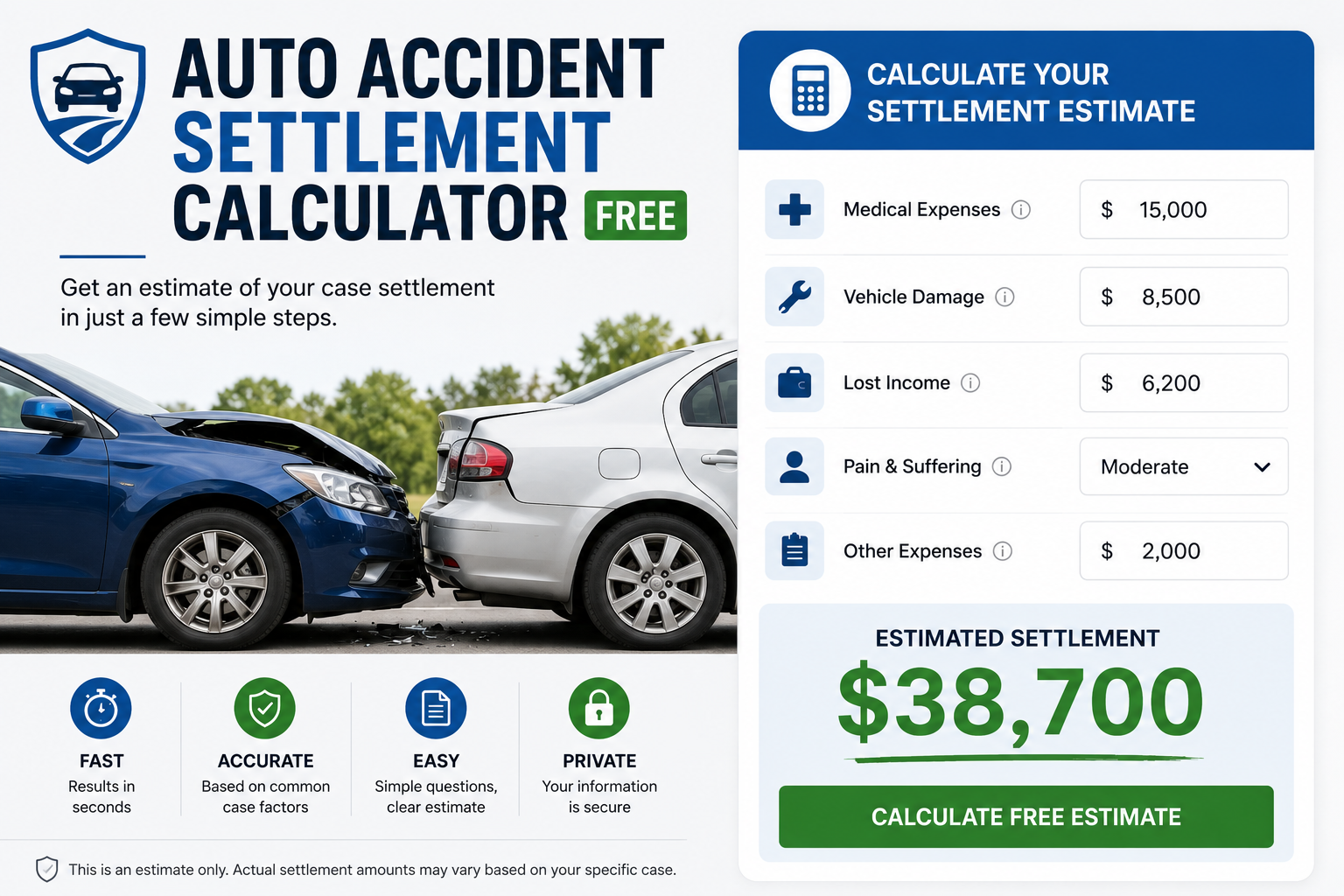
This free auto accident settlement calculator gives you three different ways to size up a claim: a quick estimate when you just want a fast ballpark, a realistic low-to-high settlement range instead of one falsely-precise number, and a side-by-side comparison of what you’d likely net settling it yourself versus hiring an attorney. No signup, no email required — just enter your numbers and get results instantly. This is an educational estimation tool, not legal advice.
Use the Quick Estimate tab for a fast single-number ballpark, the Settlement Range tab to see a realistic low-to-high band, or the Attorney vs. Self-Represent tab to compare your likely net outcome under both paths — instantly.
Table of Contents
- Free Auto Accident Settlement Calculator
- What Is an Auto Accident Settlement?
- Why Settlement Estimates Should Be a Range, Not One Number
- Quick Estimate vs. Detailed Range: Which Should You Trust More?
- Should You Hire an Attorney? The Math Behind the Decision
- How Insurers Typically Treat Unrepresented Claimants
- What This Calculator Doesn’t Account For
- Frequently Asked Questions
Free Auto Accident Settlement Calculator
Select a tab below for a quick single-number estimate, a realistic low-to-high settlement range, or a comparison of settling yourself versus hiring an attorney. All fields are editable — this tool is free to use with no limits.
What Is an Auto Accident Settlement?
An auto accident settlement is the negotiated payment an insurance company (or, less commonly, an at-fault individual) agrees to pay a claimant in exchange for resolving a claim without going to trial. Most car accident claims — the large majority, by most accounts — settle rather than reach a courtroom, since litigation is slower and costlier for everyone involved. A settlement typically covers both your documented economic losses (medical bills, lost wages, property damage) and an amount for pain and suffering, in exchange for you releasing the insurer and at-fault party from further liability related to the accident.
Why Settlement Estimates Should Be a Range, Not One Number
Any calculator — this one included — that spits out a single confident dollar figure is overselling its own precision. Real settlement negotiations move within a range shaped by liability strength, how well losses are documented, the specific insurer’s internal practices, your jurisdiction’s legal norms, and how the negotiation itself unfolds. The Settlement Range tab above deliberately gives you a low and high bound instead of one number, because that’s a more honest reflection of how these numbers actually behave in practice — a low, conservative estimate using a modest pain-and-suffering multiplier and no future costs, and a high estimate using a larger multiplier plus any anticipated future medical expenses.
Quick Estimate vs. Detailed Range: Which Should You Trust More?
The Quick Estimate tab exists for speed — three fields, one number, useful when you just want a fast sense of scale before digging deeper. It deliberately skips lost wages and any future costs to keep things simple, which means it will generally understate a claim that includes either of those factors.
The Settlement Range tab is the more complete tool — it accounts for lost wages and optional future medical costs, and gives you a band rather than a single point. If you’re using this calculator to actually think through a real claim rather than just satisfy curiosity, start with the Settlement Range tab and treat the Quick Estimate as a sanity check, not the other way around.
Should You Hire an Attorney? The Math Behind the Decision
The decision to hire a personal injury attorney comes down to a genuine math question: does the increase in settlement value an attorney typically negotiates outweigh their contingency fee and case costs? The Attorney vs. Self-Represent tab above models exactly this trade-off using two editable assumptions:
- Unrepresented discount: Insurers are commonly understood to offer lower settlements to claimants without legal representation, on the theory (often accurate) that an unrepresented claimant is less likely to push back hard, understand the claim’s full value, or escalate to litigation.
- Attorney uplift: Representation is commonly associated with meaningfully higher gross settlements, particularly on claims involving disputed liability, significant injury, or where the true value isn’t obvious from the documentation alone.
Both figures are editable rules of thumb, not guarantees — the real answer depends heavily on your specific claim’s complexity, the strength of liability, and the specific insurer involved. As a general pattern, though: the math tends to favor hiring an attorney more clearly as claim value, injury severity, and liability disputes increase, and favor self-representation more on small, clear-cut, low-value claims where the fee has more room to outweigh any uplift.
How Insurers Typically Treat Unrepresented Claimants
Insurance adjusters generally know that an unrepresented claimant is less likely to know the full value of their claim, less likely to have gathered comprehensive documentation, and less likely to escalate a dispute to litigation if an offer feels low. This isn’t universal or guaranteed on every file, but it’s a well-recognized dynamic in the claims industry, and it’s part of why initial offers to unrepresented claimants are often described as opening low rather than reflecting the insurer’s actual internal valuation of the claim. Understanding this dynamic — even if you ultimately choose to self-represent — is useful simply so you know an early low offer isn’t necessarily the insurer’s final position.
What This Calculator Doesn’t Account For
- Comparative or contributory fault: None of the three tabs above reduce the estimate for shared fault — if liability is disputed, your actual recovery could be reduced or barred entirely depending on your state’s negligence rule.
- Policy limits: A claim’s estimated value and what’s actually collectible are different things if the at-fault driver’s insurance policy limit is lower than the claim’s value.
- Jurisdiction-specific damage caps: Some states cap certain categories of damages (particularly non-economic damages in specific case types), which this general-purpose calculator doesn’t apply.
- Pre-existing conditions and causation disputes: Real claims are frequently contested on whether an injury (or how much of it) was actually caused by this specific accident, which can shrink a claim’s practical value well below its theoretical one.
- Statute of limitations and procedural deadlines: This tool says nothing about filing deadlines, which vary by state and case type and can eliminate a claim entirely if missed.
Given these gaps, treat every number this tool produces as a rough educational starting point for your own thinking — not a substitute for reviewing your specific facts with a licensed attorney in your jurisdiction, especially before signing any settlement release.
Frequently Asked Questions
Is this settlement calculator really free?
Yes — all three tabs are free to use with no signup, no email capture, and no limit on how many times you run a calculation. Nothing you enter is submitted anywhere; the math runs entirely in your browser.
Why does the Quick Estimate give a different number than the Settlement Range tab?
The Quick Estimate tab is intentionally simplified — it excludes lost wages and future medical costs to keep things fast, and uses a single moderate multiplier rather than a range. The Settlement Range tab is more complete and will generally produce a wider, more realistic picture, especially if you have lost wages or anticipated future treatment to add.
Should I always hire an attorney based on this comparison?
Not automatically — the Attorney vs. Self-Represent tab uses editable general assumptions, and the right answer depends heavily on your specific claim’s size, complexity, and whether liability is disputed. Most personal injury attorneys offer a free consultation, which is a lower-risk way to get a case-specific opinion than relying solely on a general calculator.
Does this calculator account for who was at fault?
No — none of the three tabs on this page adjust for shared fault. If liability is disputed in your case, your actual recovery could be reduced (comparative negligence states) or barred entirely (contributory negligence states, or once you cross your state’s modified comparative negligence threshold), regardless of what these tabs show.
What should I do with the number this calculator gives me?
Treat it as a starting reference point for your own thinking and documentation — not a number to quote directly to an insurance adjuster as if it were an appraisal. Use it to sanity-check settlement offers you receive, decide whether the math favors getting an attorney’s opinion, and understand roughly how the pieces of a claim (specials, pain and suffering, fees) fit together before you’re negotiating for real.
How accurate are the multiplier and discount/uplift percentages used here?
They reflect commonly cited industry rules of thumb, not verified statistics for any specific insurer or jurisdiction. Every number on this page is editable specifically so you can adjust them if you have better information — from an attorney consultation, a similar settled case, or your own research — rather than relying on generic defaults.