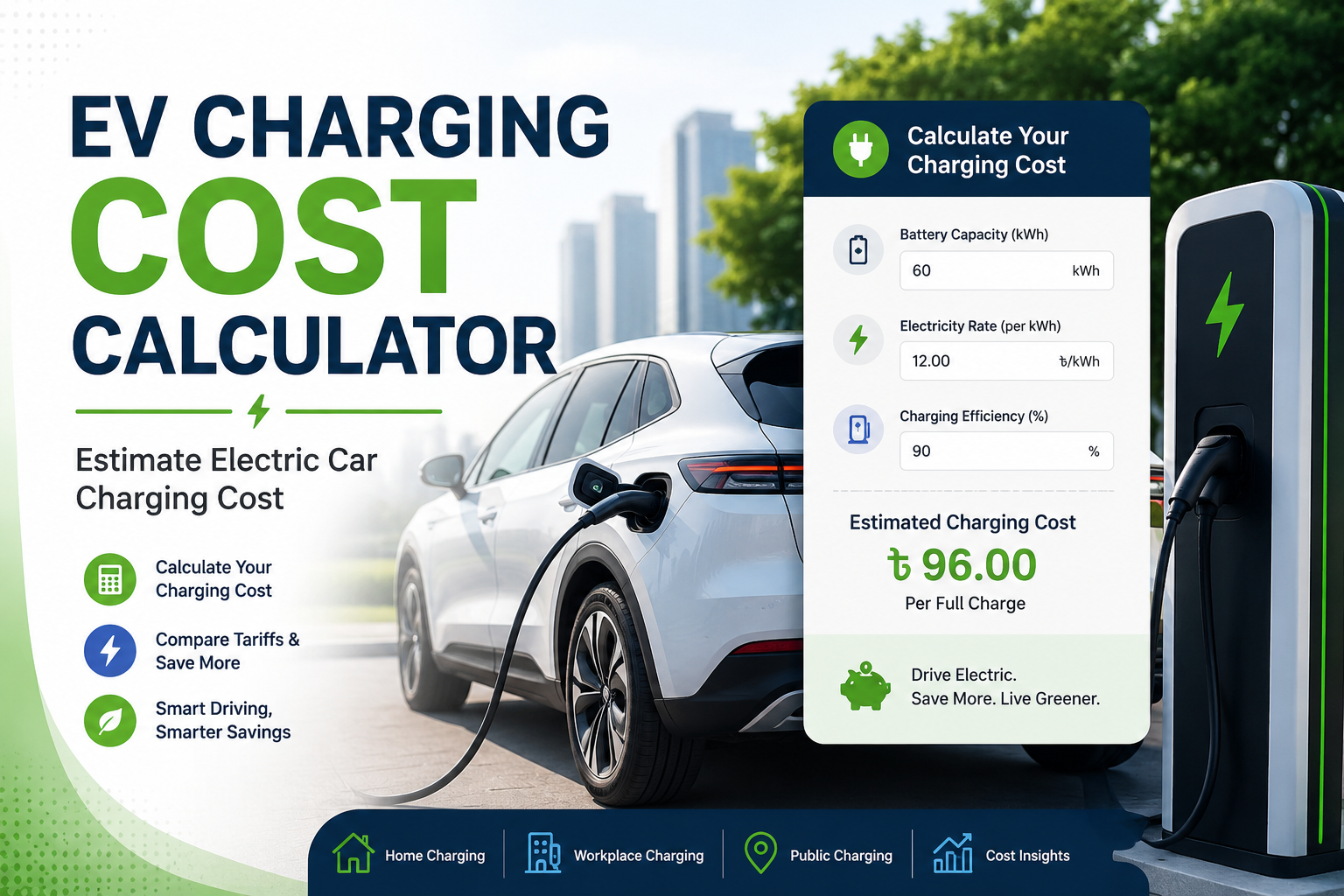
Wondering exactly how much it costs to charge your electric car? Whether you plug in at home overnight or stop at a public DC fast charger on a road trip, our free EV Charging Cost Calculator gives you a precise estimate in seconds — covering home charging, public station fees, and a full EV vs gas cost comparison.
Stop estimating. Enter your real numbers and find out your true cost to charge an electric car — daily, monthly, and annually.
Table of Contents
- EV Charging Cost Calculator (Free Tool)
- What Is an EV Charging Cost Calculator?
- Home Charging vs Public Station
- Understanding kWh Electricity Cost
- Level 2 Charger Cost Explained
- EV vs Gas Cost Comparison
- Frequently Asked Questions
⚡ EV Charging Cost Calculator
Use the tabs below to calculate your home EV charging cost, estimate a public station session, or run a full EV vs gas cost comparison. Supports USD and EUR.
⚡ Electric Vehicle
⛽ Gas Vehicle
What Is an EV Charging Cost Calculator?
An EV charging cost calculator is an online tool that estimates how much you’ll spend charging your electric car — whether at home on a Level 1 or Level 2 charger, or at a public DC fast charging station. By entering your battery size, current charge level, local electricity rate, and charging efficiency, the calculator gives you an accurate cost to charge an electric car for any scenario.
This tool combines three separate calculations in one place: home charging cost, public station cost, and a full EV vs gas cost comparison — so you can make smarter decisions about when, where, and how to charge your EV.
Home Charging vs Public Station — Which Is Cheaper?
The biggest factor in your charging bill is where you charge. Here’s how home charging vs public station costs compare in 2024:
Home Charging Cost
Home charging is almost always the cheapest option. The average US residential electricity rate is $0.13–$0.17/kWh. For a 60 kWh battery charged from 20% to 80%, you’d use roughly 40 kWh from the wall (accounting for charging efficiency), costing about $5.20–$6.80 per charge. That works out to $30–$60/month for a typical commuter driving 30–50 miles daily.
In Europe, home electricity averages €0.20–€0.35/kWh depending on country, making the same 40 kWh session cost approximately €8–€14.
Public Station Cost
Public Level 2 stations typically charge $0.20–$0.30/kWh, while DC fast chargers (like Tesla Superchargers, Electrify America, or EVgo) average $0.25–$0.45/kWh. Some networks bill per minute rather than per kWh, which can be significantly more expensive if your car charges slowly.
Bottom line: home charging is 2–3× cheaper per kWh than public fast charging. If you can charge at home overnight, you should — and use public chargers only for top-ups on longer trips.
Understanding kWh Electricity Cost for EV Charging
The kWh electricity cost is the most important number in any EV charging calculation. One kilowatt-hour (kWh) is the standard unit of electrical energy — the same unit shown on your utility bill. Here’s what typical electricity rates look like:
US Electricity Rates by Region
US residential electricity rates range from about $0.09/kWh in states like Louisiana to over $0.30/kWh in Hawaii and parts of California. The national average is approximately $0.13/kWh. Always use your actual utility rate for the most accurate results — check your monthly electricity bill or your utility’s website.
European Electricity Rates
EU residential rates vary significantly by country: Germany averages around €0.32/kWh, France about €0.20/kWh, and Spain around €0.25/kWh. Nordic countries with abundant hydropower can be as low as €0.10–€0.15/kWh. The EU average is approximately €0.28/kWh.
Time-of-use (TOU) rates can significantly reduce your EV charging cost. Many utilities offer off-peak rates of $0.07–$0.10/kWh for overnight charging (typically 11pm–7am). Scheduling your Level 2 charger to charge during these hours can cut your monthly EV charging bill by 30–50%.
Level 2 Charger Cost — What to Expect
A Level 2 charger (240V EVSE) is the most practical home charging solution for EV owners. Here’s a complete breakdown of Level 2 charger costs:
Equipment Cost
A residential Level 2 EVSE unit costs between $200 and $800 depending on brand, features, and maximum power output. Popular options include:
- ChargePoint Home Flex — $699 (16–50A, up to 37 miles of range per hour)
- JuiceBox 48 — $649 (48A, up to 34 miles of range per hour)
- Emporia EV Charger — $399 (48A, one of the most affordable premium units)
- Grizzl-E Classic — $299 (40A, durable and weather-resistant)
Installation Cost
Professional electrical installation for a Level 2 charger typically costs $200–$1,000. The range depends on your electrical panel’s capacity, the distance from the panel to the installation location, and local labor rates. If your panel needs upgrading to support a 240V/50A circuit, costs can be higher.
Payback Period
Compared to using a Level 1 (120V) charger or paying public charging rates, a Level 2 home charger typically pays for itself in 1–3 years through electricity savings alone. Many US states and utilities offer rebates of $200–$500 that can significantly shorten the payback period.
EV vs Gas Cost Comparison
One of the most compelling arguments for electric vehicles is the dramatically lower fuel cost. Here’s how the EV vs gas cost comparison breaks down with realistic 2024 numbers:
Example: 12,000 Miles per Year (US)
Inputs: 12,000 miles/year · EV at 3.5 mi/kWh · $0.13/kWh electricity · Gas car at 30 MPG · $3.50/gallon gas
EV annual fuel cost: (12,000 ÷ 3.5) × $0.13 = $446/year
Gas
annual fuel cost: (12,000 ÷ 30) × $3.50 = $1,400/year
Annual
savings: $954/year (68% cheaper)
5-year savings:
$4,770
Example: 15,000 km per Year (Europe)
Inputs: ~9,300 miles/year · EV at 4 mi/kWh · €0.28/kWh · Gas car at 35 MPG (~6.7L/100km) · €1.80/L (~€6.80/gal) gas
EV annual cost: ~€651/year
Gas annual cost:
~€1,515/year
Annual savings: ~€864/year
Use the EV vs Gas Cost Comparison tab in the calculator above to run your specific numbers.
Frequently Asked Questions About EV Charging Costs
How much does it cost to fully charge an electric car?
The cost to charge an electric car to full depends on battery size and electricity rate. At the US average of $0.13/kWh: a 40 kWh Nissan Leaf costs about $5.20 for a full charge; a 75 kWh Tesla Model 3 costs about $9.75; and a 100 kWh Tesla Model S costs about $13. At European rates (€0.28/kWh), multiply by roughly 2.15×.
Is it cheaper to charge at home or at a public station?
Home charging is significantly cheaper in almost every market. Home charging vs public station cost comparison: home averages $0.10–$0.17/kWh while public DC fast chargers average $0.25–$0.45/kWh — making home charging 2–3× cheaper per kWh. The only time public charging makes sense financially is during long-distance trips where home charging isn’t possible.
How do I calculate kWh electricity cost for EV charging?
Formula: Cost = (Battery kWh × % charged) ÷ Charging Efficiency × Rate per kWh. For example: charging a 60 kWh battery from 20% to 80% (60% = 36 kWh net) at 90% efficiency requires 40 kWh from the wall. At $0.13/kWh, that’s $5.20. Use the calculator above to automate this instantly.
What is the Level 2 charger cost for home installation?
Total Level 2 charger cost including equipment and installation is typically $400–$1,800. The unit itself costs $200–$800, and professional installation adds $200–$1,000. Many utilities offer rebates of $200–$500, and the US federal tax credit may cover 30% of the cost (up to $1,000) under the Inflation Reduction Act.
How does the EV vs gas cost comparison work?
The EV vs gas cost comparison divides annual miles by EV efficiency (mi/kWh) and multiplies by the electricity rate to get EV annual fuel cost. For gas, it divides annual miles by MPG and multiplies by gas price. The difference is your annual savings. At typical US rates, EV drivers save $800–$1,500/year on fuel compared to a 30 MPG gas car.
Does this calculator work for both USD and EUR?
Yes. The EV charging cost calculator supports both USD ($) and EUR (€). Simply select your currency from the dropdown and enter your local electricity rate. For US drivers, the default rate is $0.13/kWh. For European drivers, switch to EUR and the default updates to €0.28/kWh.
Is this EV charging cost calculator free?
Yes, completely free with no registration required. Use it as many times as you like for any EV, any electricity rate, or any charging scenario.
Conclusion
Electric vehicle fuel costs are dramatically lower than gasoline — but how much you save depends on your local electricity rate, how often you charge at home vs. public stations, your vehicle’s efficiency, and your driving habits. Our free EV Charging Cost Calculator puts all of that math in one place.
Use the Home Charging tab to estimate your monthly electricity bill for EV charging. Use the Public Station tab to check the cost of a DC fast charge on a road trip. And use the EV vs Gas tab to see exactly how much you’d save by switching to — or staying in — an electric vehicle.
Bookmark this page for quick access whenever you need to check the cost to charge an electric car, compare home charging vs public station pricing, or calculate your annual EV vs gas cost savings.
Looking for more EV and automotive tools? Browse our full calculator collection for tire sizing, car loan payments, fuel cost estimators, and much more.