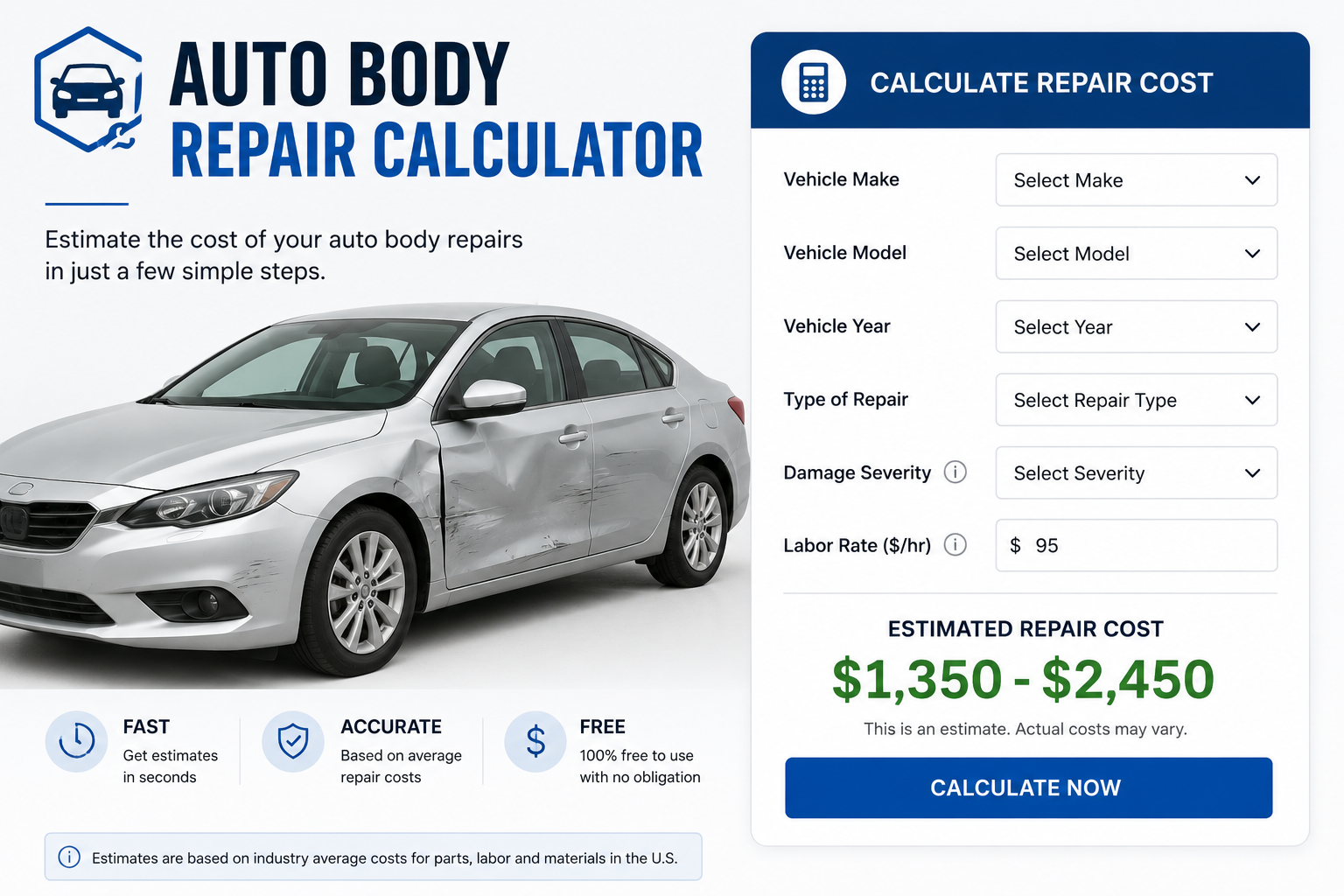
Whether you backed into a pole, caught a stray shopping cart, or survived a multi-car fender-bender, the first question on every driver’s mind is the same: how much is this going to cost? Auto body repair pricing varies dramatically based on the type of damage, the panels affected, your vehicle’s make and class, local labor rates, and paint complexity. Our free Auto Body Repair Calculator gives you an instant cost estimate broken down by labor, parts, and materials — so you walk into any body shop fully informed and ready to compare quotes.
Use the Damage Estimator tab to get a cost range for your specific type of damage, the Paint Job tab to estimate a full or partial repaint, or the Claim Analyzer tab to decide whether filing an insurance claim or paying out-of-pocket saves you more money in the long run.
Table of Contents
- Auto Body Repair Calculator (Free Tool)
- Auto Body Repair Cost by Damage Type
- Understanding Labor Rates at Body Shops
- Paintless Dent Repair vs. Traditional Repair
- Auto Paint Types and Their Effect on Cost
- When to File an Insurance Claim vs. Pay Out of Pocket
- Tips for Getting the Best Body Shop Estimate
- Frequently Asked Questions
Auto Body Repair Calculator
Select your damage type, severity, vehicle class, and region to get an instant cost estimate with a labor, parts, and materials breakdown. All ranges are based on current industry averages and are intended for planning purposes — get at least two written estimates from licensed shops before authorizing any work.
Auto Body Repair Cost by Damage Type
Auto body repair prices span an enormous range — from a $75 paintless dent repair on a small ding to $12,000+ for severe hail damage on a luxury vehicle. The table below shows current industry average cost ranges organized by repair type for a standard vehicle in an average-cost market.
| Damage Type | Cost Range | Severity | Key Notes |
|---|---|---|---|
| Minor Dent / Ding (PDR) | $75 – $350 | Low | Best results when paint is intact. No filler or paint needed. |
| Moderate Dent (conventional) | $300 – $900 | Moderate | Filler, prime, repaint required. Creases add cost. |
| Major Dent / Panel Damage | $800 – $2,500 | High | May require panel reshaping or replacement. |
| Minor Scratch (clear coat) | $80 – $400 | Low | Wet sand & polish or touch-up pen may suffice. |
| Moderate Scratch (paint layer) | $200 – $800 | Moderate | Panel repaint required for color-layer damage. |
| Deep Scratch (primer/metal) | $400 – $1,400 | High | Rust risk. Fill, prime, repaint essential. |
| Bumper Repair (crack/scuff) | $300 – $900 | Moderate | Plastic welding, filler, sand, blend repaint. |
| Bumper Replacement | $700 – $2,500 | High | Add $150–$500 for ADAS sensor recalibration. |
| Door Panel Repair | $400 – $1,500 | Moderate | Adjacent panel may need blending. |
| Door Panel Replacement | $900 – $3,000 | High | Hardware transfer, color match, window regulator check. |
| Fender Repair / Replacement | $300 – $1,800 | Moderate | Bolt-on fenders: easier / cheaper than welded quarter panels. |
| Quarter Panel Repair/Replace | $500 – $5,000 | Very High | Welded structural panel. Labor-intensive. Most expensive body repair. |
| Windshield Replacement | $200 – $600 | Moderate | ADAS-equipped vehicles add $150–$500 for recalibration. |
| Hail Damage — Light | $1,000 – $3,500 | High | PDR on most panels. Usually covered by comprehensive insurance. |
| Hail Damage — Heavy | $3,000 – $12,000+ | Very High | Combination PDR + conventional + possible total loss. |
Understanding Labor Rates at Body Shops
Labor is typically the largest component of any auto body repair bill. Body shop labor rates in the US range from approximately $75 to $200 per hour, depending on shop type, location, and certifications. Here is what drives rate differences:
- Geographic location is the biggest factor. Shops in California, New York, and other high-cost-of-living metro areas regularly charge $140–$200+/hour, while shops in the rural Midwest or South may charge $75–$100/hour for the same quality of work.
- Shop certifications justify premium rates. OEM-certified shops (BMW Certified Collision Center, Tesla Approved Body Shop, Audi Certified Collision, etc.) invest heavily in specialized equipment and training. Their rates are higher, but they use factory-approved repair procedures and parts.
- Dealership body shops typically charge the highest rates but offer OEM parts, factory repair standards, and direct warranty coverage on their work — important for newer luxury vehicles.
- Independent shops offer the widest rate range and the most pricing flexibility. A well-rated independent with ASE certifications can match dealer quality at significantly lower rates.
- Insurance direct repair programs (DRPs) negotiate standardized labor rates with preferred shops, which can work in your favor (faster service, streamlined claims) or against you (shops may cut corners to maintain the insurer’s price target).
Paintless Dent Repair vs. Traditional Repair
For small dents where the paint is still intact, Paintless Dent Repair (PDR) is almost always the better choice. A skilled PDR technician uses specialized metal rods and glue-pull tools to massage a dent back to factory shape from behind the panel — without any filler, sanding, or repainting. The result is invisible, preserves the factory paint, and typically costs 75–85% less than conventional repair.
Paintless Dent Repair (PDR)
- Preserves original factory paint
- Cost: $75–$450 per dent
- Same-day or next-day turnaround
- No risk of paint mismatch
- Maintains vehicle resale value
- Only works if paint is intact
- Cannot fix sharp creases or tears
- Limited by panel access from behind
Traditional Body Repair
- Works on any dent, crack, or tear
- Can restore heavily damaged panels
- Handles structural damage
- Cost: $300–$2,500+ per panel
- Multi-day turnaround
- Paint match risk (older vehicles)
- Filler can crack over time
- Reduces resale value vs. factory paint
Auto Paint Types and Their Effect on Repair Cost
The type of paint on your vehicle directly affects repair cost in two ways: material cost and the difficulty of achieving a perfect color match. Here is how each finish type affects your bill:
| Paint Type | Cost Multiplier | Match Difficulty | Common On |
|---|---|---|---|
| Solid / Single-Stage | × 1.0 (baseline) | Easy | Economy cars, fleet vehicles, older models |
| Metallic / 2-Stage Base & Clear | × 1.10–1.20 | Moderate | Most modern vehicles (most common finish) |
| Pearl / Tri-Stage | × 1.25–1.40 | Difficult | Honda, Toyota, luxury brands — pearl whites |
| Matte / Satin | × 1.25–1.35 | Difficult | BMW Frozen, Audi matte, specialty vehicles |
| Color-Shift / Chameleon | × 2.00–3.00 | Very Difficult | Custom builds, aftermarket wraps |
| OEM Factory Wrap / Film | Full wrap replacement | N/A — replace section | Tesla, some Porsches, fleet graphics |
When to File an Insurance Claim vs. Pay Out of Pocket
The most common mistake drivers make after a minor accident is reflexively filing an insurance claim. In many cases — particularly for repair costs below $2,000–$2,500 — paying out of pocket can save you significantly more over 3–5 years than filing a claim and absorbing the resulting premium increase.
Here is the general decision framework:
- If repair cost ≤ your deductible: Never file. Your insurer pays nothing, and you get a claim on your record.
- If repair cost is 1–1.5× your deductible: Almost certainly pay out of pocket. The insurance benefit is small, but the surcharge impact is not.
- If repair cost is 2× your deductible or more: Run the numbers. Use the Claim Analyzer tab above, accounting for your current premium and years claim-free.
- If damage is structural, involves other parties, or exceeds $5,000: Almost always file. Large claims justify the premium impact.
- Hail, flood, or other comprehensive claims: Comprehensive claims have less premium impact than collision claims in most states. More often worth filing.
Tips for Getting the Best Body Shop Estimate
- Always get at least three written estimates. Auto body repair pricing is notoriously variable. The same repair on the same vehicle can carry a 40–60% price difference between shops on the same street. Written estimates allow you to compare line by line.
- Ask for a breakdown by labor hours, parts, and materials. A vague single-number estimate is a red flag. A trustworthy shop itemizes labor hours at a stated rate, lists OEM vs. aftermarket part costs, and shows paint materials separately.
- Check for I-CAR Gold Class or ASE certification. I-CAR Gold Class is the industry’s highest training certification for collision repair. Shops that maintain it invest in ongoing technician training and proper repair procedures.
- Clarify whether OEM or aftermarket parts are being used. OEM (Original Equipment Manufacturer) parts are more expensive but fit perfectly and maintain your vehicle’s structural integrity and warranty. Aftermarket parts save money but may not meet OEM tolerances.
- Ask specifically about ADAS recalibration. If your vehicle has radar-based cruise control, automatic emergency braking, or lane departure warning — and the affected panel houses sensors or cameras — recalibration is mandatory after any structural repair or bumper replacement. It can add $150–$600 and is often omitted from initial estimates.
- Photograph all damage before repair. Document every scratch, dent, and scuff from multiple angles before authorizing any work. This protects you if additional damage is claimed during the repair process.
- Get a guarantee in writing. Reputable shops guarantee their paint work for life against peeling, fading, and cracking. Get the warranty terms in writing before you leave your keys.
Frequently Asked Questions
How much does auto body repair cost on average?
Average auto body repair costs range from $75 for a minor paintless dent repair to $12,000+ for severe hail damage or quarter panel replacement on a luxury vehicle. For the most common repairs — bumper scuffs, minor dents, and single-panel repaints — expect to pay $300–$1,500 at an average-cost shop. Factors that push costs higher include vehicle class (luxury/exotic), paint type (pearl, tri-stage), structural damage, and ADAS sensor recalibration requirements.
Is a small dent worth fixing?
For resale value, yes — especially for dents visible on prominent panels (hood, doors, fenders). A professional PDR repair on a dent where the paint is intact costs $75–$350 and is invisible when done correctly. Unrepaired dents reduce perceived vehicle value by more than the repair cost at trade-in or private sale. For daily drivers you plan to keep, minor dents are a personal preference call. However, any dent that has broken through the paint should be repaired promptly to prevent rust formation.
What is the most expensive auto body repair?
The most expensive individual body panel repair is the quarter panel — the rear structural panel that includes the wheel arch. Unlike bolt-on fenders, quarter panels are welded to the vehicle’s unibody frame. Replacing one requires cutting, welding, primer, body work, paint, and blending adjacent panels — totaling $1,500–$5,000 or more on a standard vehicle, and significantly higher on luxury models. Severe hail damage across the entire vehicle can also generate very high bills ($3,000–$15,000+) due to the sheer number of panels affected.
How long does auto body repair take?
Repair time varies by damage severity. A PDR dent repair takes 30 minutes to a few hours and is often same-day. A single panel paint repair is typically 1–3 business days. Bumper replacement takes 2–4 days. Door or fender replacement requires 3–5 days. Major collision repairs involving multiple panels, structural work, or parts procurement can take 1–4 weeks, especially if OEM parts must be ordered. Parts availability — particularly for newer models or EVs — is currently the most common cause of extended repair timelines.