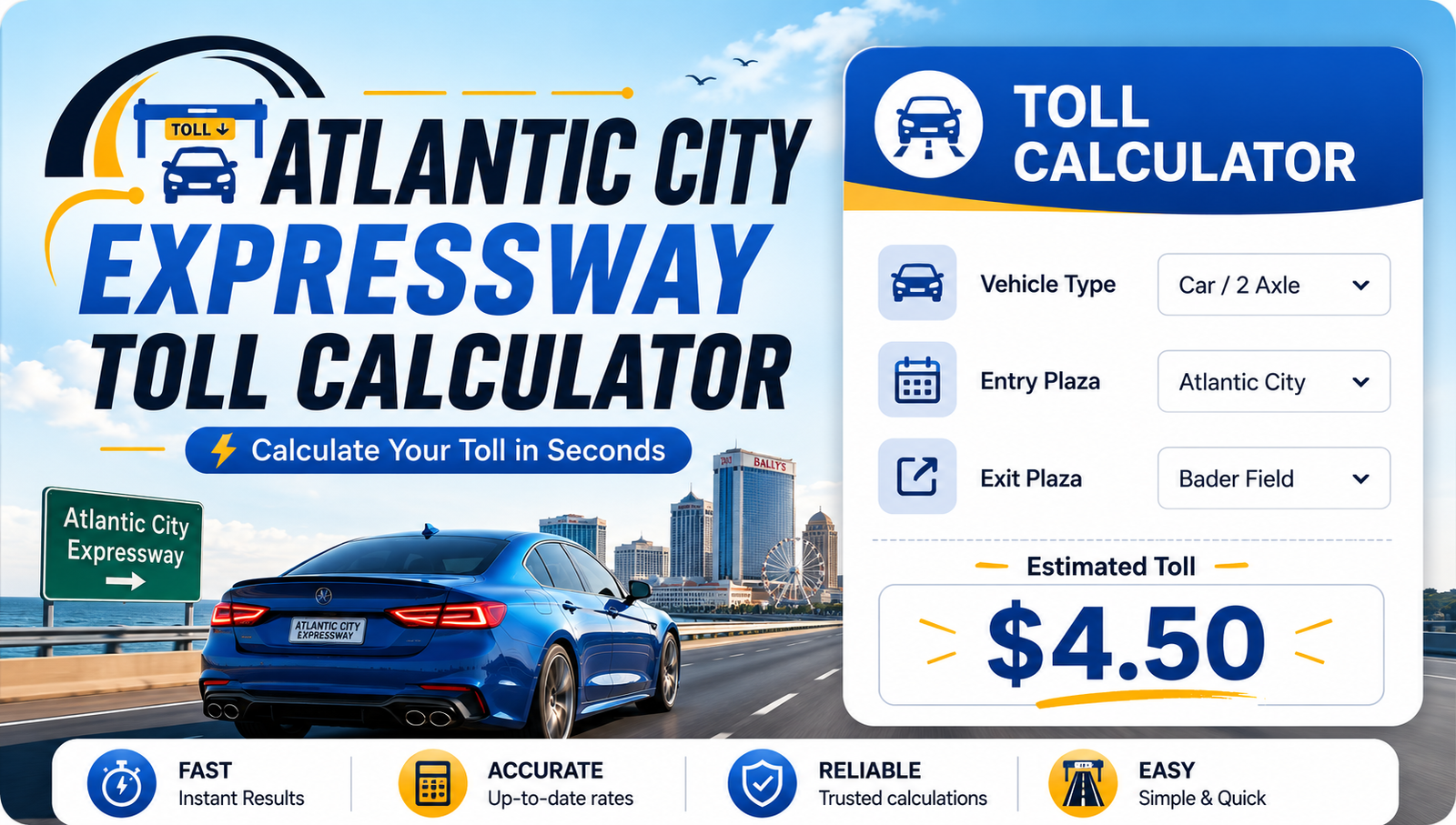
The Atlantic City Expressway Toll Calculator helps you estimate what a trip on the AC Expressway actually costs — combining the mainline barrier toll with any ramp/interchange tolls along your route, projecting a regular commute out to weekly, monthly, and annual totals, and comparing E-ZPass against cash/Toll-By-Plate pricing. Because toll rates on the Atlantic City Expressway are set and periodically adjusted by the South Jersey Transportation Authority (SJTA), every rate field below is editable so you can plug in the current posted rate and get an accurate total.
Use the Single Trip tab to estimate one trip’s total toll cost, the Commute Cost tab to project a regular commute out to weekly, monthly, and annual totals, or the E-ZPass vs Cash tab to see how much E-ZPass saves you over a number of trips — instantly.
Table of Contents
- Atlantic City Expressway Toll Calculator (Free Tool)
- How Atlantic City Expressway Tolls Are Structured
- Mainline Toll vs. Ramp/Interchange Tolls
- E-ZPass vs. Cash / Toll-By-Plate
- How Truck and Multi-Axle Tolls Work
- Estimating Your Regular Commute Cost
- Tips for Reducing Your Toll Costs
- Frequently Asked Questions
Atlantic City Expressway Toll Calculator
Select a tab below to estimate a single trip’s toll cost, project a regular commute, or compare E-ZPass against cash pricing. All rate fields are editable — enter the current posted rates from SJTA or your E-ZPass statement for an accurate total.
| Payment Method | Cost per Trip | Total Cost |
|---|
How Atlantic City Expressway Tolls Are Structured
The Atlantic City Expressway (ACE) is operated by the South Jersey Transportation Authority (SJTA), running between the Camden/Philadelphia area and Atlantic City, New Jersey. Like most toll roads, its pricing isn’t a single flat fee — it’s built from a main barrier toll plus, at certain interchanges, smaller ramp tolls that apply only if your specific trip enters or exits at one of those points.
Because SJTA periodically reviews and adjusts toll rates, this article intentionally avoids quoting specific dollar figures as fixed facts — every rate field in the calculator above is editable so you can enter the current posted rate for your route and payment method, sourced from SJTA’s official toll schedule or your own E-ZPass statement, and get an accurate total from there.
Mainline Toll vs. Ramp/Interchange Tolls
The mainline toll is the primary barrier toll most drivers on the Expressway will encounter regardless of exactly where they enter or exit — it’s the largest single component of most trips’ total cost. Separately, certain interchange ramps along the route carry their own smaller toll, charged only to vehicles using that specific ramp. This means two trips of similar length can have different total toll costs purely based on which exits were used — a driver who only crosses the mainline pays less than one whose route also uses a tolled ramp.
If you’re not sure whether your specific route crosses a ramp toll, set the ramp toll count to 0 in the Single Trip tab above and compare against SJTA’s route-specific toll information, or check a recent E-ZPass statement showing your actual charges for that trip.
E-ZPass vs. Cash / Toll-By-Plate
E-ZPass is generally the lowest-cost way to pay tolls on the Atlantic City Expressway, using an electronic transponder that’s read automatically as you pass through a toll point — no stopping required at most modern toll points. Cash payment, where still available, and Toll-By-Plate (where a camera photographs your license plate and mails you a bill) are typically priced at or above the E-ZPass rate, with Toll-By-Plate in particular often carrying an added administrative or processing charge on top of the base toll to cover the cost of billing by mail.
For anyone crossing the Expressway with any regularity, the E-ZPass rate advantage compounds quickly — the E-ZPass vs Cash tab above lets you see exactly how much that adds up to over a given number of trips.
How Truck and Multi-Axle Tolls Work
Like most toll roads, the Atlantic City Expressway prices larger vehicles higher than standard passenger cars, generally scaled by axle count — a standard car or small SUV has 2 axles and pays the base rate, while trucks, RVs, and vehicles towing trailers with additional axles pay a surcharge for each axle beyond the base 2. This reflects the greater road wear heavier, multi-axle vehicles cause. If you’re driving anything larger than a standard passenger vehicle, confirm your vehicle’s axle count and the current per-axle surcharge with SJTA before budgeting for a trip, since this can meaningfully change the total for a truck or a car towing a trailer compared to the base passenger rate.
Estimating Your Regular Commute Cost
A single trip’s toll can feel small in isolation, but it adds up fast for anyone using the Expressway regularly for work, school, or recurring travel. The Commute Cost tab above projects a known one-way (or round-trip) cost out to weekly, monthly, and annual totals — useful for building an accurate transportation budget, comparing the Expressway route against an alternate non-tolled route, or simply understanding what a daily commute is actually costing over a full year rather than one trip at a time.
Tips for Reducing Your Toll Costs
- Use E-ZPass instead of cash or Toll-By-Plate: The rate difference alone often justifies the transponder for anyone crossing more than occasionally.
- Check for commuter or frequent-user discount programs: Some toll authorities, including SJTA on certain routes, offer reduced rates for high-frequency E-ZPass users — confirm current availability directly with SJTA or E-ZPass NJ.
- Plan routes to avoid unnecessary ramp tolls: If more than one exit serves your destination, compare whether an alternate interchange avoids an extra ramp toll.
- Keep your E-ZPass account funded and in good standing: An inactive or low-balance account can result in being billed at the higher Toll-By-Plate rate by default, even if you have a transponder installed.
- Reconsider vehicle configuration for occasional trailer trips: If a trip only occasionally requires towing, factor the added per-axle toll surcharge into whether towing versus an alternate transport method makes sense for that specific trip.
Frequently Asked Questions
Where do I find the current, official Atlantic City Expressway toll rates?
The South Jersey Transportation Authority (SJTA), which operates the Expressway, publishes its official current toll schedule. Your own E-ZPass NJ account statement will also show the exact amount charged for any trip you’ve already taken, which is the most reliable source for your specific route and vehicle class.
Why did I get charged more than I expected on one trip?
The most common reasons are: your route crossed a ramp/interchange toll in addition to the mainline toll, your account was billed at the higher Toll-By-Plate rate rather than the E-ZPass rate (often due to a low balance, inactive transponder, or a rental/borrowed vehicle without your transponder installed), or you were driving a vehicle with more axles than a standard passenger car. Check your E-ZPass statement for an itemized breakdown of that specific charge.
Is E-ZPass always cheaper than Toll-By-Plate on the AC Expressway?
Generally, yes — Toll-By-Plate typically includes an added administrative fee on top of the base toll to cover the cost of photographing your plate and mailing an invoice, making it more expensive than the equivalent E-ZPass transaction in most toll systems, the AC Expressway included. Confirm the exact current difference with SJTA, since the specific gap between rates can change.
Does every trip on the AC Expressway cross a ramp toll?
No. Ramp tolls apply only at specific interchanges — many trips only cross the mainline barrier toll. Whether your route crosses a ramp toll depends entirely on which exits you use to enter and leave the Expressway, which is why the Single Trip tab above lets you set the ramp toll count to 0 for a mainline-only trip.
How much does towing a trailer add to my toll?
Toll roads generally price by axle count, so a car towing a trailer with its own axle(s) typically pays a surcharge for each axle beyond the standard 2-axle passenger vehicle rate. The exact per-axle surcharge amount should be confirmed with SJTA, since it applies per axle and can add up meaningfully for larger trailers.
Can I estimate my annual commute cost before committing to a route?
Yes — use the Single Trip tab to establish an accurate one-way cost for your specific route and payment method, then feed that number into the Commute Cost tab along with your expected commute days per week to see the projected weekly, monthly, and annual total. This is useful for comparing a tolled route against a longer, non-tolled alternative before deciding which is actually more cost-effective for your situation.