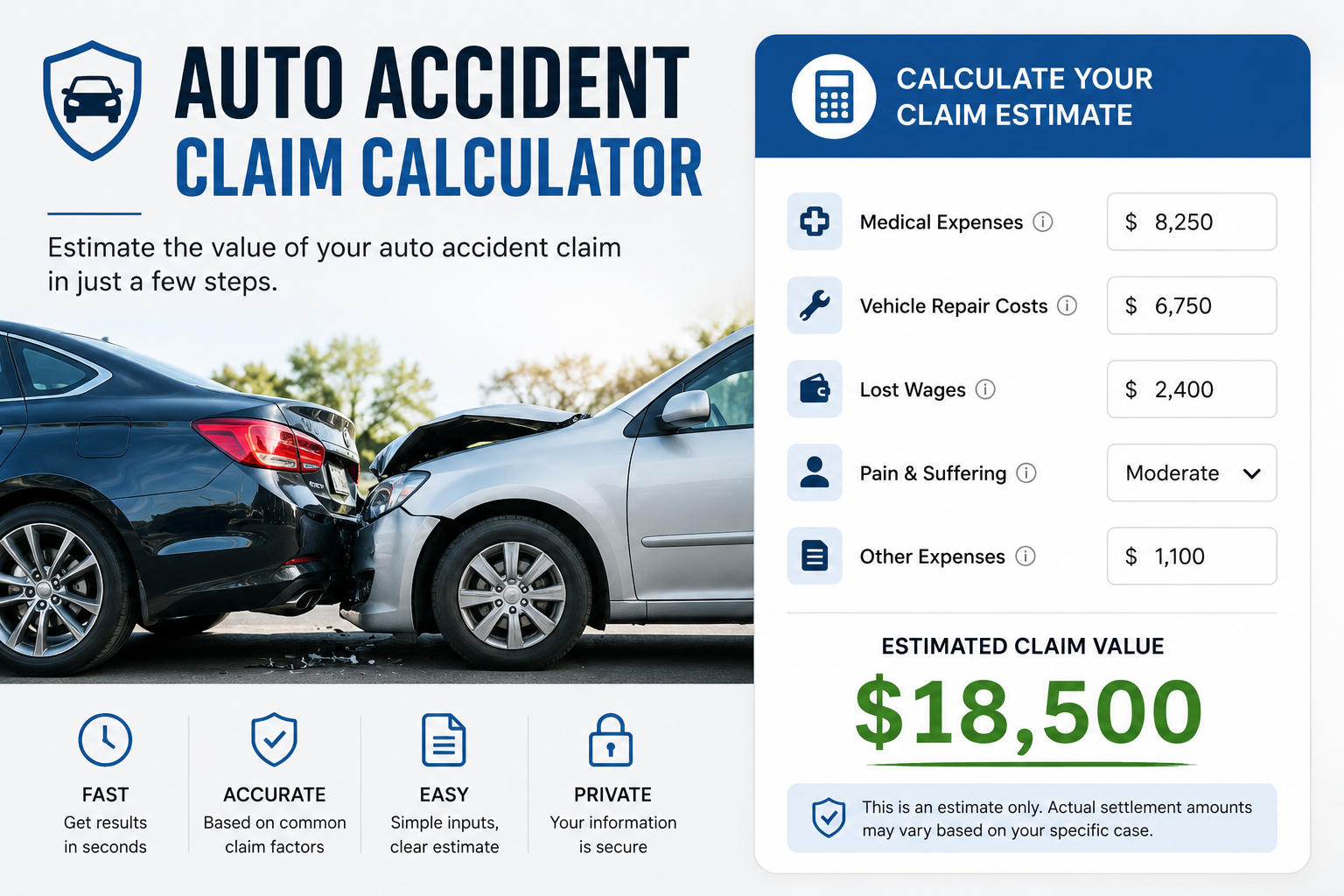
The Auto Accident Claim Calculator estimates what a car accident injury claim might be worth using the same multiplier method insurance adjusters and personal injury attorneys commonly start with — combining your documented economic losses with an estimate for pain and suffering, adjusting for shared fault under your state’s negligence rule, and showing what actually lands in your pocket after policy limits, attorney fees, and case costs. This is an educational estimation tool, not legal advice — every real claim depends on case-specific facts, jurisdiction, and negotiation that a formula alone can’t capture.
Use the Settlement Value tab to estimate your claim’s total value, the Comparative Negligence tab to adjust for shared fault, or the Net Payout tab to see what remains after policy limits, attorney fees, and costs — instantly.
Table of Contents
- Auto Accident Claim Calculator (Free Tool)
- What Is an Auto Accident Claim Worth?
- How to Calculate Pain and Suffering
- Special Damages: What Counts as Economic Loss
- Comparative and Contributory Negligence Explained
- Policy Limits: Why Your Claim Might Be Capped
- Attorney Fees and Case Costs: What You Actually Take Home
- When to Consult a Personal Injury Attorney
- Frequently Asked Questions
Auto Accident Claim Calculator
Select a tab below to estimate your claim’s settlement value, adjust it for shared fault, or calculate your net payout after fees. This tool provides a general estimate only — it is not legal advice, and actual settlement outcomes vary widely based on facts, jurisdiction, insurer, and negotiation.
What Is an Auto Accident Claim Worth?
An auto accident injury claim’s value is generally understood as the sum of two categories: special damages (documented, quantifiable economic losses like medical bills and lost income) and general damages (non-economic harm like pain, suffering, and reduced quality of life, which don’t come with a receipt). Property damage to the vehicle itself is usually handled and paid separately and more quickly than the injury claim, since it’s straightforward to document with repair estimates.
There is no universal formula that produces a legally guaranteed number — insurance adjusters, plaintiff’s attorneys, and juries all weigh the same facts differently. What this calculator provides is the same starting-point estimation method widely used as a first pass before negotiation begins, not a prediction of what any specific insurer will ultimately offer or what a jury would award.
How to Calculate Pain and Suffering
Because pain and suffering has no receipt or invoice behind it, two informal methods are commonly used to translate it into a dollar figure:
The Multiplier Method
Medical expenses are multiplied by a factor — typically 1.5 to 5 — based on injury severity, permanence, and impact on daily life. Minor, fully-resolved soft tissue injuries sit at the low end of the range; severe, permanent, or disabling injuries sit at the high end. This is the method used in the Settlement Value tab above.
The Per Diem Method
An alternative approach assigns a daily dollar value to pain and suffering (often anchored to the claimant’s daily wage, on the theory that a day of suffering is worth at least a day’s pay) and multiplies it by the number of days from the accident through maximum medical recovery. This method tends to produce larger figures for injuries with long recovery periods, even if the medical bills themselves are modest.
Neither method is legally binding — they’re negotiating starting points. Insurers frequently use their own proprietary software and internal guidelines that don’t publicly disclose their exact formula, and a jury (if a case goes to trial) isn’t bound by either method at all.
Special Damages: What Counts as Economic Loss
- Medical expenses: Emergency care, hospitalization, surgery, physical therapy, medication, medical devices, and reasonably anticipated future treatment tied to the accident.
- Lost wages and earning capacity: Income lost during recovery, and — for more serious injuries — the reduced future earning capacity if the injury permanently limits your ability to work.
- Property damage: Vehicle repair or replacement cost, diminished resale value, and rental car costs while your vehicle was out of service.
- Out-of-pocket expenses: Mileage to medical appointments, over-the-counter medication, home care assistance, and other accident-related costs not covered elsewhere.
Every category above is strongest with documentation — receipts, pay stubs, mileage logs, and medical records all directly support the corresponding line item, and gaps in documentation are one of the most common reasons an insurer disputes or discounts a claimed amount.
Comparative and Contributory Negligence Explained
Most accidents involve some dispute over fault, and how your state handles shared fault can dramatically change what you actually recover:
- Pure comparative negligence: Your recovery is reduced by your percentage of fault, no matter how high — even a claimant found 90% at fault can still recover the remaining 10% of damages.
- Modified comparative negligence (50% bar): You can recover, reduced by your fault percentage, only if your fault is under 50%. At 50% or more, recovery is barred entirely.
- Modified comparative negligence (51% bar): The most common rule among states — you can recover, reduced by your fault percentage, as long as your fault is 50% or less. Once your fault exceeds 50% (i.e., 51%+), recovery is barred.
- Contributory negligence: The strictest rule, used in only a handful of jurisdictions (Alabama, Maryland, North Carolina, Virginia, and Washington D.C.) — any fault on your part, even 1%, bars recovery entirely.
This is exactly why insurance adjusters spend so much energy disputing fault percentages even on relatively small claims — a shift from 45% to 55% fault can be the difference between a full comparative-negligence reduction and a complete bar to recovery, depending on the state.
Policy Limits: Why Your Claim Might Be Capped
Even a well-documented, high-value claim is generally capped at the at-fault driver’s insurance policy limit — the maximum amount their policy will pay out, regardless of how much the claim is actually worth. Many drivers carry only state-minimum liability coverage, which in a serious injury case can be far below the claim’s real value.
When a claim exceeds the available policy limit, a claimant’s remaining options generally include: pursuing the at-fault driver’s personal assets directly (often impractical if they have little to collect), or turning to their own underinsured motorist (UIM) coverage if they purchased it — which exists specifically to cover this exact gap. This is one of the strongest arguments for carrying meaningful UIM coverage on your own policy, since you have no control over how much liability coverage another driver carries.
Attorney Fees and Case Costs: What You Actually Take Home
Personal injury attorneys typically work on contingency — no upfront fee, with the attorney instead taking an agreed percentage (commonly around 33% pre-litigation, rising to around 40% if a lawsuit is filed, though exact terms vary by firm and case) of whatever is recovered. Case costs — filing fees, medical record requests, expert witness fees, and similar expenses — are typically deducted separately from the contingency fee, and different fee agreements handle the order of these deductions differently.
The practical result: the “settlement amount” reported by a case is very different from what a claimant actually receives. Use the Net Payout tab above to see this gap clearly, and always read your specific fee agreement closely — particularly whether costs come out before or after the contingency percentage is calculated, since that changes the final number.
When to Consult a Personal Injury Attorney
This calculator is useful for a rough, educational sense of scale — but several situations generally warrant speaking with a licensed personal injury attorney before accepting any settlement offer:
- Any significant or permanent injury where future medical needs or lost earning capacity are hard to quantify on your own.
- Disputed fault, especially in states with a modified comparative or contributory negligence rule where the fault percentage itself can determine whether you recover anything at all.
- A settlement offer that seems low relative to your documented specials, or one made unusually quickly after the accident, before the full extent of injuries is known.
- Claims that may exceed the at-fault driver’s policy limits, where pursuing underinsured motorist coverage or other avenues requires navigating your own insurer’s process.
- Any claim involving a commercial vehicle, government entity, or multiple at-fault parties, where liability and available coverage are more complex than a standard two-driver accident.
Most personal injury attorneys offer free initial consultations specifically so you can get case-specific guidance before deciding whether representation makes sense for your situation.
Frequently Asked Questions
Is this calculator’s estimate what I’ll actually receive?
No. This tool applies a widely used estimation method to give you a general sense of scale, but actual settlements depend on evidence quality, liability disputes, insurer practices, jurisdiction-specific law, and negotiation — factors a formula can’t capture. Treat the result as a starting point for your own research and conversations with an attorney, not a prediction.
What multiplier should I use for my injury?
As a general guide: fully-resolved soft tissue injuries (like mild whiplash) tend to sit around 1.5, injuries requiring more extensive treatment with some lasting effects around 2.5-3, serious injuries with extended recovery around 3.5, and permanent impairment or disability toward 5 or occasionally higher in especially severe cases. These are general conventions, not fixed rules — actual cases vary.
Why does my state’s negligence rule matter so much?
Because it can determine whether you recover anything at all, not just how much. In a contributory negligence state, being found even slightly at fault can bar your entire claim. In a modified comparative state, crossing the 50% or 51% threshold does the same. Pure comparative negligence states are the most forgiving, reducing recovery proportionally without ever fully barring it.
What if the at-fault driver doesn’t have enough insurance?
Your recovery is generally capped at their policy limit unless you can pursue their personal assets (often impractical) or have your own underinsured motorist (UIM) coverage, which is specifically designed to cover the gap between what the at-fault driver’s policy pays and your actual damages. Check your own policy for UIM coverage if you’re in this situation.
Should I accept the insurance company’s first offer?
Initial offers are frequently lower than a claim’s estimated value and are often made before the full extent of injuries and future treatment needs are known — accepting early can permanently close out your claim before you understand its full worth. Comparing an offer against your own documented specials and a reasonable pain-and-suffering estimate, or getting a professional opinion, before accepting is generally worthwhile, especially for anything beyond a minor, fully-resolved injury.
Does hiring an attorney always increase my net recovery?
Not automatically — the attorney’s fee comes out of the settlement, so representation only nets you more if the increase in the total settlement they negotiate exceeds their fee and costs. In practice, attorneys often do increase net recovery meaningfully on contested or higher-value claims because insurers frequently offer more to represented claimants, but this isn’t guaranteed on every case, particularly very small, undisputed claims.