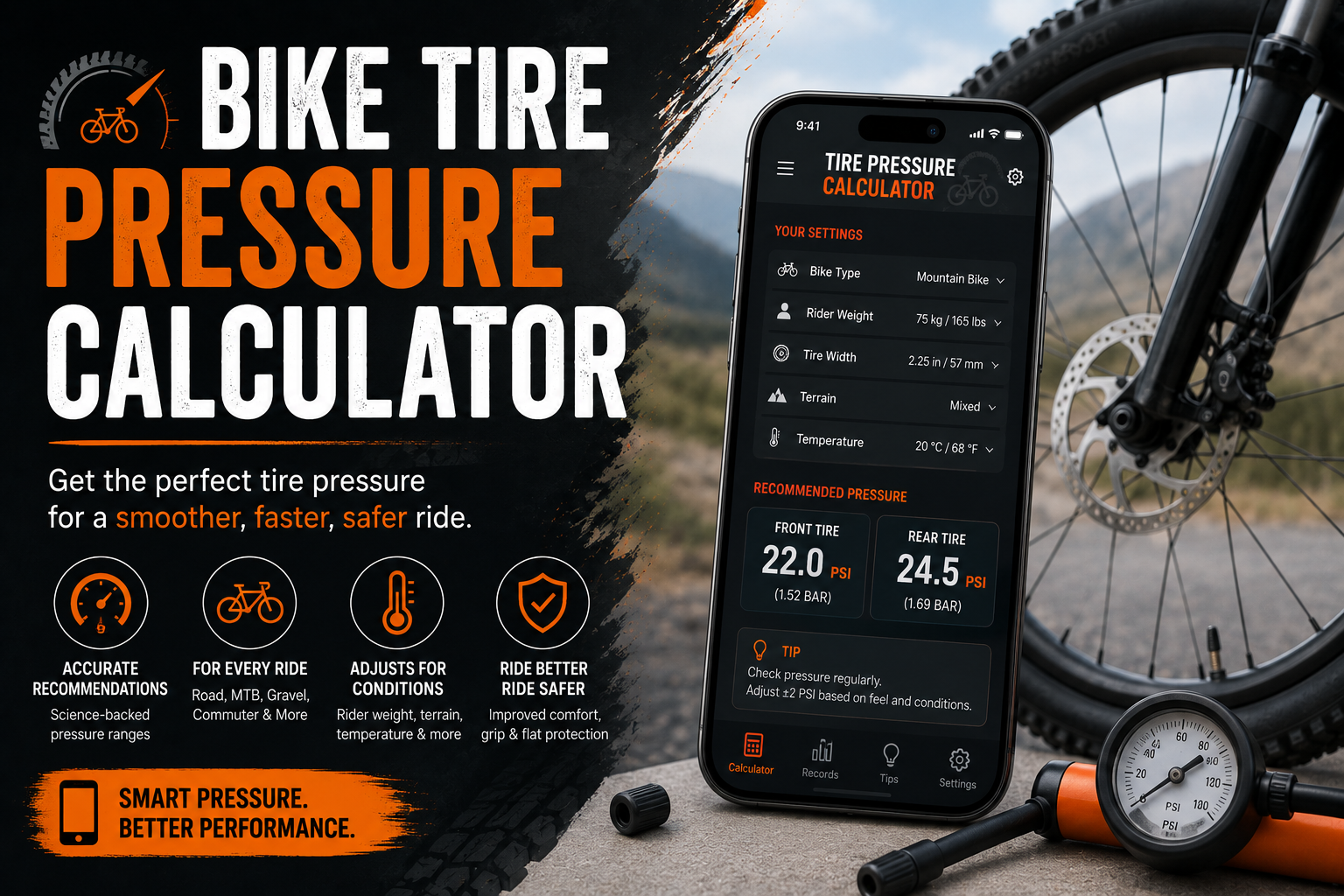
The Bike Tire Pressure Calculator gives you a sensible starting PSI based on your weight, tire width, and bike type — then helps you split it between front and rear, and adjust for terrain, weather, and a tubeless setup. Tire pressure recommendations are inherently a starting point, not an exact science; every published calculator (including this one) gives you a reasonable place to begin, with the expectation that you’ll fine-tune from there based on feel.
Use the Recommended Pressure tab to get a starting PSI for your weight and tire width, the Front vs. Rear Split tab to divide that pressure correctly between wheels, or the Condition Adjustments tab to fine-tune for terrain, weather, and temperature — instantly.
Table of Contents
- Bike Tire Pressure Calculator (Free Tool)
- How Tire Pressure Affects Ride Quality
- Weight, Tire Width, and Pressure — The General Relationship
- Why Front and Rear Pressure Should Differ
- Tubeless vs. Tubed: Pressure Differences
- Adjusting for Terrain, Weather, and Temperature
- Always Respect the Sidewall Min/Max PSI
- Frequently Asked Questions
Bike Tire Pressure Calculator
Select a tab below to get a recommended starting pressure, split it front vs. rear, or fine-tune for conditions. These are starting-point recommendations — always stay within your tire’s printed minimum and maximum PSI.
How Tire Pressure Affects Ride Quality
Tire pressure sits at the center of a genuine trade-off. Higher pressure reduces rolling resistance on smooth surfaces and resists pinch flats, but transmits more road buzz and can actually reduce traction on rough or loose surfaces by bouncing the tire over irregularities instead of letting it deform around them. Lower pressure improves comfort and grip by letting the tire conform to the surface, but increases rolling resistance on smooth pavement, raises pinch-flat risk (especially with inner tubes), and can cause the rim to bottom out on hard impacts.
The modern consensus among tire researchers (notably work popularized by Silca and adopted broadly across the industry) is that most riders have historically run higher pressure than optimal, especially on wider modern tires — the old “as hard as possible” instinct from narrow-tire road cycling doesn’t transfer well to today’s wider road, gravel, and mountain bike tires.
Weight, Tire Width, and Pressure — The General Relationship
Two variables dominate any tire pressure recommendation: rider (plus bike and gear) weight and tire width. A wider tire has more air volume and a larger contact patch, so it needs less pressure to support the same weight without excessive sidewall flex — this is why gravel and mountain bike tires run dramatically lower pressures than narrow road tires despite often supporting similar rider weights.
The Recommended Pressure tab above scales a published-style reference point for each bike category by your specific tire width (pressure roughly scales inversely with width) and rider weight (pressure roughly scales with the square root of weight, a relationship that comes from keeping the tire’s compression, or “drop,” at a roughly constant target percentage across different loads) — this mirrors the general shape of tire pressure guidance used across the industry, though exact optimal numbers are tire-specific and best confirmed by testing and feel.
Why Front and Rear Pressure Should Differ
Most riders carry noticeably more weight on the rear wheel than the front — a typical road riding position puts roughly 45% of combined rider-and-bike weight on the front wheel and 55% on the rear, and this shifts further rearward with a loaded saddle bag, hydration pack, or rear panniers. Running identical pressure front and rear means the front tire is effectively overinflated relative to its actual load, sacrificing grip and comfort on the wheel that does the steering.
Running the front tire a few PSI lower than the rear — proportional to the actual weight split — is standard practice among experienced riders and is exactly what the Front vs. Rear Split tab above calculates from your specific weight distribution.
Tubeless vs. Tubed: Pressure Differences
Tubeless tire setups can generally run meaningfully lower pressure than an equivalent tubed setup — commonly somewhere in the range of 10-15% lower — because the main reason tube-and-tire setups need higher minimum pressure is to prevent pinch flats (the inner tube getting pinched between the tire and rim on a hard impact). Without an inner tube to pinch, tubeless setups can run softer for better comfort and traction while still resisting flats reasonably well, though rim damage from very hard impacts (“burping” air past the bead, or denting the rim) remains a risk at very low pressures regardless of tube status.
Adjusting for Terrain, Weather, and Temperature
- Rougher terrain: Lower pressure lets the tire absorb bumps and maintain contact with an irregular surface instead of skipping over it — a meaningful comfort and traction gain on gravel, technical trail, or poorly maintained pavement.
- Wet conditions: A small pressure reduction increases the tire’s contact patch and conformability, improving grip on a slick surface — the trade-off is a small increase in rolling resistance, generally worth it for the traction gain.
- Temperature changes: Air pressure inside a tire rises and falls slightly with ambient temperature — a tire inflated in a cool garage will read a bit higher once warmed by sun and pavement heat, and vice versa. This effect is real but modest (roughly 1-2% per 10°F/5-6°C of temperature change) and mainly matters if you’re inflating well ahead of a ride in significantly different conditions than expected.
Always Respect the Sidewall Min/Max PSI
Every bicycle tire has a manufacturer-specified minimum and maximum pressure printed directly on the sidewall — this is the hard safety limit, not a suggestion, and it overrides any general calculator (including this one) for your specific tire. Exceeding the maximum PSI risks a sudden tire blowout; running below the minimum on a tubed setup meaningfully increases pinch-flat risk and, on any setup, can allow rim damage from hard impacts. Treat every recommendation above as a starting point to test within your tire’s printed range, not a number to chase regardless of what your specific tire is rated for.
Frequently Asked Questions
What PSI should I run on a road bike?
It depends heavily on your weight and tire width — a lighter rider on a wide 32mm tire might run 60-70 PSI comfortably, while a heavier rider on a narrow 25mm tire might need closer to 100-110 PSI. Use the Recommended Pressure tab above with your specific weight and tire width rather than relying on a single generic number, since modern road tires are generally run at lower pressure than older conventional wisdom suggested.
Should my front and rear tire pressure really be different?
Yes, generally — running the front a few PSI lower than the rear (proportional to your actual front/rear weight distribution) improves front-wheel grip and comfort without meaningfully sacrificing anything, since the front wheel typically carries less load than the rear.
How much lower can I run tubeless tires?
Commonly 10-15% lower than an equivalent tubed setup, since eliminating the inner tube removes the primary pinch-flat risk that drives minimum pressure recommendations upward on tubed setups. Very low tubeless pressures still carry some risk of “burping” air past the tire bead or damaging the rim on hard impacts, so don’t treat tubeless as license to go arbitrarily low.
Does tire pressure really change with temperature?
Yes, modestly — air pressure inside any sealed container (including a bicycle tire) rises with temperature and falls as it cools, following basic gas behavior. The effect is generally small (roughly 1-2% per 10°F change) and mainly relevant if you inflate a tire in very different conditions than you’ll be riding in.
Is there a single “correct” tire pressure formula?
Not a single universally agreed-upon exact formula — published guidance varies by source, and the most precise methods (based on measuring actual tire “drop” or compression percentage under load) require tire-specific volume data that varies by casing design. This calculator uses a widely-referenced general relationship (pressure scales inversely with tire width and with the square root of rider weight) as a practical starting point, not a definitive physical calculation — always fine-tune from the suggested range based on your own ride feel.