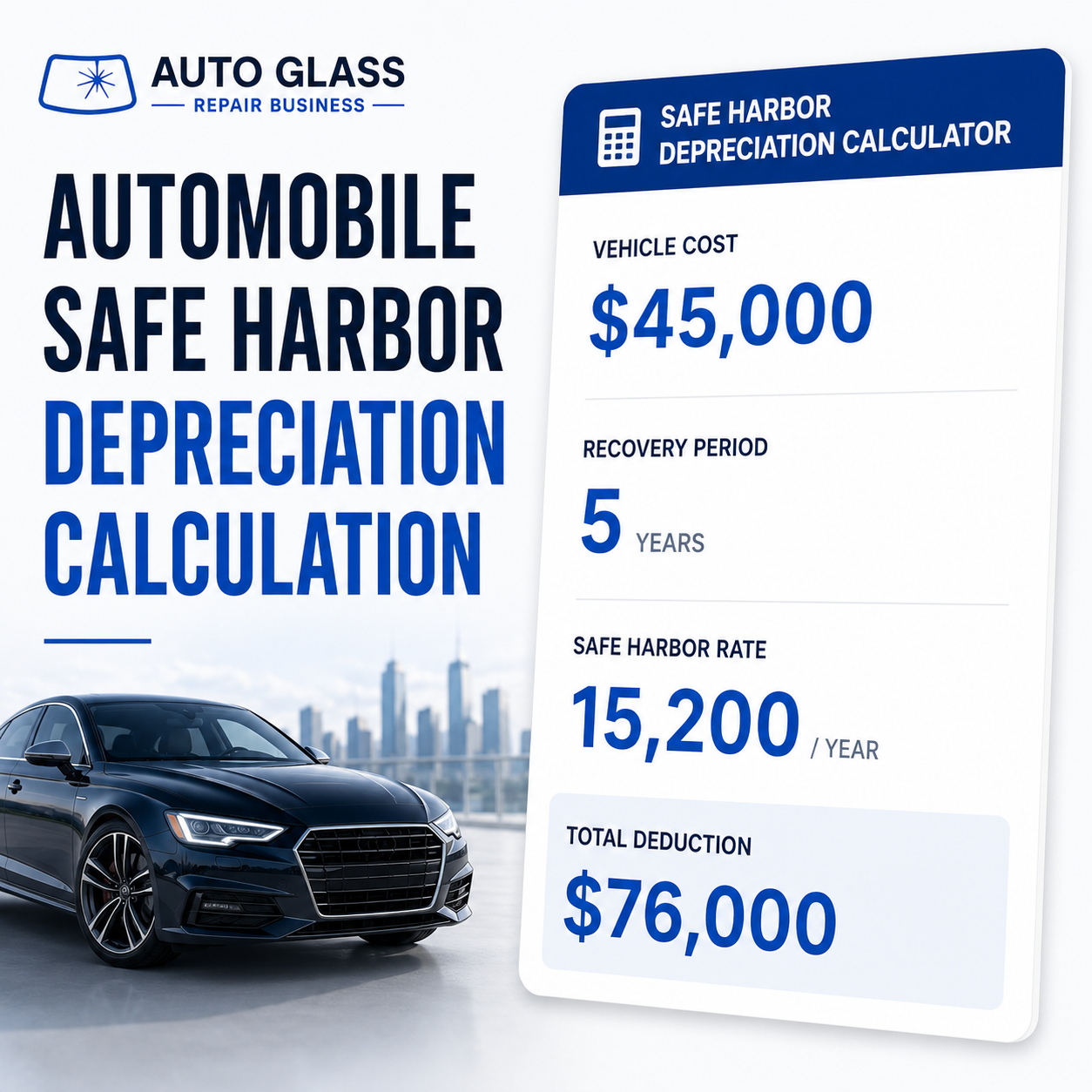
The Automobile Safe Harbor Depreciation Calculator models the IRS’s Section 280F safe harbor method (established in Rev. Proc. 2019-13) for business vehicles subject to the “luxury automobile” depreciation limits after taking 100% bonus depreciation. This is a genuinely technical area of tax law — this tool is educational only, not tax advice, and every dollar limit below is an editable placeholder you should replace with the current figures from IRS guidance for your vehicle’s specific placed-in-service year, since Section 280F limits are adjusted annually and differ by vehicle type.
Use the Safe Harbor Schedule tab to model your year-by-year depreciation deduction, the Heavy Vehicle Exception tab to check whether your SUV or truck bypasses the 280F limits entirely, or the Tax Savings Summary tab to see your total tax benefit and the cost of having that benefit spread out over multiple years instead of taken all at once.
Table of Contents
- Automobile Safe Harbor Depreciation Calculator (Free Tool)
- What Is the Section 280F Safe Harbor Depreciation Method?
- Why the Safe Harbor Method Exists: The “Depreciation Cliff”
- How the Safe Harbor Calculation Works, Step by Step
- The Heavy Vehicle Exception (GVWR Over 6,000 Lbs)
- Safe Harbor Doesn’t Reduce Your Deduction — It Delays It
- Where to Find Current IRS Section 280F Limits
- Frequently Asked Questions
Automobile Safe Harbor Depreciation Calculator
Select a tab below to model your safe harbor depreciation schedule, check the heavy vehicle exception, or see a tax savings summary. Replace every placeholder dollar limit with the current figure from IRS guidance applicable to your vehicle before relying on the output.
| Year | MACRS % | Tentative Amount | 280F Limit | Actual Deduction | Remaining Basis |
|---|
What Is the Section 280F Safe Harbor Depreciation Method?
Internal Revenue Code Section 280F caps the annual depreciation deduction available for “luxury automobiles” used in a trade or business — passenger vehicles at or below 6,000 pounds gross vehicle weight rating (GVWR). These caps exist to prevent businesses from fully expensing very expensive vehicles quickly, and they’re adjusted annually for inflation, with separate tables depending on the vehicle’s placed-in-service year.
The safe harbor method, established by Rev. Proc. 2019-13, is an optional method the IRS created specifically for taxpayers who elected 100% bonus depreciation on a 280F-limited vehicle. It allows the portion of basis that couldn’t be deducted in year one (because it exceeded the 280F cap) to be recovered gradually over subsequent years, using the standard MACRS depreciation table percentages applied against each year’s own 280F limit.
Why the Safe Harbor Method Exists: The “Depreciation Cliff”
Before this safe harbor guidance, taking 100% bonus depreciation on a 280F-limited vehicle created an awkward trap. Bonus depreciation is meant to let you deduct 100% of an asset’s basis immediately — but the 280F cap still limited the actual first-year deduction to a relatively small dollar amount. Under the ordinary depreciation rules, once 100% bonus is elected, the asset is treated as if its entire basis were already recovered for MACRS table purposes, meaning no further depreciation deductions would be allowed in years two through five at all — not because the basis was exhausted, but because the accounting mechanics assumed it was, even though the 280F cap meant only a small fraction of it had actually been deducted.
The safe harbor method fixes this “depreciation cliff” by explicitly allowing continued deductions in those later years, calculated against the 280F limits that apply to each of those years — restoring the ability to eventually recover the full basis instead of leaving a large chunk of it permanently stranded until the vehicle is sold or disposed of.
How the Safe Harbor Calculation Works, Step by Step
- Year 1: Deduct the lesser of the full basis (since 100% bonus was elected) or the Year 1 Section 280F limit.
- Years 2 through 6: Apply the standard MACRS 5-year table percentage (32%, 19.2%, 11.52%, 11.52%, 5.76% for years 2-6 respectively) to the original, unadjusted basis — not the declining remaining balance — to get a tentative amount, then cap it at that year’s Section 280F limit. The smaller of the two is the actual deduction for the year.
- Year 7 and beyond (if basis remains): Once the MACRS table is exhausted, continue deducting the lesser of the remaining unrecovered basis or that year’s Section 280F “succeeding years” limit, for as many additional years as it takes to fully recover the basis.
For an expensive vehicle with a large basis, this can genuinely take many years beyond the nominal 5-6 year MACRS recovery period — the Safe Harbor Schedule tab above models exactly how many, given your specific basis and limit inputs.
The Heavy Vehicle Exception (GVWR Over 6,000 Lbs)
Section 280F’s limits only apply to passenger automobiles at or below 6,000 pounds gross vehicle weight rating (GVWR) — the manufacturer’s rated maximum weight, found on the vehicle’s door-jamb sticker, not its curb weight or actual loaded weight. Many SUVs, pickup trucks, and vans exceed this threshold and are therefore entirely exempt from the 280F depreciation caps.
These heavier vehicles are instead subject to a separate, specific Section 179 cap for SUVs (a smaller cap than the general Section 179 limit for other business equipment, also indexed for inflation), with any remaining basis above that cap typically eligible for bonus depreciation without a 280F-style ceiling. In practice, this often means the vehicle’s entire business-use-adjusted cost can be deducted in the placed-in-service year — a materially different, and often far more favorable, outcome than the multi-year safe harbor schedule that applies to lighter vehicles.
Safe Harbor Doesn’t Reduce Your Deduction — It Delays It
A subtle but important point: the safe harbor method doesn’t reduce the total amount of depreciation you’ll eventually claim on a 280F-limited vehicle — over enough years, you recover 100% of the depreciable basis either way. What the 280F limits actually cost you is time value of money: a dollar of tax savings received this year is worth more than the same dollar received five or ten years from now, so spreading the deduction out reduces its present-day value even though the nominal total is unchanged.
The Tax Savings Summary tab above quantifies exactly this — showing your total (undiscounted) tax savings alongside its present value at a discount rate you choose, so you can see the real economic cost of the deferral rather than just the sticker-total deduction figure.
Where to Find Current IRS Section 280F Limits
- The IRS Revenue Procedure for your vehicle’s placed-in-service year: The IRS publishes updated 280F limits annually — search for the current-year Revenue Procedure covering “depreciation limitations for passenger automobiles” or consult IRS Publication 463 and 946.
- Your tax software or preparer: Most professional tax software has current-year 280F tables built in and will apply them automatically to a vehicle asset entry.
- A CPA or tax attorney familiar with business vehicle depreciation, particularly if your situation involves multiple vehicles, mixed business/personal use, or a heavy vehicle where the Section 179 SUV cap and business income limitation both come into play.
Frequently Asked Questions
Do I have to use the safe harbor method?
The safe harbor method under Rev. Proc. 2019-13 is generally elective for taxpayers who took 100% bonus depreciation on a 280F-limited vehicle. Whether it applies to your specific situation, and whether an election or specific reporting is required, is a question for a qualified tax professional familiar with your full return.
Why does the calculator use the original basis instead of the remaining balance for the MACRS percentage?
This mirrors how the safe harbor method itself works — the MACRS table percentage for each year is applied against the vehicle’s original, unadjusted basis (not the declining remaining balance), with the Section 280F limit as the separate constraint. This is a deliberate mechanic in the IRS guidance, not a simplification.
What if my vehicle’s basis never fully recovers?
For very expensive vehicles, full recovery under the safe harbor method can take many years — the calculator models this out however long it takes at the entered “Year 4+” limit. If you sell or dispose of the vehicle before basis is fully recovered, the remaining unrecovered basis is generally addressed through separate disposal/gain-or-loss rules rather than continued annual depreciation — consult a tax professional at the point of sale or disposal.
Does the heavy vehicle exception mean no depreciation limits at all?
It means the Section 280F “luxury automobile” limits don’t apply, but other limitations still can — most notably the Section 179 cap specific to heavy SUVs (a smaller figure than the general Section 179 limit for other business property) and the overall Section 179 business income limitation. Trucks and vans with a full-size cargo bed or seating configuration meeting certain IRS specifications may also be treated differently than SUVs under Section 179 — confirm your specific vehicle’s classification with a tax professional.
Is this the same as the depreciation limits for vehicles that didn’t use bonus depreciation?
No — a vehicle depreciated under ordinary MACRS without electing bonus depreciation follows a more straightforward year-by-year application of the MACRS percentage to the basis, capped each year by the applicable 280F limit, without the “cliff” problem this safe harbor method was specifically designed to fix. The safe harbor method is specifically for vehicles where 100% bonus depreciation was elected.