If your 32:1 application is a water-cooled outboard motor or personal watercraft, look for oil certified to the TC-W3 standard (Two-Cycle Water-cooled, version 3) established by the NMMA (National Marine Manufacturers Association). TC-W3 oils are specifically formulated for the higher-RPM, sustained-load demands of marine 2-stroke engines. Land-based 2-stroke oils should not be used in outboard motors — the different combustion conditions and cooling methods require a different additive package. Conversely, TC-W3 marine oil should not be used in air-cooled chainsaws or trimmers.
Common Mistakes When Mixing 32:1 Fuel
Even experienced users make these mistakes. Knowing them can save you from an expensive engine repair:
- Guessing the measurement: “Eyeballing” oil into a gas can — even by an experienced hand — introduces significant errors. At 32:1, 1 gallon of gas requires exactly 4.00 fl oz of oil. Use a graduated measuring container every time.
- Using old, stale gasoline: Gasoline degrades within 30–60 days, especially ethanol-blended fuel. Stale gas causes hard starting, varnish deposits in carburetors, and poor performance. Always mix with fresh fuel.
- Ignoring ethanol content: Fuel with more than 10% ethanol (E15, E85) can degrade rubber fuel lines and carburettor diaphragms in older equipment, cause phase separation in premix, and reduce the energy content of the fuel. Most small engines require E10 or lower.
- Not shaking the container: Oil and gasoline can partially separate during storage, even in a properly sealed container. Always give your fuel can a shake before filling your equipment to ensure a uniform mixture reaches the engine.
- Mixing too much fuel: Pre-mixed 2-stroke fuel should be used within 30 days. Mixing a 5-gallon batch when you only use 1 gallon per season leaves you with 4 gallons of degraded fuel. Mix only what you will use in 30 days, or add a quality fuel stabilizer if you need to store it longer.
- Using the wrong ratio because the oil bottle says “50:1”: Some 2-stroke oil bottles are labeled “for 50:1 mix” on the front. If your engine specifies 32:1, you still use 4.00 fl oz of that oil per gallon — you simply use more oil per gallon than the label’s example suggests. The ratio is determined by your engine, not by the oil bottle’s example.
- Confusing 32:1 with 32 mL per liter: These are not the same. 32:1 means 1/32 of the total volume is oil. For 1 liter of gasoline at 32:1, you add 1000/32 = 31.25 mL of oil — not 32 mL. The difference is small (about 2.4%) but measurable over time.
Frequently Asked Questions
How much oil do I add for a 32:1 mix with 1 gallon of gas?
For a 32:1 mix with 1 US gallon of gasoline, you need to add exactly 4.00 fl oz (118.3 mL) of 2-stroke oil. That is precisely one standard 4 fl oz (1/2 cup) measuring cup — one of the cleanest, most memorable numbers in 2-stroke mixing.
How much oil for 32:1 with 5 liters of gas?
For 5 liters of gasoline at 32:1, add 156.25 mL of 2-stroke oil — approximately 5.28 fl oz. The formula is simple: divide your gasoline quantity in mL (5000 mL) by 32 to get the oil quantity in mL (156.25 mL).
Can I use 50:1 oil at a 32:1 ratio?
Yes — the “50:1” on an oil bottle refers to the ratio at which the manufacturer designed the oil to be used, not a physical property of the oil itself. If your engine requires 32:1, you measure 4.00 fl oz of that oil per gallon of gas, regardless of what the bottle’s suggested ratio says. The ratio is always determined by your engine’s owner manual, not the oil bottle.
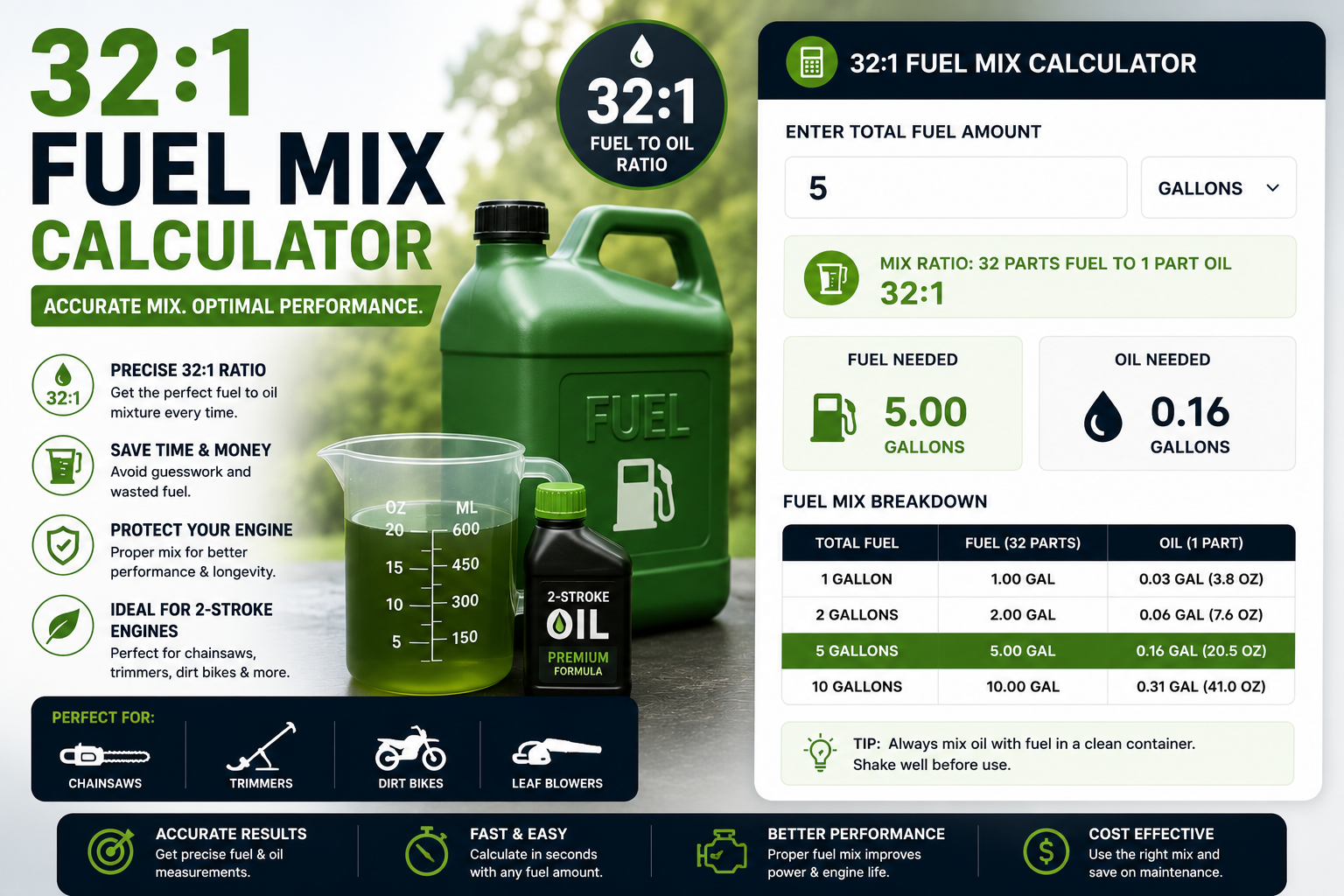
Mixing 2-stroke fuel at the correct ratio is one of the most important maintenance tasks for any 2-cycle engine — and if your equipment specifies 32:1, our free 32 to 1 Fuel Mix Calculator makes it effortless. Enter your gasoline amount in gallons, liters, or fluid ounces, click Calculate, and get the exact oil quantity you need. No charts to look up, no mental math required.
A 32:1 ratio means 32 parts gasoline to 1 part 2-stroke oil. This was the standard specification for a wide range of older Stihl, Echo, Homelite, Poulan, and McCulloch equipment made from the 1970s through the early 2000s. If your chainsaw, trimmer, or blower’s owner manual specifies 32:1, use this calculator to mix with confidence every time.
Table of Contents
- 32:1 Fuel Mix Calculator (Free Tool)
- What Is a 32:1 Fuel Mix Ratio?
- How Much Oil for 32:1? Quick Reference
- How to Mix 32:1 Fuel Step by Step
- Which Engines Use 32:1?
- 32:1 vs Other Mix Ratios
- Which 2-Stroke Oil to Use at 32:1
- Common Mistakes When Mixing 32:1 Fuel
- Frequently Asked Questions
⛽ 32:1 Fuel Mix Calculator
Select your preferred unit tab, enter the amount of gasoline you want to mix, and click Calculate to get the exact amount of 2-stroke oil needed for a 32:1 ratio.
| Gasoline | Oil (fl oz) | Oil (mL) | Oil (tsp) | Oil (tbsp) |
|---|
What Is a 32:1 Fuel Mix Ratio?
A 32:1 fuel mix ratio means you are combining 32 parts of gasoline with 1 part of 2-stroke oil before pouring the mixture into your equipment’s fuel tank. Two-stroke (2-cycle) engines do not have a separate oil reservoir like 4-stroke engines do — instead, they rely entirely on oil mixed directly into the gasoline to lubricate the crankshaft bearings, piston, cylinder walls, and other internal components as the fuel burns.
The “32:1” designation refers to the volume ratio of gasoline to oil. For every 32 units of gasoline — whether measured in gallons, liters, fluid ounces, or any other unit — you add exactly 1 unit of 2-stroke oil. The math works out to: for every gallon (128 fluid ounces) of gasoline, you add 4.00 fluid ounces (118.3 mL) of 2-stroke oil. This notable round number — exactly 4 oz per gallon — is one reason the 32:1 ratio was so popular with older equipment manufacturers. It made field mixing straightforward even before dedicated measuring containers were widely available.
At 32:1, the oil content is 3.03% of the total mixture by volume — higher than the 2.44% at 40:1 and the 1.96% at 50:1, but lower than the 3.85% at 25:1. This places 32:1 firmly in the “rich” category of 2-stroke mixes, providing robust lubrication suited to the engine tolerances and oil qualities of equipment designed decades ago.
How Much Oil for 32:1? Quick Reference
Here are the most commonly needed 32:1 oil quantities at a glance:
- 1 US gallon of gas → 4.00 fl oz (118.3 mL) of 2-stroke oil
- ½ gallon of gas → 2.00 fl oz (59.1 mL) of 2-stroke oil
- ¼ gallon of gas → 1.00 fl oz (29.6 mL) of 2-stroke oil
- 2 gallons of gas → 8.00 fl oz (236.6 mL) of 2-stroke oil
- 2.5 gallons of gas → 10.00 fl oz (295.7 mL) of 2-stroke oil
- 5 gallons of gas → 20.00 fl oz (591.5 mL) of 2-stroke oil
- 1 liter of gas → 31.25 mL of 2-stroke oil
- 5 liters of gas → 156.25 mL of 2-stroke oil
- 10 liters of gas → 312.5 mL of 2-stroke oil
Notice the elegant simplicity of the 32:1 ratio in gallon-based measurements: exactly 4 fluid ounces per US gallon. A standard 4 fl oz (half-cup) measuring cup gives you the perfect dose for one gallon of gas — no calculator needed once you know this shortcut. For larger batches, it scales cleanly: 2 gallons = 8 oz (one cup), 4 gallons = 16 oz (one pint), 8 gallons = 32 oz (one quart).
How to Mix 32:1 Fuel Step by Step
Follow these steps every time you mix 32:1 fuel to ensure a safe, properly blended mixture that protects your engine:
- Confirm your ratio: Open your engine’s owner manual and verify it specifies 32:1. Do not mix by memory — ratios vary by model, year, and even break-in period. Using the wrong ratio can void warranties and damage the engine.
- Choose the right oil: Use only oil specifically labeled “2-stroke,” “2-cycle,” or “TC-W3” (for water-cooled marine applications). The oil must be designed to burn cleanly inside a combustion chamber — automotive 4-stroke engine oil will not do this and will cause heavy carbon deposits and damage.
- Use a clean, dedicated fuel container: Never mix directly in the equipment’s tank. Use a clean, DOT-approved fuel container with no residue from old, stale fuel or a different oil ratio. Even a small amount of old pre-mix can throw off your new ratio.
- Measure the oil precisely: Use a graduated measuring container, not a kitchen spoon. For 1 gallon, you need exactly 4.00 fl oz. Small measurement errors have a larger impact at small fuel quantities — mixing a single quart (32 fl oz) requires only 1 fl oz of oil, and even a small over- or under-measurement significantly changes the ratio.
- Add oil first: Pour the measured 2-stroke oil into the empty fuel container before adding any gasoline. This ensures the oil is thoroughly mixed as the gasoline flows in on top of it, rather than sitting on top of a full tank of gasoline.
- Add fresh gasoline: Pour the gasoline slowly on top of the oil. Use fuel that is no more than 30 days old for best results. Ethanol-blended fuel (E10, up to 10% ethanol) is acceptable for most equipment; avoid E15 or E85 unless the manufacturer explicitly approves it. High ethanol content can degrade rubber fuel system components and cause phase separation when mixed with 2-stroke oil.
- Cap and shake: Seal the container tightly and shake it gently for 30–60 seconds to ensure the oil is fully dispersed in the gasoline. The mixture should appear uniform, not cloudy or separated in layers.
- Label your container: Mark the container clearly with the date mixed and the ratio (32:1). Premixed fuel has a shelf life of approximately 30 days — after that, the gasoline begins to degrade, the ethanol can absorb moisture and cause phase separation, and the oil may begin to settle. Do not store premix longer than 30 days without a quality fuel stabilizer.
- Shake before each use: Even properly mixed fuel can develop slight separation if it sits for several days. Give the container a gentle shake before each use to redistribute the oil evenly through the gasoline.
Which Engines Use 32:1?
The 32:1 ratio was widely specified during the peak years of consumer 2-stroke equipment — roughly the 1970s through the early 2000s. If your equipment is from that era, there is a strong chance it requires 32:1. Here are the most common applications:
Chainsaws
Many older chainsaw models — particularly those from Stihl, Husqvarna, Poulan, Homelite, and McCulloch — originally specified 32:1. Stihl chainsaws manufactured before approximately 2003 commonly called for 32:1 with their branded “Stihl HP” mineral oil. Later models updated to 50:1 when the company introduced their “Stihl HP Ultra” full-synthetic oil. If your Stihl chainsaw has a green or orange label from before 2003, 32:1 is likely the correct ratio — verify in your manual.
String Trimmers and Brush Cutters
Echo string trimmers and brush cutters from many production years specify 32:1. Echo has long offered their “Red Armor” oil blended for their equipment, and their older equipment commonly required 32:1 with this oil. Some later Echo models updated to 50:1, but many — especially commercial-grade models — have retained 32:1. Always check the specific trimmer model year against its owner manual or the label on the air filter cover, which often lists the ratio.
Leaf Blowers and Handheld Equipment
Many older Stihl, Echo, Husqvarna, and Shindaiwa leaf blowers and combination handheld tools specified 32:1. This is especially common for equipment made in the 1990s and early 2000s before 50:1 synthetic-rated oils became widespread. Commercial landscaping equipment from this era was designed around 32:1 mineral oil specifications, and running a leaner mix in these engines — even with better-quality modern synthetic oil — may not provide adequate lubrication if the engine was engineered for the higher oil content of 32:1.
Outboard Motors
Some older Mercury, Evinrude, Johnson, and Yamaha 2-stroke outboard motors specified 32:1 during normal operation, with some requiring a richer 25:1 or even 16:1 during the initial break-in period. Outboard motors are particularly sensitive to lubrication ratio because they operate at sustained high RPM under load for extended periods — conditions that generate more heat than most land-based 2-stroke equipment. If in doubt about your outboard’s ratio, always err on the richer side (lower ratio number) rather than running too lean.
Vintage Motorcycles and Mopeds
Many 1970s and 1980s 2-stroke motorcycles — including older Yamaha, Suzuki, Kawasaki, and Vespa models — specified 32:1 or nearby ratios. Vintage 2-stroke bike enthusiasts often still mix 32:1 with quality semi-synthetic oil as a conservative middle ground between the richer mixes of the era and the leaner modern specifications, providing good protection for aged bearings and seals without the carbon buildup of a very rich mix.
Break-In Period Applications
Even some modern engines that normally run 50:1 specify a richer 32:1 ratio for the initial break-in period — typically the first 5–10 hours of operation. During break-in, the cylinder walls, rings, and bearings are still wearing to their final mated surfaces, generating more friction and heat than a fully broken-in engine. The richer 32:1 mix provides extra oil during this critical period. Always check your new equipment’s manual for break-in ratio instructions before first use.
32:1 vs Other Mix Ratios — How Does It Compare?
Understanding how 32:1 fits among the other common 2-stroke ratios helps you make the right decision if you are considering upgrading oil type or if your manual offers a range of acceptable ratios:
32:1 vs 25:1
A 25:1 mix is richer than 32:1 — it contains more oil per gallon. At 25:1 you add 5.12 fl oz per gallon; at 32:1 you add 4.00 fl oz. The 25:1 ratio provides even more lubrication and is found in older, higher-stress applications. If your engine specifies 32:1, do not switch to 25:1 without manufacturer guidance — the extra oil may cause carbon buildup, plug fouling, and power loss in an engine designed for the cleaner-burning 32:1 ratio. However, a one-tank use of 25:1 accidentally in a 32:1 engine is unlikely to cause lasting damage — just excessive smoke and potential plug fouling.
32:1 vs 40:1
A 40:1 mix is leaner than 32:1 — it contains less oil per gallon (3.20 fl oz vs 4.00 fl oz). Running 40:1 in an engine designed for 32:1 reduces lubrication by 20%, which can accelerate bearing and cylinder wear, increase operating temperatures, and potentially cause premature engine failure under sustained load. Do not substitute 40:1 for 32:1 without manufacturer approval.
32:1 vs 50:1
A 50:1 mix is significantly leaner than 32:1 — it contains only 2.56 fl oz of oil per gallon, compared to 4.00 fl oz at 32:1. That is 36% less oil. Running 50:1 in an engine that requires 32:1 is a significant risk, especially if the engine is older with worn seals and bearings that depend on the higher oil content for adequate lubrication. The only exception would be if your engine manufacturer explicitly states that a switch to full-synthetic oil allows use at 50:1 — some do make this allowance.
Here is a quick comparison table for oil quantity per gallon across common ratios:
- 25:1 → 5.12 fl oz (151.4 mL) per gallon — richest
- 32:1 → 4.00 fl oz (118.3 mL) per gallon
- 40:1 → 3.20 fl oz (94.6 mL) per gallon
- 50:1 → 2.56 fl oz (75.7 mL) per gallon — leanest
Which 2-Stroke Oil to Use at 32:1
Choosing the right oil is just as important as mixing at the correct ratio. At 32:1, you have several quality options:
Mineral (Conventional) 2-Stroke Oil
Mineral 2-stroke oil is petroleum-based and was the standard lubricant when most 32:1 equipment was designed. It is perfectly acceptable for engines specifying 32:1 and is widely available at hardware stores, home improvement centers, and fuel stations. The main downsides of mineral oil compared to synthetic are shorter shelf life once mixed, more smoke and carbon deposits during combustion, and lower performance at temperature extremes. Brands to consider: Stihl HP, Echo Power Blend (standard), Husqvarna XP.
Semi-Synthetic 2-Stroke Oil
Semi-synthetic oils blend petroleum base stock with a portion of synthetic base oil. They offer improved lubrication compared to pure mineral oil, produce less smoke and carbon buildup, and have better performance in cold weather starts. At 32:1, semi-synthetic oils provide noticeably cleaner combustion than mineral oil while remaining a cost-effective option for everyday use. Brands to consider: Husqvarna LS+, Motul 510, Maxima Super M.
Full-Synthetic 2-Stroke Oil
Full-synthetic 2-stroke oils offer the highest lubrication performance, the least smoke and carbon, the best cold-weather viscosity, and the longest premixed fuel shelf life. At 32:1, a full-synthetic oil is “overkill” in the sense that these oils are formulated to provide adequate lubrication at leaner ratios like 50:1 — but there is no harm in using them at 32:1 if your engine requires it. The extra oil simply burns off as slightly more exhaust smoke, but there is no risk of damage from “over-oiling” at 32:1 with a quality synthetic. Brands to consider: Stihl HP Ultra, Echo Red Armor, Amsoil SABER, Motul 800 2T.
TC-W3 Oil (for Water-Cooled Applications)
If your 32:1 application is a water-cooled outboard motor or personal watercraft, look for oil certified to the TC-W3 standard (Two-Cycle Water-cooled, version 3) established by the NMMA (National Marine Manufacturers Association). TC-W3 oils are specifically formulated for the higher-RPM, sustained-load demands of marine 2-stroke engines. Land-based 2-stroke oils should not be used in outboard motors — the different combustion conditions and cooling methods require a different additive package. Conversely, TC-W3 marine oil should not be used in air-cooled chainsaws or trimmers.
What to Avoid
- 4-stroke motor oil (SAE 30, 10W-30, 5W-30, etc.): Never use automotive or small-engine 4-stroke oil in a 2-stroke engine. It does not burn cleanly and will quickly foul plugs, coat cylinder walls with carbon, and clog exhaust ports.
- Recycled or used motor oil: Contains contaminants and combustion byproducts that will damage 2-stroke engines.
- Gear oil or hydraulic oil: Not formulated for combustion — will cause severe damage.
- Unknown or unlabeled oil: If the container does not clearly state “2-stroke” or “2-cycle” on the label, do not use it.
Common Mistakes When Mixing 32:1 Fuel
Even experienced users make these mistakes. Knowing them can save you from an expensive engine repair:
- Guessing the measurement: “Eyeballing” oil into a gas can — even by an experienced hand — introduces significant errors. At 32:1, 1 gallon of gas requires exactly 4.00 fl oz of oil. Use a graduated measuring container every time.
- Using old, stale gasoline: Gasoline degrades within 30–60 days, especially ethanol-blended fuel. Stale gas causes hard starting, varnish deposits in carburetors, and poor performance. Always mix with fresh fuel.
- Ignoring ethanol content: Fuel with more than 10% ethanol (E15, E85) can degrade rubber fuel lines and carburettor diaphragms in older equipment, cause phase separation in premix, and reduce the energy content of the fuel. Most small engines require E10 or lower.
- Not shaking the container: Oil and gasoline can partially separate during storage, even in a properly sealed container. Always give your fuel can a shake before filling your equipment to ensure a uniform mixture reaches the engine.
- Mixing too much fuel: Pre-mixed 2-stroke fuel should be used within 30 days. Mixing a 5-gallon batch when you only use 1 gallon per season leaves you with 4 gallons of degraded fuel. Mix only what you will use in 30 days, or add a quality fuel stabilizer if you need to store it longer.
- Using the wrong ratio because the oil bottle says “50:1”: Some 2-stroke oil bottles are labeled “for 50:1 mix” on the front. If your engine specifies 32:1, you still use 4.00 fl oz of that oil per gallon — you simply use more oil per gallon than the label’s example suggests. The ratio is determined by your engine, not by the oil bottle’s example.
- Confusing 32:1 with 32 mL per liter: These are not the same. 32:1 means 1/32 of the total volume is oil. For 1 liter of gasoline at 32:1, you add 1000/32 = 31.25 mL of oil — not 32 mL. The difference is small (about 2.4%) but measurable over time.
Frequently Asked Questions
How much oil do I add for a 32:1 mix with 1 gallon of gas?
For a 32:1 mix with 1 US gallon of gasoline, you need to add exactly 4.00 fl oz (118.3 mL) of 2-stroke oil. That is precisely one standard 4 fl oz (1/2 cup) measuring cup — one of the cleanest, most memorable numbers in 2-stroke mixing.
How much oil for 32:1 with 5 liters of gas?
For 5 liters of gasoline at 32:1, add 156.25 mL of 2-stroke oil — approximately 5.28 fl oz. The formula is simple: divide your gasoline quantity in mL (5000 mL) by 32 to get the oil quantity in mL (156.25 mL).
Can I use 50:1 oil at a 32:1 ratio?
Yes — the “50:1” on an oil bottle refers to the ratio at which the manufacturer designed the oil to be used, not a physical property of the oil itself. If your engine requires 32:1, you measure 4.00 fl oz of that oil per gallon of gas, regardless of what the bottle’s suggested ratio says. The ratio is always determined by your engine’s owner manual, not the oil bottle.
My chainsaw originally called for 32:1. Can I switch to 50:1 with synthetic oil?
Possibly — but only if the equipment manufacturer explicitly approves it. Some older Stihl and Echo equipment that originally specified 32:1 with mineral oil has been updated by the manufacturer to allow 50:1 with their brand of full-synthetic oil. Check Stihl’s or Echo’s official website for your specific model. If no official guidance exists, continue with 32:1 to be safe. Running 50:1 in an engine designed for 32:1 without manufacturer approval risks under-lubrication and accelerated wear.
What happens if I accidentally mix at 40:1 instead of 32:1?
Running one tank of 40:1 in a 32:1 engine is unlikely to cause immediate catastrophic failure, but it does reduce lubrication by about 20%. The engine will run slightly hotter and with more friction than intended. If you realize the mistake before running the tank, drain and remix at the correct ratio. If the tank has already been run, it is not worth draining — just be sure to mix correctly going forward and avoid sustained high-load operation until the next correctly mixed tank is in use.
How long does 32:1 premixed fuel last?
Premixed 32:1 fuel should ideally be used within 30 days of mixing. After 30 days, the gasoline begins to oxidize and the ethanol (in E10 fuel) can absorb atmospheric moisture and cause phase separation — where the water-ethanol mixture separates from the gasoline and oil, leaving a corrosive layer at the bottom of the container. If you need to store premix longer, add a quality fuel stabilizer (such as Sta-Bil 360 Protection for ethanol-blended fuels) at mixing time, which can extend shelf life to 1–2 years in a sealed container.
Is 32:1 the same as 3% oil?
Not exactly. At 32:1, the oil represents 1/33 of the total mixture (not 1/32) — because the total volume is 32 parts gas plus 1 part oil = 33 parts total. So oil at 32:1 is actually approximately 3.03% of the total mixture by volume. This distinction is mostly academic for practical mixing — the difference between 3% and 3.03% is negligible — but it is worth knowing if you are trying to cross-reference ratios that are expressed as percentages.
Can I mix different brands of 2-stroke oil together at 32:1?
While mixing different brands of 2-stroke oil is generally discouraged, it is less dangerous than mixing oil types (e.g., mineral with synthetic). If you must top off a partially used container with a different brand, ensure both oils are the same type (both mineral, both synthetic) and both are intended for air-cooled or water-cooled applications as appropriate. The best practice is always to use a single, consistent oil in your equipment — switching brands between fills can introduce uncertainty about the actual lubrication quality being delivered to the engine.