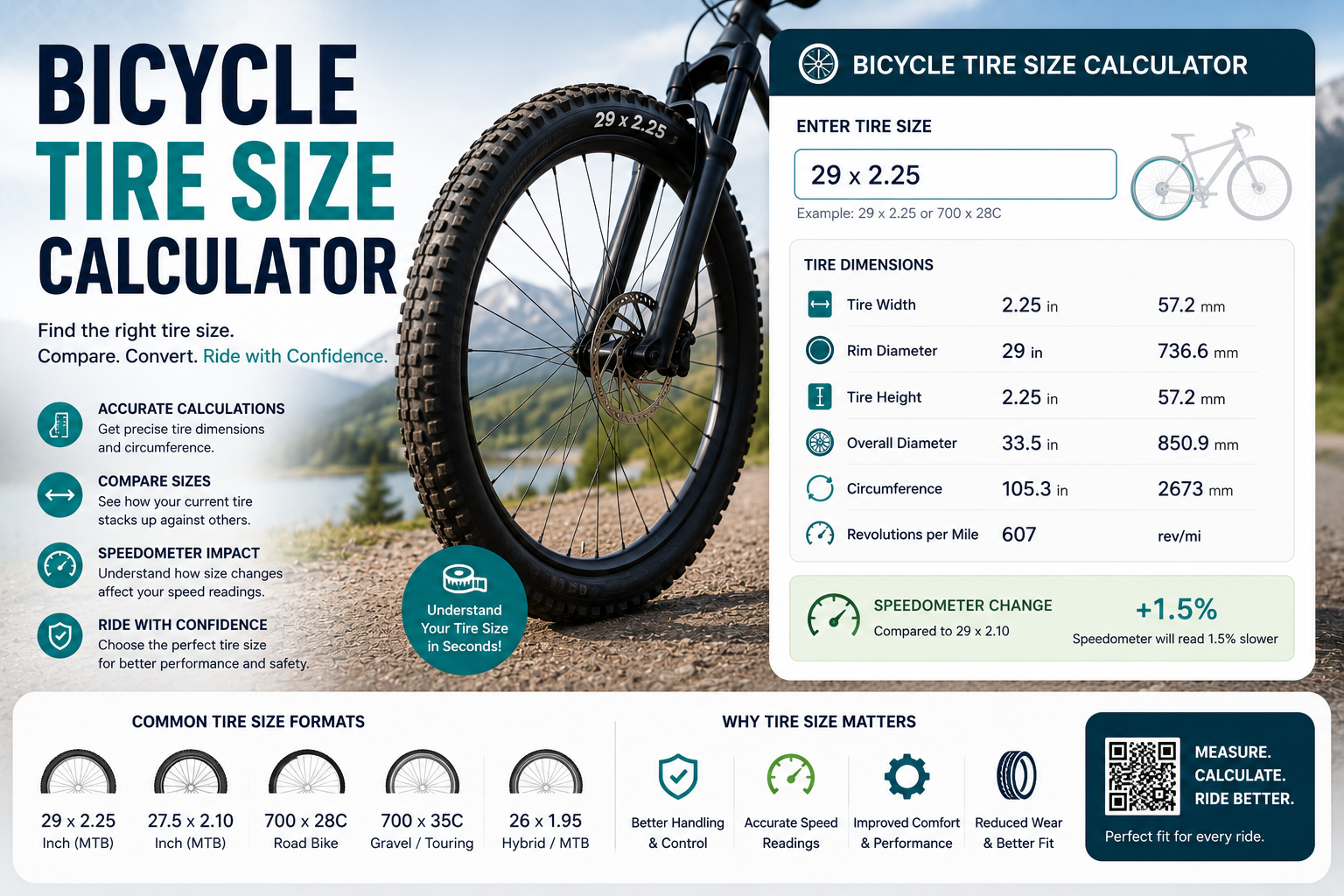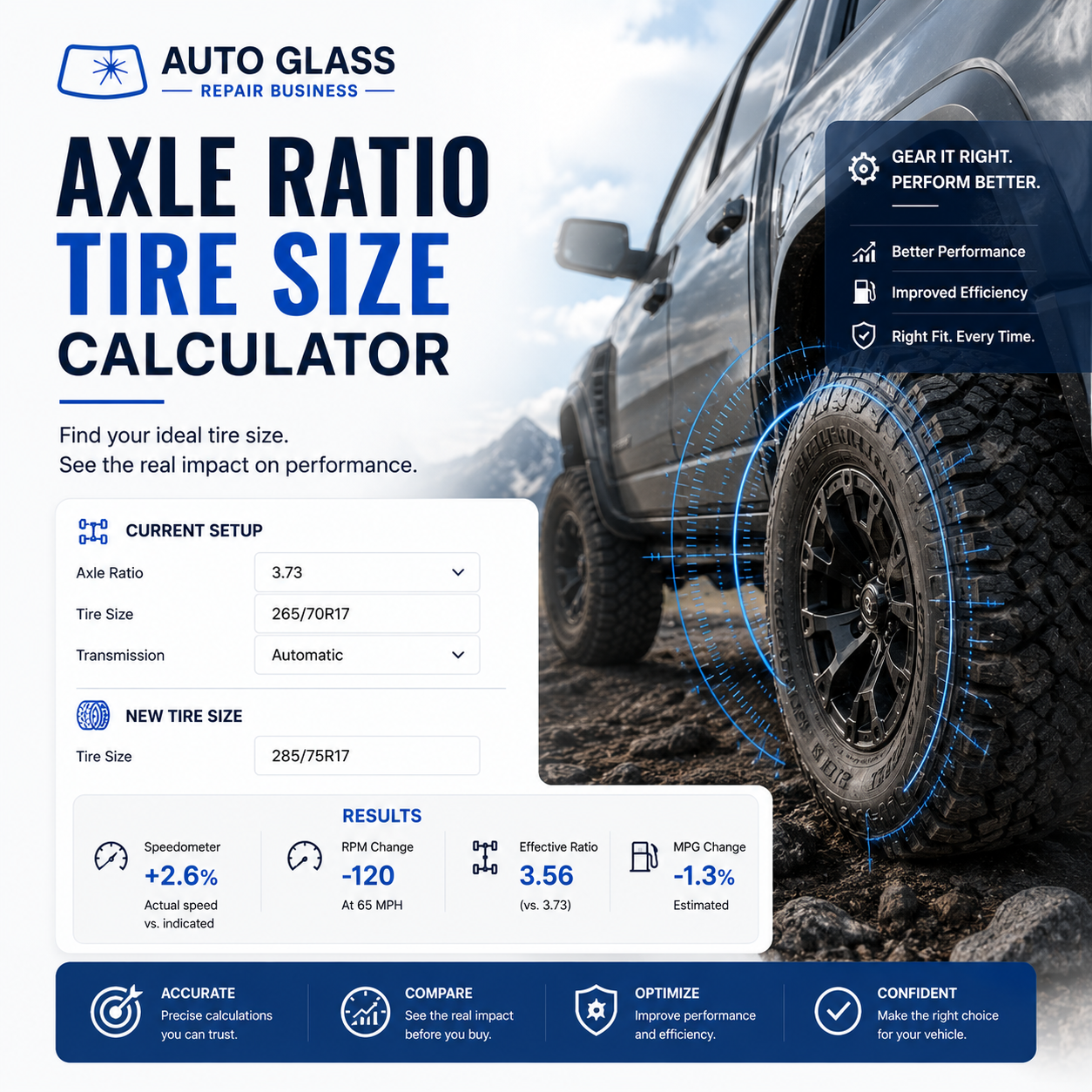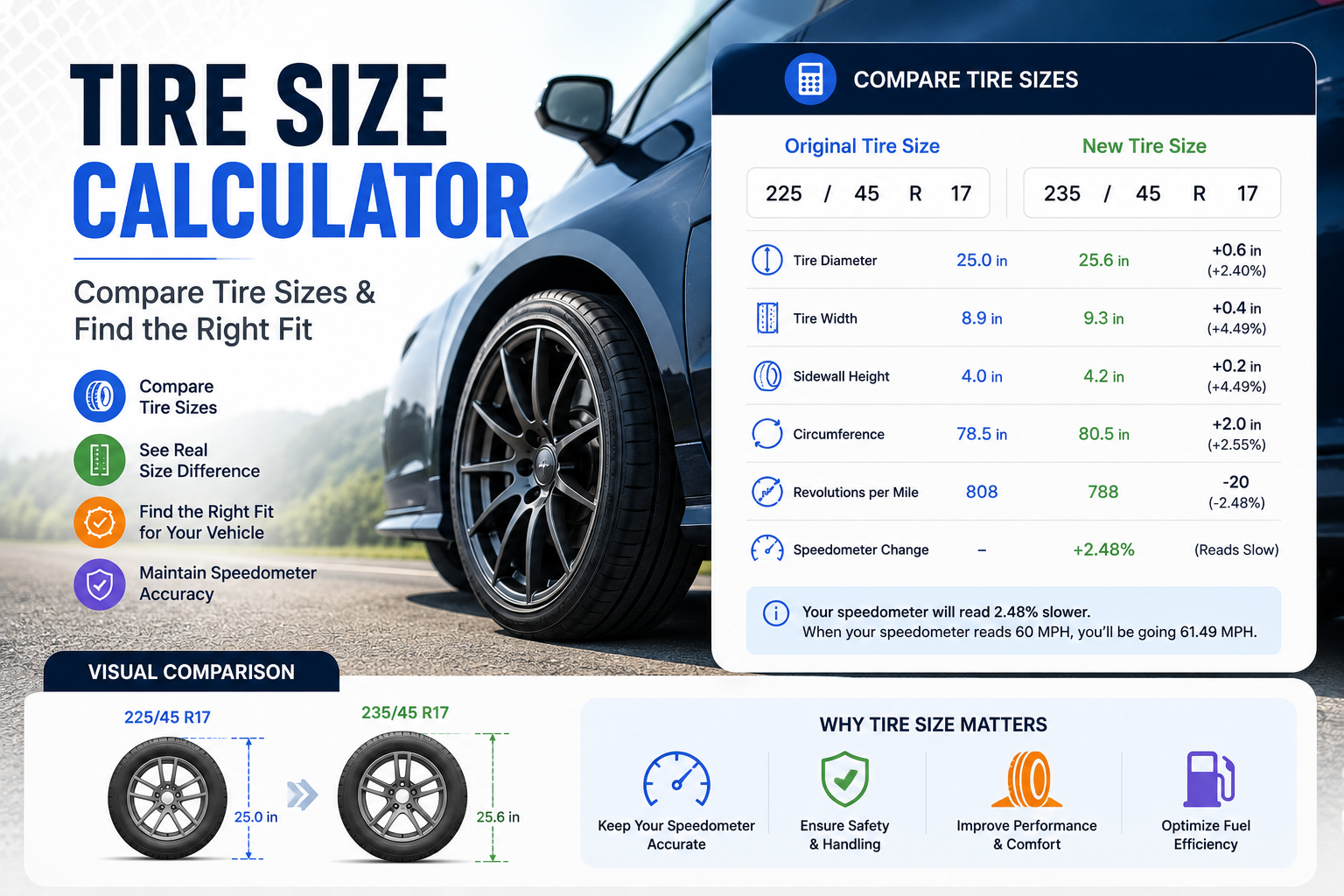
Need to know exactly how your tires measure up? Whether you’re switching to a different size, going up a plus size, or just want to verify your speedometer stays accurate, our free Tire Size Calculator gives you every dimension you need — instantly. No guesswork, no charts to cross-reference.
Enter your tire size in standard P-metric format and get the full breakdown: tire diameter, sidewall height, circumference, and revolutions per mile. Use the comparison tab to see exactly how two sizes differ — including the speedometer error you’d get by switching.
Table of Contents
- Tire Size Calculator (Free Tool)
- What Is a Tire Size Calculator?
- How to Read a Tire Size
- Comparing Tire Sizes
- Understanding Plus Sizing
- Speedometer Error Explained
- Frequently Asked Questions
🔧 Tire Size Calculator
Use the tabs below to calculate tire dimensions from a single tire size, compare two tire sizes side by side, or check your speedometer error after a size change.
| Measurement | Original | New | Difference |
|---|
What Is a Tire Size Calculator?
A tire size calculator is an online tool that converts the three numbers on the sidewall of your tire — width, aspect ratio, and rim diameter — into real-world measurements like overall diameter, sidewall height, circumference, and revolutions per mile. It eliminates the need to look up complex charts or perform manual calculations.
Tools like the 1010Tires tire size calculator are used by drivers, mechanics, and enthusiasts to verify that a replacement or upgrade tire will fit their vehicle, won’t rub on suspension components, and won’t throw off their speedometer or odometer readings. This calculator replicates that functionality in one free, easy-to-use tool.
There are three main calculations most drivers need: measuring a single tire’s dimensions, comparing two different tire sizes side by side, and calculating the speedometer correction required after switching sizes. This tool covers all three.
How to Read a Tire Size
Every passenger car tire has a standardized size code printed on the sidewall. Understanding what each number means is the first step to using a tire size calculator correctly. A typical tire size looks like this:
225 / 45 R 17
The First Number — Section Width (mm)
The first number (225) is the tire’s section width in millimeters — measured from sidewall to sidewall at the widest point of the inflated tire. Common widths range from 155 mm for small economy cars to 335 mm for wide performance vehicles. A wider tire generally provides more grip but may not fit every wheel well.
The Second Number — Aspect Ratio (%)
The second number (45) is the aspect ratio — the sidewall height expressed as a percentage of the section width. A 45-series tire has a sidewall height equal to 45% of 225 mm = 101.25 mm. Lower aspect ratios (35, 40, 45) mean shorter, stiffer sidewalls — common on sports cars. Higher ratios (55, 65, 70) mean taller sidewalls — common on SUVs and trucks for a softer ride.
The Third Number — Rim Diameter (inches)
The third number (17) is the rim diameter in inches — the diameter of the wheel the tire is designed to mount on. This must match your wheel exactly. Common rim diameters range from 14″ to 22″ for passenger cars, and up to 24″+ for trucks and SUVs.
The Full Calculation
Once you have those three numbers, the overall tire diameter is calculated as:
Overall Diameter = (Rim Diameter × 25.4) + (2 × Sidewall Height)
Sidewall Height = Section Width × (Aspect Ratio ÷ 100)
For a 225/45R17: Sidewall = 225 × 0.45 = 101.25 mm. Diameter = (17 × 25.4) + (2 × 101.25) = 431.8 + 202.5 = 634.3 mm (24.97″).
Comparing Tire Sizes — What to Look For
When switching tire sizes — whether upgrading to a wider tire, changing aspect ratios, or moving to a different rim diameter — the most important thing to check is the overall diameter difference. This single measurement affects clearance, speedometer accuracy, gear ratios, and ride quality all at once.
The ±3% Rule
As a general rule of thumb, most vehicles can safely accommodate a tire size change of up to ±3% in overall diameter without significant issues. Beyond that range, you may experience:
- Rubbing: A significantly larger tire can contact the fender liner, suspension components, or frame during turns or suspension compression
- Speedometer error: A larger tire covers more ground per revolution, making your speedometer read slower than your actual speed
- Odometer inaccuracy: Your odometer will record fewer miles than you’ve actually driven
- Gear ratio shift: A larger diameter effectively lengthens your final drive ratio, which can reduce acceleration and affect fuel economy
Width vs Diameter
Width and diameter are both important but affect different things. Width primarily affects grip, handling, and clearance in the wheel well. Diameter affects speedometer accuracy, ground clearance, and the visual appearance of the wheel gap. You can often go wider on a tire without changing the diameter by adjusting the aspect ratio — for example, switching from 215/55R16 to 225/50R16 increases width while keeping the overall diameter nearly identical.
Understanding Plus Sizing
Plus sizing (also called “plus one,” “plus two,” etc.) is the practice of increasing rim diameter while decreasing tire aspect ratio to maintain the same overall tire diameter. It’s one of the most common upgrade strategies for enthusiasts who want larger wheels without affecting speedometer accuracy or fitment.
How Plus Sizing Works
The goal of plus sizing is to keep the overall diameter constant while moving to a larger rim. Each time you increase rim size by 1 inch, you typically need to reduce the aspect ratio to compensate:
- Stock (Plus 0): 215/55R16 → overall diameter 26.3″
- Plus 1: 225/50R17 → overall diameter 26.1″ (nearly identical)
- Plus 2: 235/45R18 → overall diameter 26.3″ (matches stock exactly)
- Plus 3: 245/40R19 → overall diameter 26.7″ (slightly larger)
Benefits and Trade-offs of Plus Sizing
Larger wheels with lower profile tires improve steering response and cornering precision because the shorter, stiffer sidewall deflects less under load. The look is also more aggressive. However, lower profile tires are more susceptible to pothole damage and rim bends, and the stiffer sidewall transmits more road vibration into the cabin. If you primarily drive on rough urban roads or live in a cold climate with poor pavement, lower profiles may not be worth the trade-off.
Speedometer Error — Why It Matters and How to Fix It
Your vehicle’s speedometer calculates speed based on how many times your wheels rotate per minute — multiplied by the tire’s circumference. When you change to a different size tire, the circumference changes, and the speedometer no longer reads correctly. This is called speedometer error.
How Speedometer Error Is Calculated
The formula is straightforward:
Actual Speed = Indicated Speed × (New Tire Circumference ÷ Old Tire Circumference)
Example: If your stock tire is 215/55R16 (circumference: 83.1″) and you switch to 235/45R17 (circumference: 83.7″), your speedometer reads 60 mph but your actual speed is 60 × (83.7 ÷ 83.1) = 60.4 mph — only 0.7% error, negligible. But if you switch to a significantly larger tire, the error compounds quickly.
Fixing Speedometer Error
There are three main options to correct speedometer error after a tire size change:
- ECU/PCM recalibration: A dealer or tuner can reprogram your vehicle’s computer to account for the new tire size. Most accurate method, especially for modern vehicles.
- Speedometer gear change: On older vehicles with mechanical speedometers, replacing the speedometer drive gear corrects the reading. Inexpensive and effective for classic cars.
- Inline speedometer corrector: Devices like the SpeedoHealer plug into the vehicle’s speed sensor signal and apply a correction factor. Easy to install without dealer involvement.
- Choose a tire size within ±1%: The simplest fix — use our comparison calculator to find a new size that keeps the overall diameter within 1% of stock.
Impact on Odometer and Warranty
An uncorrected speedometer error also affects your odometer. If your tires are 3% larger than stock, your odometer will under-record your mileage by 3% — meaning your car is actually older (by miles) than it reads. Over 100,000 miles, that’s 3,000 real miles unaccounted for. This matters for warranty claims, lease agreements, and resale value.
Frequently Asked Questions About Tire Sizes
What tire sizes are interchangeable?
Tire sizes are interchangeable when they have the same overall diameter (within ±3%) and will physically fit in the wheel well. You can often change width and aspect ratio simultaneously to maintain diameter. For example, 205/60R16, 215/55R16, and 225/50R16 are all very close in overall diameter (~26.1–26.3″) and are commonly used as interchangeable alternatives. Use the comparison tab above to verify any size swap before purchasing.
Can I put a wider tire on my current rims?
Yes, within limits. Each rim width supports a range of tire widths. As a general rule, the tire section width should be 1.0–2.0 inches (25–50 mm) wider than the rim width. Going too narrow causes the tire to balloon; too wide causes poor handling and bead seating issues. For example, a 7″ wide rim typically supports tires from 195 mm to 235 mm. Check your vehicle’s owner manual or the placard on the door jamb for the approved range.
How much does tire size affect fuel economy?
Larger, wider tires typically reduce fuel economy in two ways: increased rolling resistance from a larger contact patch, and increased rotational mass that takes more energy to accelerate. Going up one plus size (e.g., 16″ to 17″ wheels) typically reduces fuel economy by 1–3%. Going significantly larger — particularly on trucks and SUVs with aggressive off-road tires — can reduce fuel economy by 5–10% or more.
What does “R” mean in a tire size?
The “R” in a tire size (e.g., 225/45R17) stands for Radial, which describes the internal construction of the tire. Virtually all modern passenger car and light truck tires are radial construction. In older tires you might see “D” (Diagonal/Bias-ply) or “B” (Bias-belted), but these are uncommon in modern applications outside specialty vehicles.
Is it safe to mix tire sizes on one vehicle?
Generally no — most manufacturers recommend identical tires on all four corners for optimal handling and safety. Mixing different diameters on the same axle can stress the differential and cause unpredictable handling. However, some vehicles (particularly sports cars like the Porsche 911) use staggered fitments with different front and rear sizes — this is factory-approved and accounts for different front/rear load distributions. Always check your vehicle’s manufacturer guidelines before mixing sizes.
How do I know if a new tire size will rub?
Rubbing occurs when the tire contacts the fender liner, inner fender, suspension components, or steering rack during turns or suspension travel. The main factors are overall diameter (taller tires may hit the top of the wheel well), section width (wider tires may contact the inner fender), and wheel offset (affects how far inward or outward the tire sits). The safest approach is to use our comparison calculator to find the diameter and width difference, then search owner forums for your specific vehicle to see if others have successfully run that size.
Is this tire size calculator free?
Yes, completely free with no registration required. Use it as many times as you like for any tire size, any comparison, or any speedometer correction calculation. All calculations run in your browser — no data is sent to any server.
Conclusion
Choosing the right tire size is about more than aesthetics — it affects safety, handling, speedometer accuracy, fuel economy, and warranty compliance. Our free Tire Size Calculator gives you the complete picture before you buy, so there are no surprises when the new rubber hits the road.
Use the Tire Dimensions tab to get full measurements from any tire size in seconds. Use the Compare Sizes tab to verify that a replacement or upgrade maintains a safe overall diameter. And use the Speedometer tab to calculate exactly how much your speedo will be off — and how many real miles you’ll actually be driving.
Bookmark this page and use it every time you’re considering a tire change — it takes 30 seconds and could save you from an expensive mistake.
Looking for more automotive tools? Browse our full calculator collection for gear ratio calculators, horsepower estimators, fuel cost tools, wheel offset calculators, and much more.