
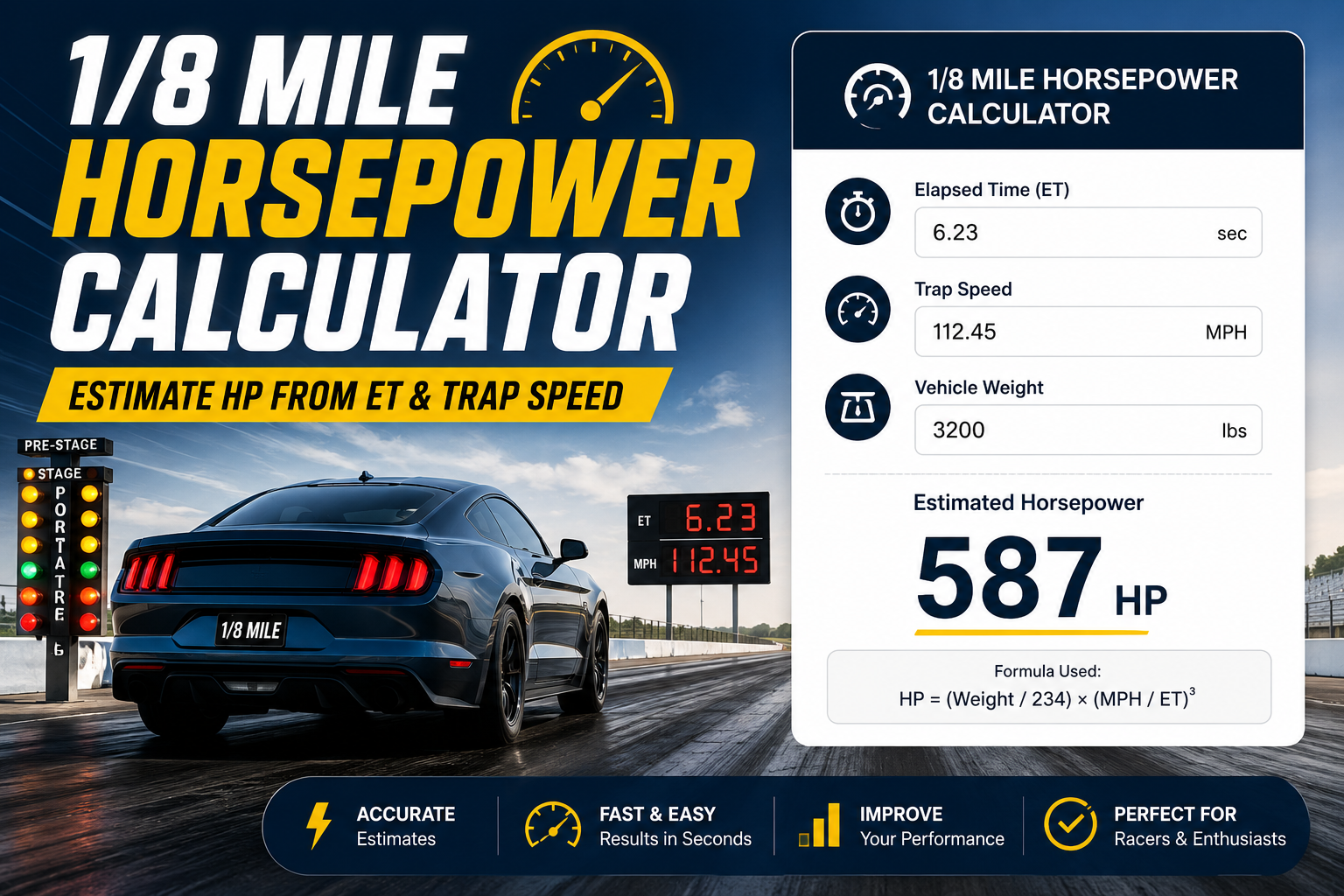
Want to know how much horsepower your car is actually putting to the ground? Whether you just ran your best pass at the local eighth-mile track or you’re comparing runs before a tune, our free 1/8 Mile Horsepower Calculator gives you an instant estimate — using either your elapsed time (ET) or your trap speed. No dyno required.
Enter your car’s weight and your eighth-mile numbers and find out your estimated wheel horsepower from the 1/8 mile in seconds.
Table of Contents
- 1/8 Mile Horsepower Calculator (Free Tool)
- What Is a 1/8 Mile Horsepower Calculator?
- ET Method vs Trap Speed Method
- The 1/8 Mile HP Formula Explained
- Converting 1/8 Mile to 1/4 Mile HP
- How to Run a Better 1/8 Mile Pass
- Frequently Asked Questions
🏁 1/8 Mile Horsepower Calculator
Use the tabs below to calculate horsepower from your elapsed time (ET) or from your trap speed. You can also run a 1/8 to 1/4 mile converter to estimate your full quarter-mile numbers.
What Is a 1/8 Mile Horsepower Calculator?
A 1/8 mile horsepower calculator is an online tool that estimates your vehicle’s engine output using your eighth-mile drag racing results — specifically your elapsed time (ET) or trap speed. Rather than booking expensive dyno time, you can use real track data to get a reliable horsepower estimate in seconds.
Most drag strips in the United States and abroad run 1/8 mile (660-foot) tracks rather than the traditional quarter mile. This makes the 1/8 mile calculator essential for everyday racers who want to translate their strip results into a meaningful horsepower number — and compare it against dyno figures or other drivers.
This tool combines three calculations in one place: the ET-based HP formula, the trap speed HP formula, and a 1/8 to 1/4 mile converter — so you can get a complete picture of your car’s performance from a single eighth-mile pass.
ET Method vs Trap Speed Method — Which Is More Accurate?
Both methods use proven formulas, but they measure different things and have different strengths. Here’s how each approach works:
Elapsed Time (ET) Method
The ET method uses your total 1/8 mile elapsed time and your vehicle’s weight. It’s based on the Hale formula, which was derived empirically from thousands of race results. The formula is:
HP = Vehicle Weight ÷ (ET ÷ 5.825)³
The ET method is straightforward but is sensitive to your reaction time, launch quality, and 60-foot time. A poor launch will inflate your ET and make your HP estimate look lower than reality. For the most accurate results using the ET method, use your best clean pass — not a run where you spun the tires off the line.
Trap Speed Method
The trap speed method uses your speed at the finish line (the “trap”) and vehicle weight. It’s generally considered more consistent and forgiving than the ET method because trap speed is not affected by how cleanly you launched. The formula is:
HP = Vehicle Weight × (Trap Speed ÷ 234)³
The trap speed method is the preferred choice when you want to measure engine output independently of driver skill. A car with a great engine but a slow reaction time will show a more accurate HP number via trap speed than via ET.
Which Should You Use?
Use both methods and compare. If the results are close (within 5–10%), your data is consistent and reliable. If ET-based HP is significantly lower than trap-speed HP, you likely have a poor launch or a bad 60-foot time that’s dragging your ET down. This is a useful diagnostic tool in itself — it tells you where your performance gains should come from.
The 1/8 Mile HP Formula Explained
Both formulas used in this calculator are derived from the Hale Horsepower Formula, originally developed for the quarter mile by Roger Hale and later adapted for the 1/8 mile. The underlying physics: kinetic energy at the finish line is proportional to horsepower delivered to the wheels over the course of the run.
ET-Based Formula Breakdown
The constant 5.825 in the ET formula is the eighth-mile equivalent of the quarter-mile constant (7.825 for the 1/4 mile). It’s calibrated so that the formula outputs realistic HP estimates for a wide range of vehicle classes.
Example: A 3,400 lb car runs an 8.50-second 1/8 mile.
HP = 3,400 ÷ (8.50 ÷ 5.825)³ = 3,400 ÷
(1.4592)³ = 3,400 ÷ 3.107 ≈ 1,094 hp
Trap Speed Formula Breakdown
The constant 234 in the trap speed formula is the eighth-mile equivalent of the quarter-mile constant (234 for the 1/4 mile at the same physics scaling). It relates the cube of trap speed to the ratio of power to mass.
Example: A 3,400 lb car traps 85 mph at the eighth-mile stripe.
HP = 3,400 × (85 ÷ 234)³ = 3,400
× (0.3632)³ = 3,400 × 0.04789 ≈ 163 hp
Note that in the example above, an 8.50 ET typically corresponds to around 85 mph trap speed for most cars — and those would produce very different HP numbers because the ET formula constant is calibrated differently. Always use consistent, real data from the same pass for the most meaningful comparison.
Crank HP vs Wheel HP
Both formulas estimate rear-wheel horsepower (WHP) — the power actually delivered to the ground. To estimate crank horsepower (what manufacturers advertise), divide by a drivetrain efficiency factor:
- Rear-wheel drive (RWD): ~82–88% efficiency → divide WHP by 0.85
- Front-wheel drive (FWD): ~88–92% efficiency → divide WHP by 0.90
- All-wheel drive (AWD): ~78–83% efficiency → divide WHP by 0.80
Our calculator applies a standard 15% drivetrain loss (85% efficiency) to display both the estimated crank HP and estimated wheel HP side by side.
Converting 1/8 Mile to 1/4 Mile Numbers
Many racers and enthusiasts need to convert their 1/8 mile results to equivalent quarter-mile numbers — whether to compare against quarter-mile records, spec sheets, or friends who run on different tracks. The calculator’s converter tab handles this automatically using the most widely accepted conversion formulas.
ET Conversion (Shinoda Formula)
The standard multiplier for converting 1/8 mile ET to estimated 1/4 mile ET is ×1.5548 (often approximated as ×1.55). This was popularized by drag racing statistician and engineer Lance Shinoda.
Formula: QT = 1/8 ET × 1.5548
Examples:
- 7.00 second 1/8 mile → approximately 10.88 second 1/4 mile
- 8.00 second 1/8 mile → approximately 12.44 second 1/4 mile
- 9.00 second 1/8 mile → approximately 13.99 second 1/4 mile
- 10.00 second 1/8 mile → approximately 15.55 second 1/4 mile
Trap Speed Conversion
The standard multiplier for converting 1/8 mile trap speed to 1/4 mile trap speed is ×1.2155.
Formula: Q Trap = 1/8 Trap × 1.2155
Examples:
- 80 mph 1/8 trap → approximately 97.2 mph 1/4 mile trap
- 100 mph 1/8 trap → approximately 121.6 mph 1/4 mile trap
- 120 mph 1/8 trap → approximately 145.9 mph 1/4 mile trap
Keep in mind that these conversions are estimates for cars that pull reasonably hard through the entire quarter mile. Vehicles with very high gearing, aggressive power bands, or significant aerodynamic drag may deviate from the formula. Always verify with actual track data when possible.
How to Run a Better 1/8 Mile Pass
Getting the most accurate data from the track requires more than just a fast car. Here are the key variables that affect your ET and trap speed — and how to control them for a clean, representative pass.
Vehicle Weight — Use the Right Number
Always include driver weight, passenger weight (if applicable), and fuel load in your calculator input. A common mistake is using the manufacturer’s curb weight without adding driver and fuel. For a solo driver, add approximately 180 lbs to the curb weight. A full tank of gas adds another 80–130 lbs depending on tank size.
For the most accurate results, weigh your car on a scale at the track — many strips offer this service. Corner weight scales are common at track day events.
Tire Pressure and Traction
Traction at launch is critical for a representative ET. If you spin the tires off the line, your 60-foot time suffers and your ET will be worse than your car is capable of. For street tires, dropping pressure to 25–30 psi can improve bite. For drag radials, consult the manufacturer’s recommended launch pressure (often 18–22 psi). Slicks require heat cycling and careful pressure management.
Track Conditions
Air density directly affects horsepower — cooler, drier, denser air makes more power. The best conditions for a fast pass are:
- Temperature: 50–65°F (10–18°C) — denser air means more combustion oxygen
- Humidity: Low — dry air is denser than humid air
- Altitude: As low as possible — power drops roughly 3% per 1,000 feet of elevation
- Track surface: Prepped with VHT traction compound for best grip
Consistency Over Single Runs
A single pass can be misleading. Run at least 3–5 passes under similar conditions and use your best consistent run for the HP calculator. Throw out outliers caused by poor launches, traffic, or unusual track conditions. The more consistent your passes, the more reliable your estimated HP figure.
Frequently Asked Questions About 1/8 Mile Horsepower
How accurate is the 1/8 mile HP calculator?
The 1/8 mile horsepower calculator is typically accurate to within ±5–10% of actual dyno figures for normally aspirated vehicles under good track conditions. Accuracy decreases for cars with unusual power delivery characteristics — such as heavily turbocharged engines with large power spikes, or very high-revving engines with a narrow powerband. For the most accurate results, use the trap speed method on a best clean pass.
What weight should I use in the calculator?
Use your total race weight: curb weight + driver + fuel + any passengers. For a typical street car driven solo with a half tank of fuel, this is usually the manufacturer’s curb weight plus about 250–300 lbs. Stripping the interior, removing the spare tire, or running without passengers will lower your race weight and improve your calculated HP ratio. Always weigh your car at the track for the most accurate input.
What is a good 1/8 mile ET for a street car?
For reference, here’s a rough guide to 1/8 mile ET ranges and what they represent:
- 13.0–16.0 seconds: Stock economy/commuter car (100–180 hp)
- 10.5–12.9 seconds: Stock sport compact or mild V6 (180–280 hp)
- 9.0–10.4 seconds: Performance car or mild modification (280–450 hp)
- 7.5–8.9 seconds: High performance / heavily modified street car (450–700 hp)
- 6.0–7.4 seconds: Serious race-built street/strip car (700–1,200 hp)
- Under 6.0 seconds: Pro-class drag car (1,200+ hp)
Is crank HP or wheel HP shown in the results?
The primary “Est. Horsepower” figure shown is a crank HP estimate derived from the Hale formula applied to the full vehicle weight. The “Est. Wheel HP” figure applies a standard 15% drivetrain loss. This aligns with most rear-wheel drive vehicles. If you have AWD (which typically loses 17–22%), your actual wheel HP will be slightly lower than shown.
Why does the ET formula give different results than the trap speed formula?
The two formulas measure different aspects of performance. The ET formula captures your entire run — including the launch. A poor reaction time or wheel spin will slow your ET and artificially lower the ET-based HP estimate. The trap speed formula only measures speed at the finish line, which is independent of how you launched. If your trap-speed HP is significantly higher than your ET-based HP, you’re losing time at the start — typically in the 60-foot. Focus on reaction time, launch RPM, and traction to close the gap.
Can I use this calculator for motorcycles?
Yes. The Hale formula works for any vehicle — cars, trucks, motorcycles, or UTVs. For motorcycles, make sure to include the rider’s weight in the total weight figure. Also note that motorcycles often have very low drivetrain loss (5–8%)** due to chain or belt drive vs. a multi-jointed driveshaft, so your wheel HP will be closer to crank HP than in a car.
Does altitude affect the HP estimate?
Yes, significantly. At higher altitude, thinner air reduces engine power — naturally aspirated engines lose approximately 3% of power per 1,000 feet of elevation. However, the calculator does not apply an altitude correction — it calculates the HP your engine actually made at your current altitude. If you want to compare results between different elevations, apply the correction manually: multiply your calculated HP by (1 + 0.03 × elevation_in_thousands_of_feet) to get the sea-level equivalent.
Is this calculator free to use?
Yes, completely free with no registration required. Use it as many times as you like for any vehicle, track result, or comparison scenario. The calculator runs entirely in your browser — no data is sent to any server.
Conclusion
Your eighth-mile time slip contains more information than just a number — it’s a window into how much power your engine is making, how effectively you’re putting it to the ground, and what your equivalent quarter-mile performance looks like. Our free 1/8 Mile Horsepower Calculator puts all of that math in one place.
Use the From ET tab for a quick estimate from your elapsed time. Use the From Trap Speed tab for a more launch-independent result. And use the 1/8 → 1/4 Mile Converter to see where you’d stack up on a full quarter-mile track.
Remember: the more consistent your passes, the more reliable your HP estimate. Track your results over multiple runs, tune for consistency before chasing peak power, and let the data guide your build decisions.
Bookmark this page for quick access every time you hit the track — and use your time slip to its full potential.
Looking for more automotive performance tools? Browse our full calculator collection for quarter-mile estimates, tire sizing, gear ratio calculators, fuel cost estimators, and much more.