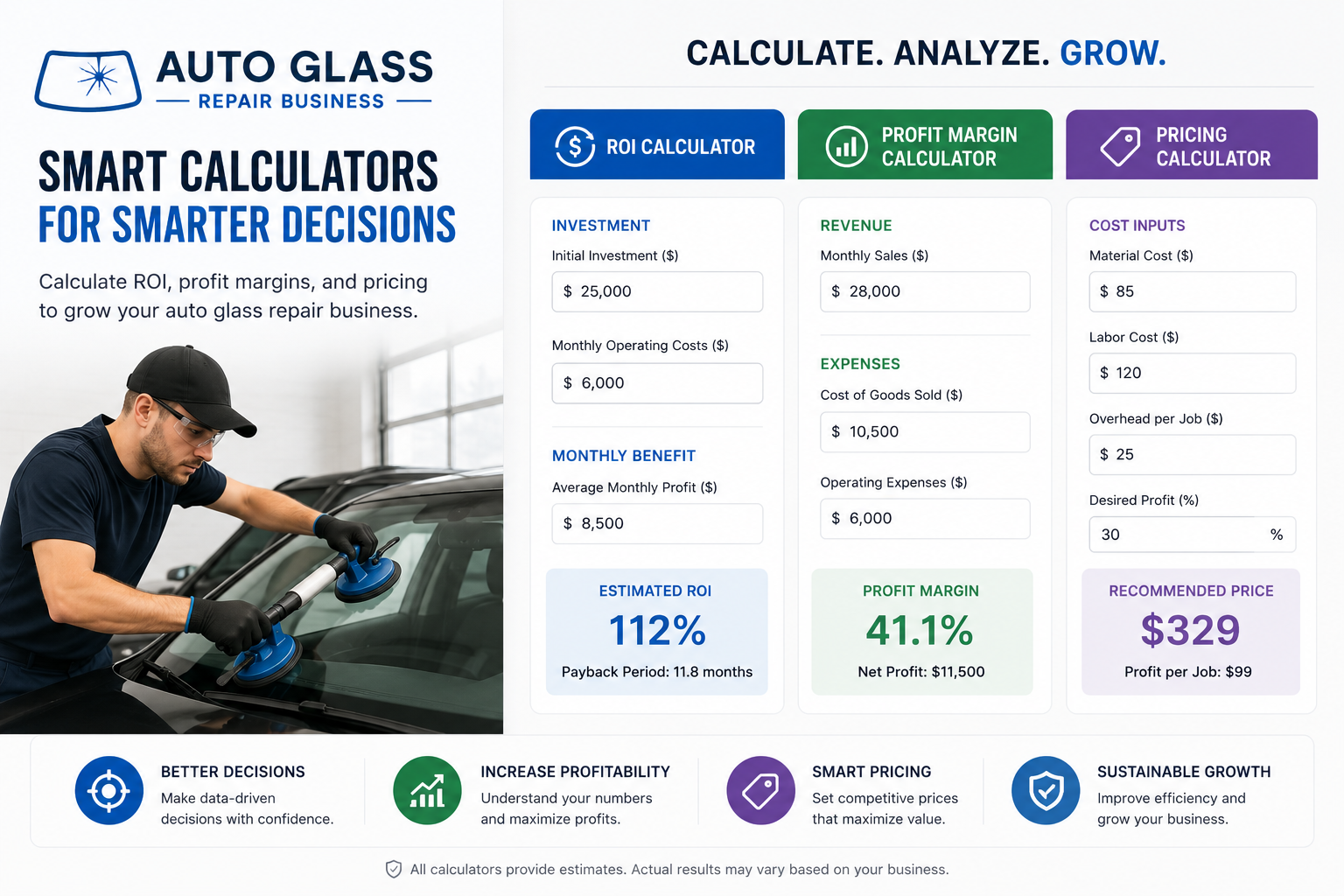
Running a profitable auto glass repair business — whether a fixed shop, mobile unit, or multi-vehicle fleet — comes down to mastering four numbers: your job pricing, your gross margin per service, your monthly breakeven volume, and your return on investment. Our free Auto Glass Repair Business Calculator puts all four tools in one place, giving shop owners, mobile technicians, and entrepreneurs a clear financial picture before committing to every job — and every dollar of overhead.
Use the Job Pricing tab to calculate the minimum and target price for any service, the Profit Margin tab to analyze margin by job type, the ROI Calculator tab to evaluate your investment payback period, or the Monthly Projections tab to model revenue, costs, and net profit at different job volumes.
Table of Contents
- Auto Glass Business Calculators (Free Tools)
- How to Price Auto Glass Services for Profit
- Typical Profit Margins by Service Type
- Insurance Billing and NAGS Pricing Explained
- ADAS Calibration — The High-Margin Add-On
- Understanding Your Breakeven Volume
- Key Performance Indicators for Auto Glass Shops
- Frequently Asked Questions
Auto Glass Repair Business Calculators
All four calculators below are pre-loaded with industry-typical values. Adjust every input to match your actual costs, local labor rates, and service mix.
| Service | Sale Price ($) | Glass Cost ($) | Labor + OH ($) |
|---|---|---|---|
| Windshield Replacement | |||
| Chip / Crack Repair | |||
| Side Window Replacement | |||
| Rear Window Replacement | |||
| ADAS Calibration |
| Metric | Monthly | Quarterly | Annual |
|---|
| Jobs / Month | Revenue | Gross Profit | Net Profit | Net Margin |
|---|
How to Price Auto Glass Services for Profit
Pricing auto glass services correctly requires understanding three distinct cost layers and setting a price that clears all of them with meaningful profit left over. The most common mistake new shop owners make is pricing from the competition down — matching the lowest local quote without understanding whether that price actually covers their costs.
Typical Profit Margins by Service Type
Not all auto glass services are equally profitable. Understanding the margin profile of each service type lets you deliberately shift your job mix toward higher-margin work and price lower-margin jobs more carefully.
| Service | Typical Gross Margin | Rating | Key Cost Driver |
|---|---|---|---|
| Chip / Crack Repair | 60–90% | Excellent | Resin kit ($5–$12). Pure labor + overhead. |
| ADAS Calibration | 55–75% | Excellent | Target/equipment amortization. High hourly rate. |
| Side Window Replacement | 35–50% | Good | Glass cost moderate. Relatively quick labor. |
| Rear Window (heated) | 30–45% | Good | Higher glass cost. Defrost connector complexity. |
| Windshield Replacement | 20–40% | Moderate | Highest glass cost. Insurance discounting compresses margin. |
| Sunroof Glass | 25–40% | Moderate | Specialized glass. Longer labor. Drain tube cleaning adds time. |
| Windshield (insurance discounted) | 15–25% | Lower | Network discounts can erode margin significantly on standard jobs. |
The strategic implication is clear: chip repairs and ADAS calibrations are margin engines. A chip repair that takes 20–30 minutes and uses $8 of resin can generate $50–$75 at a 75–90% gross margin. The same time spent on a network-discounted windshield replacement might generate $360 at only 20% margin — barely covering overhead. Smart operators actively encourage chip repairs before they become replacements and invest in ADAS calibration equipment to capture that high-margin add-on business.
Insurance Billing and NAGS Pricing Explained
The majority of auto glass revenue flows through insurance claims, making a solid understanding of insurance billing essential for every shop owner. The dominant pricing reference in the US auto glass industry is NAGS — the National Auto Glass Specifications benchmark list price, published three times per year by Safelite Solutions.
- How NAGS works: NAGS publishes a reference list price for virtually every piece of automotive glass. Insurance companies negotiate to pay a percentage of NAGS list — typically 65–80% of NAGS — as their reimbursement to your shop. This percentage is your “NAGS factor.”
- The margin erosion problem: Wholesale glass costs from suppliers have risen faster than NAGS benchmark updates, compressing the margin between what insurers pay (NAGS-based) and what you actually pay for glass. Tracking your actual glass cost as a percentage of NAGS price for every part is essential to managing this margin pressure.
- Labor reimbursement: Insurance also reimburses a labor rate per job, which varies by network and region. Verify your contracted labor rate covers your actual technician cost plus overhead — many shops discover their insurance labor rate covers only 60–70% of true labor cost when overhead is included.
- Non-NAGS billing: For glass not listed in NAGS (newer model years, specialty vehicles), bill using your actual cost plus a documented markup. Keep supplier invoices on file for every claim.
- Negotiate your network contracts: The NAGS factor and labor rate you accept when joining a network are negotiable, especially for high-volume shops. Review and renegotiate contracts annually.
ADAS Calibration — The High-Margin Add-On
Advanced Driver Assistance System (ADAS) calibration has become one of the most significant revenue opportunities in the auto glass industry. When a forward-facing camera mounted on or behind the windshield is disturbed by a replacement, federal safety standards and OEM procedures require recalibration before the vehicle is returned to service.
There are two types of ADAS calibration your shop can offer:
- Static calibration — The vehicle is parked in a controlled environment and targets are placed at precise distances using a calibration tool system (e.g., Autel, Bosch, Mahle, or OEM scan tools). Typical time: 60–90 minutes. Revenue: $175–$350. Gross margin: 60–75%.
- Dynamic calibration — The vehicle is driven at highway speed for 15–30 minutes while the system self-calibrates using road markings. Requires a skilled technician and a stretch of open highway. Often combined with static for some vehicles. Revenue: $125–$250 additional. High margin due to low material cost.
Industry data shows that shops adding ADAS calibration services report revenue increases of 15–25% on windshield replacements where it applies. The equipment investment ($8,000–$20,000 for a comprehensive system) typically pays back in 6–10 months at moderate job volume. Use the ROI Calculator tab above to model this for your specific situation.
Understanding Your Breakeven Volume
Your breakeven volume is the number of jobs per month you must complete to cover all fixed and variable costs — the point at which net profit equals zero. Knowing this number is critical: it is the floor below which your business is losing money every day it operates.
Contribution margin per job = $320 − $195 = $125
Breakeven = $6,500 ÷ $125 = 52 jobs per month
Every job above 52 contributes $125 directly to owner profit.
Use the Monthly Projections tab above to model your breakeven at different job volumes. The sensitivity table shows net profit at 50%, 75%, 100%, 125%, and 150% of your current projected volume — making it immediately clear how much cushion (or risk) your current cost structure carries.
Key Performance Indicators for Auto Glass Shops
Revenue per Job
Industry average for a blended mix of windshields, chips, and side windows. Track separately by job type.
Gross Margin
Top performers hit 45–50% through chip repair volume and ADAS add-ons. Under 20% indicates pricing or cost issues.
Technician Utilization
Percentage of paid hours that are billable job hours. Below 60% means excessive idle time eroding profitability.
Jobs per Technician/Day
Windshields take 1.5–2 hrs. Chip repairs 30 min. A well-routed mobile tech can complete 5–7 jobs per day.
Chip-to-Replacement Ratio
The % of jobs that are chip repairs vs. replacements. Higher chip % = higher blended margin. Encourage repairs early.
ADAS Attachment Rate
% of windshield replacements that include ADAS calibration. Growing rapidly as newer vehicles dominate the fleet.
Job Completion Rate
% of booked jobs that are completed. Cancellations and no-shows destroy utilization and revenue predictability.
Customer Acquisition Cost
Marketing spend per new customer. Local SEO, Google Business Profile optimization, and referral programs outperform paid ads for most small shops.
Payback Period (startup)
Well-capitalized mobile units with good route density can recover equipment investment in under 6 months. Shops take 9–18 months.
Frequently Asked Questions
What is the profit margin on windshield replacement?
Windshield replacement typically generates a gross margin of 20–40% for most auto glass shops, depending on wholesale glass cost, insurance network discounts, and local labor overhead. Cash-pay jobs tend to carry higher margins (35–45%) because there is no insurance network discount applied to the invoice. Jobs billed through heavily discounted insurance networks can compress margins to 15–25%, especially as NAGS benchmark prices lag real-world glass cost inflation. Shops with efficient routing, low overhead per job, and favorable glass supplier pricing achieve the upper end of this range.
How much does it cost to start an auto glass business?
Starting a mobile auto glass business typically requires $25,000–$45,000 in startup capital, covering: a used van or truck ($10,000–$20,000), tools and glass removal equipment ($5,000–$10,000), initial glass inventory ($3,000–$6,000), ADAS calibration equipment if included ($8,000–$20,000), insurance deposits, licensing, website, and working capital. A shop-based operation adds lease deposit and buildout costs, typically requiring $50,000–$100,000+ total. The lower end of these ranges is achievable by starting mobile-only, focusing on windshields and chips, and adding ADAS calibration once cash flow is established.
How many jobs per day does a mobile auto glass technician complete?
A well-routed mobile auto glass technician can realistically complete 4–7 jobs per day, depending on job type mix and drive time between stops. Windshield replacements require approximately 60–90 minutes of work plus drive time. Chip repairs take 20–30 minutes each. A day with 2 windshields, 3 chip repairs, and 1 side window is achievable in 7–8 hours with good routing. Efficiency drops significantly in high-traffic urban areas or when jobs are spread across a wide geographic radius. Use 5 completed jobs per day as a conservative planning baseline for a single mobile technician.
What is NAGS pricing and how does it affect my shop’s revenue?
NAGS (National Auto Glass Specifications) is a published price benchmark list used by insurance companies to determine reimbursement for auto glass claims. Insurers pay a negotiated percentage of the NAGS list price — typically 65–80% for most networks — as their contribution to your invoice. The problem is that NAGS prices update only three times per year and have consistently lagged the actual increase in wholesale glass costs, eroding shop margins over time. To protect profitability, track your glass cost as a percentage of the NAGS price for every part you stock, negotiate your NAGS factor upward when possible, and ensure your cash and out-of-network prices are not anchored to NAGS — price those based on your actual cost-plus-margin formula instead.