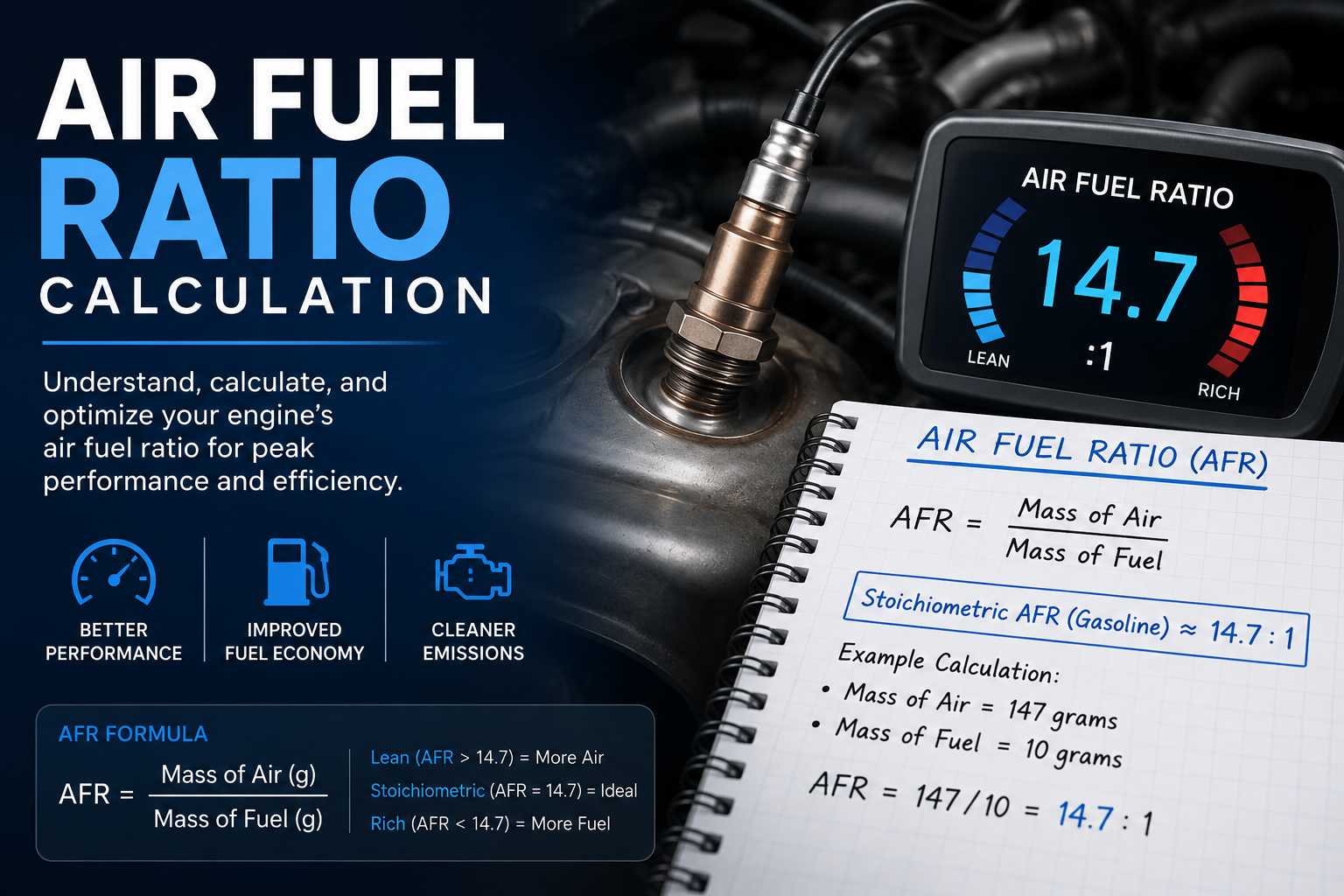
The air to fuel ratio (AFR) is one of the most fundamental measurements in internal combustion engine tuning. It describes how many parts of air are mixed with one part of fuel by mass. Get it right and your engine produces peak power or peak efficiency. Get it wrong and you face detonation, misfires, fouled plugs, or a melted piston. Our free Air to Fuel Ratio Calculator lets you convert between AFR and Lambda (λ), compare stoichiometric values across fuel types, and size fuel injectors for your target horsepower — all in one tool.
Use the AFR / Lambda tab to convert and interpret your mixture reading, the Fuel Types tab to compare stoichiometric ratios across gasoline, E85, ethanol, diesel, methanol, and more, or the Injector Size tab to calculate the fuel injector flow rate required for your power target.
Table of Contents
- Air to Fuel Ratio Calculator (Free Tool)
- What Is Air to Fuel Ratio?
- Stoichiometric AFR by Fuel Type
- AFR vs Lambda — What’s the Difference?
- Rich vs Lean: Which Is Better?
- How AFR Is Measured in a Running Engine
- Fuel Injector Sizing Explained
- Frequently Asked Questions
Air to Fuel Ratio Calculator
Select your fuel type and enter either an AFR or Lambda value — the calculator instantly converts between the two, classifies your mixture, and gives you a tuning assessment. Switch to the Fuel Types tab for a full stoichiometric comparison chart, or to Injector Size for injector flow rate calculations.
| Fuel Type | Stoich AFR | Power AFR | Cruise AFR | Lambda @ Stoich |
|---|---|---|---|---|
| Gasoline | 14.7 : 1 | 12.5–13.2 | 15.0–16.0 | 1.000 |
| E85 (85% ethanol) | 9.8 : 1 | 8.3–8.8 | 10.0–10.5 | 1.000 |
| Ethanol E100 | 9.0 : 1 | 7.6–8.1 | 9.2–9.8 | 1.000 |
| Methanol | 6.45 : 1 | 5.5–5.8 | 6.6–7.0 | 1.000 |
| Diesel | 14.5 : 1 | 17.0–20.0 | 22.0–28.0 | 1.000 |
| Propane / LPG | 15.5 : 1 | 13.2–14.0 | 15.8–16.5 | 1.000 |
| Hydrogen | 34.3 : 1 | 29.0–31.0 | 35.0–40.0 | 1.000 |
What Is Air to Fuel Ratio?
Air to fuel ratio (AFR) is the ratio of the mass of air to the mass of fuel in the air-fuel mixture present in an internal combustion engine at any given moment. It is expressed as a simple number — for example, 14.7:1 means 14.7 grams of air for every 1 gram of gasoline. AFR is the single most important tuning parameter in any fuel-injected engine because it directly controls combustion efficiency, power output, fuel economy, and exhaust emissions.
An engine’s AFR can be:
- Rich — More fuel than air (AFR below stoichiometric). Rich mixtures produce more power but consume more fuel and increase hydrocarbon emissions.
- Stoichiometric — The chemically ideal ratio where all fuel and all available oxygen are consumed. This is where three-way catalytic converters operate most efficiently.
- Lean — More air than fuel (AFR above stoichiometric). Lean mixtures improve fuel economy but can cause detonation (engine knock) and dangerously elevated exhaust gas temperatures (EGT) under high load.
Stoichiometric AFR by Fuel Type
The stoichiometric AFR is not a universal constant — it varies significantly depending on the chemical composition of the fuel. Each fuel has a different ratio of carbon, hydrogen, and oxygen atoms, which determines how much air is needed for complete combustion.
| Fuel | Stoich AFR | Peak Power AFR | Economy / Cruise AFR |
|---|---|---|---|
| Gasoline (pump) | 14.7 : 1 | 12.5–13.2 : 1 | 15.0–16.0 : 1 |
| E85 (85% ethanol / 15% gasoline) | 9.8 : 1 | 8.3–8.8 : 1 | 10.0–10.5 : 1 |
| Ethanol (E100) | 9.0 : 1 | 7.6–8.1 : 1 | 9.2–9.8 : 1 |
| Methanol (M100) | 6.45 : 1 | 5.5–5.8 : 1 | 6.6–7.0 : 1 |
| Diesel | 14.5 : 1 | 17.0–20.0 : 1 | 22.0–28.0 : 1 |
| Propane / LPG | 15.5 : 1 | 13.2–14.0 : 1 | 15.8–16.5 : 1 |
| Hydrogen (H₂) | 34.3 : 1 | 29.0–31.0 : 1 | 35.0–40.0 : 1 |
Notice that ethanol and methanol have much lower stoichiometric AFRs than gasoline — this is because oxygen atoms are already present in their molecular structure, reducing the amount of air needed for complete combustion. This is why switching from gasoline to E85 requires significantly larger fuel injectors and higher fuel pump flow rates.
AFR vs Lambda — What Is the Difference?
Lambda (λ) is a normalized, fuel-independent version of AFR. It expresses how far the actual air-fuel mixture deviates from the stoichiometric point — regardless of which fuel is being used. The formula is simple:
The key advantage of Lambda is that λ = 0.87 means the same mixture richness regardless of whether you are running gasoline, E85, or methanol. This makes Lambda the preferred unit on modern wideband O2 sensor controllers and ECUs — especially for flex-fuel systems that automatically adjust between different fuel blends.
Rich vs Lean — Which Is Better?
Neither rich nor lean is universally “better” — the optimal AFR depends entirely on what the engine is doing at that moment. Here is a practical breakdown:
Rich Mixture (λ < 1.0)
- Maximum power output at WOT
- Lower exhaust gas temperatures (EGT)
- Safer margin against detonation
- Reduced fuel economy
- Increased CO and HC emissions
- Oil dilution risk if severely rich
- Catalytic converter inefficiency
Lean Mixture (λ > 1.0)
- Best fuel economy under light load
- Lower CO / HC emissions
- Cleaner combustion
- Detonation risk at high load / boost
- Elevated exhaust gas temperatures
- Piston and valve damage if extreme
- Reduced peak power output
The practical rule for most performance gasoline engines: run stoichiometric (λ 1.00) at idle and light cruise for emissions and economy; enrich to λ 0.85–0.90 at wide-open throttle (WOT) for power and thermal protection. Never run lean under high load — the risk of detonation and catastrophic engine damage is too great.
How AFR Is Measured in a Running Engine
AFR is measured by analyzing the oxygen content of the exhaust gas. There are two primary sensor types used for this purpose:
- Narrowband O2 Sensor (NBO2) — The standard sensor fitted to virtually all OEM vehicles since the 1980s. It produces a switching voltage signal (approximately 0.1–0.9V) that tells the ECU only whether the mixture is rich or lean relative to stoichiometric. It cannot measure actual AFR precisely — it simply switches back and forth around λ = 1.0. Useless for performance tuning beyond the stock closed-loop window.
- Wideband O2 Sensor (WBO2) — A more sophisticated sensor (e.g., Bosch LSU 4.9, NTK L2H2) paired with a wideband controller (e.g., AEM X-Series, Innovate LC-2, PLX Devices). It produces a precise, linear output across a wide AFR range (typically λ 0.65–λ 1.60 for gasoline). Wideband sensors are the only accurate way to tune AFR in a performance engine and are required for any standalone ECU calibration.
For tuning purposes, a wideband controller logs AFR data against RPM, throttle position, and manifold pressure — enabling the tuner to build an accurate fuel map. Our calculator above helps you interpret the readings your wideband reports and understand what they mean for your engine’s health and performance.
Fuel Injector Sizing Explained
Properly sized fuel injectors are critical for both power and tuning headroom. An injector that is too small will max out (“go static”) before peak power is reached. An injector that is too large will have poor control resolution at idle and low load, making idle quality and part-throttle drivability difficult to tune.
The key formula for injector sizing uses Brake Specific Fuel Consumption (BSFC) — the mass of fuel consumed per unit of power per unit of time:
Example: 400 HP × 0.45 BSFC = 180 lb/hr total
Example: 180 lb/hr ÷ 8 injectors = 22.5 lb/hr each
Example: 22.5 ÷ 0.80 = 28.1 lb/hr minimum injector size
Example: 28.1 × 1.20 = 33.7 lb/hr recommended injector size
Typical BSFC values to use in the calculator: 0.40–0.45 for a well-tuned naturally aspirated gasoline engine, 0.50–0.55 for a turbocharged gasoline engine, and 0.60–0.70 for E85 (ethanol content requires significantly more fuel mass). Always select injectors rated at the actual fuel pressure your system will run — injector flow ratings are specified at a reference pressure (typically 3 Bar / 43.5 PSI).
Frequently Asked Questions
What is the ideal air to fuel ratio for gasoline?
The stoichiometric (chemically ideal) AFR for gasoline is 14.7:1 — meaning 14.7 grams of air to 1 gram of fuel. This is where three-way catalytic converters operate most efficiently and where OEM ECUs target during normal closed-loop driving. For maximum power, most gasoline engines target a richer mixture of 12.5:1 to 13.2:1 (λ 0.85–0.90) at wide-open throttle. For fuel economy at light cruise loads, a lean mixture of 15.0:1 to 16.0:1 is common.
What is the AFR for E85?
The stoichiometric AFR for E85 (a blend of approximately 85% ethanol and 15% gasoline) is 9.7:1 to 9.8:1, compared to 14.7:1 for pure gasoline. This means an E85-fueled engine needs to inject roughly 30–35% more fuel mass to maintain the same lambda value as a gasoline engine. The power AFR range for E85 is typically 8.3:1 to 8.8:1 (λ 0.85–0.90). Switching to E85 requires larger injectors, a higher-flow fuel pump, and a full ECU retune.
What is Lambda and how does it relate to AFR?
Lambda (λ) is AFR normalized to the stoichiometric point. The formula is λ = Measured AFR ÷ Stoichiometric AFR. A Lambda of 1.0 always means stoichiometric, regardless of fuel type. A Lambda below 1.0 is rich; above 1.0 is lean. Lambda is preferred in professional engine tuning because it is fuel-independent — λ 0.87 means the same mixture richness whether you are running gasoline, E85, or methanol.
What happens if the AFR is too lean?
A lean mixture under high engine load is one of the most common causes of catastrophic engine failure. When the AFR is too high (too much air, not enough fuel), combustion temperatures rise sharply, increasing the risk of detonation (engine knock). Detonation causes shock waves inside the combustion chamber that can crack pistons, damage piston rings, blow head gaskets, and destroy bearings — often within seconds at high power levels. Additionally, extremely lean conditions raise exhaust gas temperatures (EGT) to levels that can melt exhaust valves and turbine wheels. Always err on the rich side when tuning high-load conditions.
What AFR should I target for turbo or supercharged engines?
Forced induction engines are generally tuned richer than naturally aspirated engines at wide-open throttle because boost pressure increases the tendency for detonation. A typical safe WOT target for a turbocharged gasoline engine is λ 0.78–0.85 (AFR 11.5–12.5:1). Higher boost levels, lower octane fuel, and higher compression ratios all push the target richer for safety. E85 allows leaner power targets (λ 0.80–0.87) due to ethanol’s extremely high octane rating and evaporative cooling effect.
How do I measure AFR in my car?
The only accurate way to measure AFR in a running engine is with a wideband oxygen sensor and controller. Popular options include the AEM X-Series Wideband UEGO, Innovate Motorsports LC-2, and PLX Devices SM-AFR. The wideband sensor is installed in the exhaust (typically in the downpipe or exhaust header), and the controller converts the sensor’s current signal into an AFR or Lambda reading displayed on a gauge or logged by a data logger or ECU. Standard OEM narrowband O2 sensors cannot provide accurate AFR readings — they only indicate rich or lean relative to stoichiometric.
What is BSFC and why does it matter for injector sizing?
Brake Specific Fuel Consumption (BSFC) is the mass of fuel consumed per unit of power output per unit of time, expressed in lb/hr/HP (or g/kWh in metric). It represents the overall fuel efficiency of the engine and is used to calculate total fuel flow at peak power. A naturally aspirated gasoline engine typically has a BSFC of 0.40–0.45 lb/hr/HP at peak power. Turbocharged gasoline engines run 0.50–0.55, while ethanol-fueled engines (E85/E100) require 0.60–0.70 due to ethanol’s lower energy density compared to gasoline. Knowing your BSFC lets you calculate exactly how much fuel your injectors must flow to support your target power output.
What AFR does a diesel engine run?
Diesel engines operate very differently from gasoline engines. While the stoichiometric AFR for diesel is approximately 14.5:1, diesel engines always run globally lean in normal operation — often at AFRs of 18:1 to 28:1 at cruise and 17:1 to 20:1 at peak torque. Diesel combustion is heterogeneous (non-homogeneous), meaning fuel and air mix locally in the cylinder rather than pre-mixing. This means diesel engines do not knock in the traditional sense and can operate lean without the detonation risk that gasoline engines face. A diesel engine produces black smoke when it runs too rich (too much fuel for available air), which is the opposite concern from gasoline tuning.