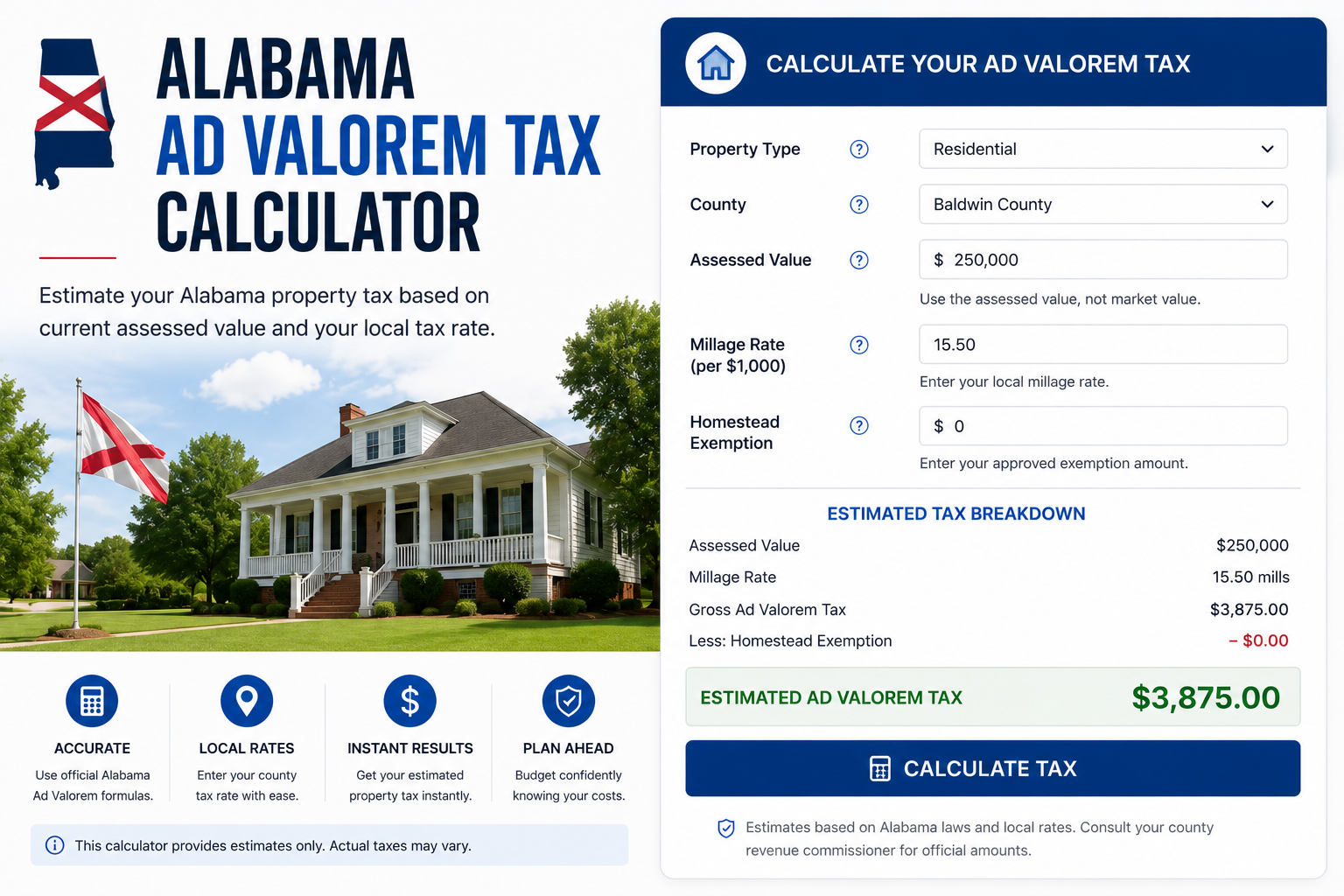
The Alabama Ad Valorem Tax Calculator helps you estimate the annual, value-based tax Alabama charges on vehicles and real property. Unlike a one-time sales tax, ad valorem tax is billed every year based on your property’s current assessed value and your local millage rate — and because Alabama’s assessment ratios and millage rates vary by property type and by county, the same $20,000 car or $250,000 home can owe very different amounts depending on where it’s registered or located.
Use the Vehicle Tax tab to estimate your annual car ad valorem tax, the Property Tax tab to estimate your home’s annual tax with homestead exemptions, or the Millage Comparison tab to see how your tax changes across a range of millage rates — instantly.
Table of Contents
- Alabama Ad Valorem Tax Calculator (Free Tool)
- What Is Ad Valorem Tax in Alabama?
- Alabama’s Four Property Classes and Assessment Ratios
- How Vehicle Ad Valorem Tax Works in Alabama
- How Home Ad Valorem Tax and Homestead Exemptions Work
- Understanding Millage Rates
- How to Find Your County’s Millage Rate
- Frequently Asked Questions
Alabama Ad Valorem Tax Calculator
Select a tab below to estimate your vehicle’s annual ad valorem tax, your home’s property tax, or to compare tax across different millage rates. All fields can be adjusted to your specific property and county.
| Millage Rate | Annual Tax | vs. Current |
|---|
What Is Ad Valorem Tax in Alabama?
Ad valorem is Latin for “according to value” — it’s a tax calculated as a percentage of what property is worth, rather than a flat fee. In Alabama, both real property (land and homes) and certain personal property (most notably motor vehicles) are subject to ad valorem tax, assessed and collected at the county level even though the underlying framework is set by the Alabama Constitution and state statute (Title 40, Code of Alabama).
The calculation always follows the same two-step structure: first, a property’s fair market value is reduced to an assessed value using a classification ratio set by the state; then, that assessed value is multiplied by the local millage rate to produce the tax owed. Both the classification ratio and the millage rate vary by property type and by location, which is exactly why this calculator asks for both.
Alabama is consistently ranked among the states with the lowest effective property and vehicle tax rates in the country — a combination of low assessment ratios (10-20% of value, versus 100% in many states) and comparatively low millage rates keeps most homeowners’ and vehicle owners’ ad valorem bills modest, even though the nominal millage numbers can look large at first glance.
Alabama’s Four Property Classes and Assessment Ratios
The Alabama Constitution divides all taxable property into four classes, each with its own assessment ratio — the percentage of fair market value that actually gets taxed:
- Class I — Public Utility Property: 30% assessment ratio. Applies to property owned by utility companies (railroads, pipelines, telecommunications infrastructure).
- Class II — All Other Property: 20% assessment ratio. The catch-all class — covers most business personal property, rental real estate, non-owner-occupied second homes, and commercial vehicles.
- Class III — Agricultural, Forest, and Owner-Occupied Residential: 10% assessment ratio. The lowest ratio, covering primary residences, farmland, timberland, and owner-occupied manufactured homes.
- Class IV — Private Passenger Automobiles and Pickup Trucks: 15% assessment ratio. Applies specifically to personal vehicles owned and operated by an individual — not vehicles used commercially or for hire.
These ratios are why a $250,000 owner-occupied home (Class III, 10%) has a lower assessed value — and often a lower tax bill — than a $250,000 rental property (Class II, 20%) taxed at the same millage rate, despite having identical market value.
How Vehicle Ad Valorem Tax Works in Alabama
Most personal vehicles registered in Alabama fall under Class IV, assessed at 15% of fair market value. The formula:
Vehicle Ad Valorem Tax = (Fair Market Value × 15%) × (Millage Rate ÷ 1000)
For example, a vehicle worth $20,000 in a county with a combined millage rate of 45 mills: assessed value = $20,000 × 15% = $3,000; tax = $3,000 × (45 ÷ 1000) = $135 per year. Use the Vehicle Tax tab above to run this with your own numbers.
A few important distinctions worth understanding:
- Ad valorem tax is not sales tax. Alabama also charges a one-time sales/use tax (state rate plus local additions) when a vehicle is purchased or first titled. Ad valorem tax is a separate, recurring annual charge tied to registration renewal — the two are frequently confused because both appear on paperwork around the time of purchase.
- The taxable value declines every year as the vehicle depreciates, since the tax is based on current fair market value (typically pulled from a standardized valuation source), not the original purchase price.
- The tax is billed at registration renewal, generally due each year by the vehicle owner’s birthday month or the county’s assigned renewal cycle, alongside the registration/tag fee.
- Commercial and non-personal-use vehicles typically fall under Class II (20%) rather than Class IV, resulting in a meaningfully higher assessed value for the same fair market value.
How Home Ad Valorem Tax and Homestead Exemptions Work
Owner-occupied homes fall under Class III, assessed at just 10% of fair market value — the lowest ratio of any property class. The formula adds one more step versus vehicles: subtracting a homestead exemption before applying the millage rate.
Property Tax = ((Fair Market Value × 10%) − Homestead Exemption) × (Millage Rate ÷ 1000)
Alabama’s standard homestead exemption (H-1) automatically exempts up to $4,000 of assessed value from state ad valorem tax for any owner-occupied primary residence — no application needed beyond claiming homestead status with the county. Beyond that baseline:
- Regular Homestead Exemption: Applies to all owner-occupied primary residences; reduces assessed value subject to state millage.
- Age 65+ Exemptions: Many counties offer a substantially larger exemption — in some cases exempting the home from county ad valorem tax entirely — for owners 65 and older, sometimes with income limits.
- Disability Exemptions: Homeowners who are permanently and totally disabled may qualify for exemptions similar to or larger than the age-65 category, depending on the county.
- Veteran Exemptions: Certain disabled veterans qualify for full or partial exemption from ad valorem tax on their primary residence.
Because these additional exemptions are administered and sized differently by each county’s revenue commissioner, the Property Tax tab above uses a single editable exemption field — enter $4,000 for the baseline state exemption, or a larger figure if you know your county’s senior, disability, or veteran exemption amount.
Understanding Millage Rates
A mill equals one-tenth of one cent, or $1 of tax for every $1,000 of assessed value. Your “total millage rate” is the sum of every taxing authority with jurisdiction over your property, layered together:
- State millage: Fixed by the Alabama Constitution at a relatively small rate applied statewide.
- County millage: Set by each county commission, funding county government operations and, frequently, a dedicated county schools portion.
- Municipal millage: Applies only if the property sits within an incorporated city or town — funds city government and services.
- School district millage: Often the largest single component, funding local public schools; can include both county-wide and city-specific school districts.
Because these layers stack differently everywhere, combined millage rates across Alabama commonly range from roughly 30 mills in some rural, unincorporated counties to well over 100 mills in certain incorporated cities with their own school systems — meaning identical assessed values can produce tax bills several times larger depending purely on location. The Millage Comparison tab above lets you model that difference directly.
How to Find Your County’s Millage Rate
- Check a prior tax notice or registration renewal: Alabama county tax bills and vehicle registration renewal notices typically itemize the millage rate applied, or at minimum show the assessed value and tax charged — you can back into the effective millage from those two numbers.
- Visit your county revenue commissioner’s website: Every Alabama county has a revenue commissioner (sometimes called the tax assessor or tax collector) whose office publishes current millage rates, often broken down by school district and municipality.
- Call the county revenue commissioner’s office directly: For a specific address or vehicle registration location, the office can confirm the exact combined millage rate that applies.
- Use the Alabama Department of Revenue’s property tax resources: The state Department of Revenue publishes general guidance and links to each county’s local millage information.
Frequently Asked Questions
What is the difference between ad valorem tax and sales tax on a car in Alabama?
Sales tax is a one-time charge paid when you purchase or title a vehicle, based on the purchase price. Ad valorem tax is a recurring annual charge paid at every registration renewal, based on the vehicle’s current fair market value. You pay both — sales tax once at purchase, and ad valorem tax every year you keep the vehicle registered.
How is a vehicle’s fair market value determined for ad valorem tax?
County licensing officials generally use a standardized third-party valuation source (such as published market value guides) tied to the vehicle’s year, make, and model to determine current fair market value at each renewal — not the price you originally paid. This is why the tax amount decreases over time as the vehicle ages and its book value drops.
Why is my vehicle’s assessment ratio 15% and not 10% like a house?
The Alabama Constitution assigns different classes different ratios by design. Owner-occupied homes get the lowest ratio (Class III, 10%) as a matter of policy favoring homeownership, while personal vehicles fall into their own category (Class IV, 15%) — still well below the 20% ratio applied to most other property, including commercial vehicles and rental real estate.
Do I automatically get the homestead exemption?
The baseline state exemption generally applies once you claim homestead status on your primary, owner-occupied residence with your county — it is not usually automatic on a newly purchased home until you file for it. Larger county-level exemptions for seniors, disabled homeowners, or veterans typically require a separate application with documentation (proof of age, disability determination, or veteran status) filed with your county revenue commissioner.
Why does my neighbor in a different city pay a different tax rate than I do?
Millage rates stack by jurisdiction — state, county, municipal, and school district. Two properties with identical fair market value and classification can owe very different amounts if one sits inside city limits with its own municipal and school millage, while the other sits in an unincorporated area of the same county with fewer layers of millage applied.
Is Alabama’s ad valorem tax really lower than most states?
Yes, generally. The combination of low assessment ratios (10-20% of value, versus 100% of assessed value in many other states) and comparatively modest millage rates means Alabama consistently ranks among the states with the lowest effective property and vehicle ad valorem tax burdens in the country, even though nominal millage figures can look unfamiliar to residents moving from states that assess at full market value.