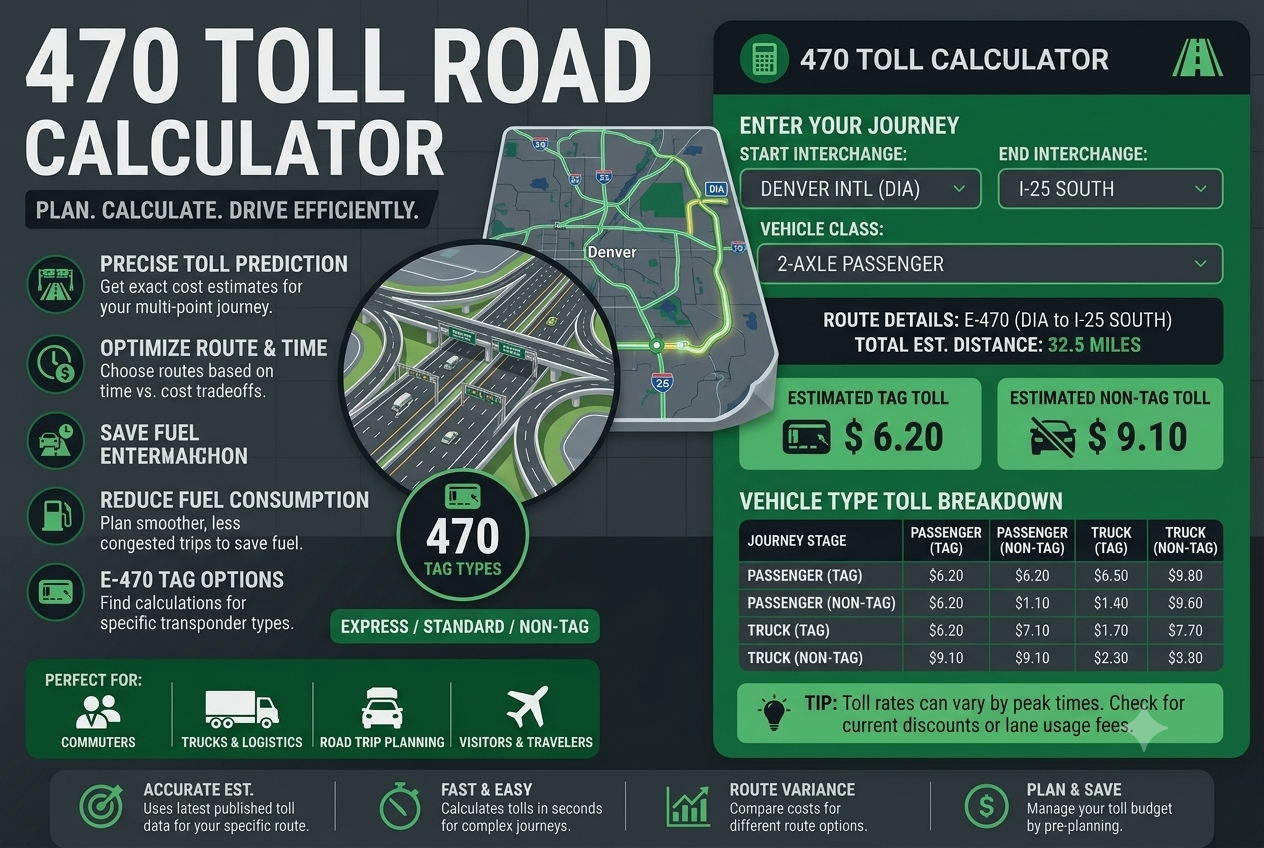
The 407 ETR (Express Toll Route) is Ontario’s premium all-electronic toll highway, stretching approximately 108 km east-west through the Greater Toronto Area. Whether you’re a daily commuter, a business driver, or an occasional user, knowing your expected toll cost before you travel helps you make smarter route decisions. Our free 407 ETR Toll Calculator estimates your toll based on entry and exit interchange, vehicle class, time of day, and payment method — with transponder and video billing options.
Use the Trip Estimator tab for a single-trip toll estimate, the Monthly Commute tab to see what the 407 costs you per month and per year, or the Zone & Rate Chart tab for a complete reference of zone rates and interchange km markers.
Table of Contents
- 407 ETR Toll Calculator (Free Tool)
- How 407 ETR Tolls Are Calculated
- 407 ETR Toll Zones Explained
- 407 ETR Peak vs. Off-Peak Hours
- Transponder vs. Video Billing
- Vehicle Classes and Toll Rates
- Is the 407 Worth It? Monthly Cost Analysis
- Tips to Reduce Your 407 ETR Bill
- Frequently Asked Questions
🛣️ 407 ETR Toll Calculator
⚠️ Disclaimer: Toll rates shown are estimates based on approximate published 407 ETR rates. Actual tolls may vary. Always verify current rates at 407etr.com before travel. Rates are in Canadian dollars (CAD).
| Zone | Transponder Off-Peak | Transponder Peak | Video Off-Peak | Video Peak |
|---|---|---|---|---|
| West Zone (Hwy 400 → Hwy 403) | ~$0.2660/km | ~$0.3325/km | ~$0.2980/km | ~$0.3730/km |
| Central Zone (Hwy 403 → Hwy 404) | ~$0.3030/km | ~$0.3788/km | ~$0.3390/km | ~$0.4240/km |
| East Zone (Hwy 404 → East End) | ~$0.2850/km | ~$0.3563/km | ~$0.3190/km | ~$0.3990/km |
| Interchange / Ramp | ~km Marker | Zone |
|---|
How 407 ETR Tolls Are Calculated
The 407 Express Toll Route is a fully electronic, all-open-road toll highway — there are no toll booths, no stopping, and no cash payments. The system uses overhead gantry-mounted sensors to detect your vehicle as you enter and exit the highway. Your toll is calculated automatically based on four key factors:
- Distance traveled: The 407 charges per kilometre, measured from your entry ramp to your exit ramp. The distance is calculated using the actual interchange positions, not a straight-line distance.
- Toll zone: The 407 is divided into three zones (West, Central, East) with different per-kilometre rates. The Central zone is the most expensive, as it runs through the densest urban area of the Greater Toronto Area.
- Time of day: Peak hour rates apply Monday through Friday from 6:00 AM to 10:00 AM and from 3:00 PM to 7:00 PM. Off-peak rates apply at all other times, including evenings, overnight hours, weekends, and statutory holidays.
- Payment method: If your vehicle has a registered 407 transponder (the small device on your windshield), you pay the transponder rate. If no transponder is detected, the overhead cameras capture your licence plate and bill you at the higher video toll rate, plus a per-trip image processing fee.
Vehicle class also plays a significant role — light vehicles (cars, SUVs, light trucks) pay the base rate, while commercial trucks with multiple axles pay progressively higher rates based on axle count and vehicle classification. Motorcycles pay a reduced rate on the 407 ETR.
407 ETR Toll Zones Explained
The 407 ETR is divided into three geographic zones, each with its own per-kilometre toll rate. Understanding which zone your travel falls into helps you estimate costs accurately.
West Zone — Highway 400 to Highway 403
The West Zone runs from the western terminus near Highway 400 (approximately km 0) to the Highway 403/10 interchange in Mississauga (approximately km 31). This zone covers approximately 31 kilometres and passes through areas north of Brampton, through Vaughan, and into Mississauga. The West Zone has the lowest per-kilometre toll rate among the three zones — roughly $0.266/km off-peak and $0.333/km at peak with a transponder.
Major interchanges in the West Zone include Highway 427, Highway 27/Islington, Highway 410/Hurontario North, and the Highway 403/10 junction. Drivers travelling between Highway 400 and Pearson International Airport commonly use this portion of the 407.
Central Zone — Highway 403 to Highway 404
The Central Zone is the longest and most expensive section, running approximately 44 kilometres from Highway 403 in Mississauga (km 31) to the Highway 404/DVP interchange in Toronto (km 75.5). This is the busiest and most congested section of the 407 corridor, with rates approximately $0.303/km off-peak and $0.379/km at peak with a transponder.
The Central Zone covers a significant portion of the Oakville and Halton Region, connecting commuters from Burlington, Oakville, and Mississauga to the Toronto core. Major interchanges include Winston Churchill Blvd, Trafalgar Rd, Hwy 5/Dundas, Guelph Line, Appleby Line, and Hwy 404/DVP. Most GTA commuters using the 407 as a primary east-west alternative to Highway 401 travel predominantly within this zone.
East Zone — Highway 404 to Eastern Terminus
The East Zone runs from the Highway 404/DVP interchange (km 75.5) to the eastern terminus near Highway 35/115 (approximately km 107), covering about 32 kilometres through Markham and Stouffville. Toll rates in the East Zone are similar to the West Zone — approximately $0.285/km off-peak and $0.356/km at peak with a transponder — making it the second most affordable zone per kilometre.
This section is important for commuters travelling between central Toronto and York Region communities including Markham, Stouffville, and communities along Highway 48. The 407 East extension has significantly reduced travel times on this corridor compared to surface roads.
407 ETR Peak vs. Off-Peak Hours
The 407 ETR charges higher peak-hour rates during the busiest travel periods. Understanding the peak schedule and timing your travel accordingly can generate significant savings, especially for regular commuters.
Peak Hours (Higher Rates)
- Morning peak: Monday through Friday, 6:00 AM to 10:00 AM
- Afternoon peak: Monday through Friday, 3:00 PM to 7:00 PM
Off-Peak Hours (Lower Rates)
- Monday through Friday, 10:00 AM to 3:00 PM (midday)
- Monday through Friday, 7:00 PM to 6:00 AM (evening/overnight)
- All day Saturday and Sunday
- All day on Ontario statutory holidays
The difference between peak and off-peak rates is significant — approximately 25% more per kilometre during peak hours across all zones. For a regular commuter travelling 30 km each way, the difference between driving at 7:30 AM vs. 10:30 AM can amount to hundreds of dollars annually. Many flexible workers and remote workers who only occasionally need to commute to the office specifically time their 407 use for midday off-peak hours to minimize costs.
If your schedule allows, leaving for work before 6:00 AM or after 10:00 AM, and returning home before 3:00 PM or after 7:00 PM, qualifies your trip for off-peak rates. Even shifting your schedule by 30–60 minutes can put you in the off-peak window and save meaningful money over the course of a month.
Transponder vs. Video Billing on the 407 ETR
Every vehicle travelling on the 407 is billed — the only question is how. The two billing methods have significantly different costs, making the transponder the economically rational choice for any regular user.
Transponder Billing
A 407 ETR transponder is a small electronic device (approximately credit-card sized) that mounts on your vehicle’s windshield behind the rearview mirror. As you drive under 407 gantries, the transponder communicates with overhead readers, automatically registering your entry and exit points. Transponder users pay the lower per-kilometre rate and avoid the image processing fee.
- Transponder monthly lease fee: approximately $3.95/month (may change — verify at 407etr.com)
- Lower per-km rate: approximately 10–12% less per km than video billing
- No image processing fee per trip
- Account required: You must set up a 407 ETR account and keep a valid credit card on file for auto-payment
- Break-even point: The transponder pays for itself after just a few trips per month compared to video billing
Video Billing (No Transponder)
If you travel on the 407 without a transponder — or if your transponder fails to read at a gantry — the overhead cameras photograph your licence plate. The system performs a licence plate lookup and bills the vehicle’s registered owner at the higher video toll rate.
- Higher per-km rate: approximately 12–15% more per km than transponder billing
- Per-trip image processing fee applied per billing period (not per trip — charged once if you travel during a billing period)
- No account needed — bills mailed to the registered plate owner
- Risk of non-payment consequences: Unpaid 407 bills can result in the Ministry of Transportation refusing to renew your vehicle licence plate sticker
- Best for: Very occasional 407 users (once or twice per year) who would not recoup the transponder lease fee
For most drivers who use the 407 even a few times per month, getting a transponder saves money. The monthly transponder fee is typically offset within the first one or two trips compared to what you would pay in video billing surcharges.
407 ETR Vehicle Classes and Toll Rates
The 407 ETR classifies vehicles into categories based primarily on the number of axles and the vehicle type. This classification directly determines the toll multiplier applied to the per-kilometre base rate.
- Light vehicles (cars, SUVs, pickups, vans, passenger vehicles): Pay the base per-km rate as listed. This is the rate published on 407etr.com and used in most toll estimate tools.
- Motorcycles: Generally pay a reduced toll compared to light vehicles. Some motorcycles may qualify for special exemptions or reduced rates — check the 407 ETR website for current motorcycle-specific rates.
- Single-unit trucks (2 axle): Commercial vans, cube trucks, and 2-axle trucks pay a higher rate than light vehicles — approximately 1.5–2× the light vehicle rate depending on axle configuration.
- Single-unit trucks (3+ axle): Larger single-body commercial trucks with three or more axles are assessed at higher rates, roughly 2.5–3× the light vehicle rate.
- Multi-unit trucks (tractor-trailers, 5-axle): Standard 18-wheelers and multi-axle commercial combinations pay the highest per-km rate — approximately 3.5–4.5× the light vehicle rate.
The overhead gantry systems on the 407 automatically classify vehicles based on the number of axles detected as the vehicle passes beneath the sensors. Misclassification disputes can be addressed through the 407 ETR customer service process. Commercial fleet operators should set up proper fleet accounts to ensure correct vehicle classification and billing.
Is the 407 Worth It? Monthly Cost Analysis
For many GTA commuters, the key financial question is not just how much the 407 costs — it’s whether the time savings justify that cost. Here is a practical framework for thinking about the value of the 407:
Time vs. Money Calculation
The 407 ETR was designed to move faster than Highway 401, particularly during peak congestion. During a typical rush hour, driving the 401 between the Highway 403 area and the 404/DVP area can take 60–90 minutes or more. The same trip on the 407 typically takes 20–35 minutes. That is a time saving of 30–60 minutes each way — 1–2 hours per round trip.
For a regular commuter making this trip at $0.38/km peak transponder rate, a 44-km Central Zone trip costs approximately $16.72 each way — about $33.50 per round trip. For five days a week, that’s approximately $725 per month (before the transponder fee). Whether that cost is worthwhile depends entirely on how you value your time and the alternative routes available to you.
Common Commute Cost Examples (Approximate)
- Hwy 427 to Hwy 404 (30 km, off-peak transponder): ~$9.20/trip, ~$200/month (5 days/week round trip)
- Hwy 403 to Hwy 404 (44 km, off-peak transponder): ~$13.30/trip, ~$290/month (round trip)
- Hwy 410 to Hwy 404 (53 km, off-peak transponder): ~$16.40/trip, ~$355/month (round trip)
- Hwy 427 to Hwy 404 (30 km, peak transponder): ~$11.50/trip, ~$250/month (round trip)
These are rough estimates — use the Monthly Commute tab of this calculator for your specific route and schedule.
Tips to Reduce Your 407 ETR Bill
- Always use a transponder: The transponder pays for itself within a few trips. Set up auto-payment to avoid late fees and keep your account in good standing.
- Travel off-peak whenever possible: Shifting your commute by just 30–60 minutes to before 6:00 AM, after 10:00 AM, or after 7:00 PM qualifies you for off-peak rates — saving approximately 20–25% per kilometre.
- Use the 407 selectively: You don’t have to use the 407 for your entire trip. Entering for just the most congested segment — for example, only between Hwy 401 and Hwy 404 — can give you significant time savings at a fraction of the full-route cost.
- Carpool or rideshare: Splitting the toll cost between two or more people immediately reduces your per-person expense without changing the toll amount. A $15 trip split between two people costs $7.50 each.
- Review your bills carefully: Check each 407 statement for correct vehicle classification and trip distances. Errors in vehicle classification — where your light vehicle is billed at a truck rate — do occur and must be disputed promptly.
- Consider employer reimbursement: Many Ontario employers reimburse 407 tolls as a business expense for employees who use the highway for work travel. Ensure you’re claiming any tolls incurred for work-related travel on your expense reports.
- Weekend and holiday travel: All travel on weekends and statutory holidays is billed at off-peak rates regardless of time of day — factor this into your travel planning if you have flexibility.
- Check for 407 ETR promotions: The 407 ETR occasionally offers promotional rates, account sign-up incentives, or transponder promotions. Check their website when setting up or renewing your account.
Frequently Asked Questions About the 407 ETR
How much does it cost to use the 407 ETR?
The cost depends on the distance you travel, which zone you’re in, the time of day, and your billing method. As a rough estimate, a typical 30-km trip on the 407 costs approximately $8–$12 for a light vehicle with a transponder during off-peak hours, and $10–$15 during peak hours. The calculator above provides estimates based on your specific entry and exit points. Verify exact current rates at 407etr.com.
What are 407 ETR peak hours?
407 ETR peak hours are Monday through Friday, 6:00 AM to 10:00 AM and 3:00 PM to 7:00 PM. Off-peak rates apply at all other times, including midday weekdays, evenings, overnight, all day on weekends, and all day on Ontario statutory holidays.
Do I need a transponder to use the 407?
No — you can use the 407 without a transponder. If you do, the overhead cameras will photograph your licence plate and you’ll receive a bill in the mail at the higher video toll rate, plus a per-billing-period image processing fee. However, getting a transponder is strongly recommended for anyone who uses the 407 regularly, as it costs less per trip and simplifies billing.
What happens if I don’t pay my 407 ETR bill?
If a 407 ETR bill goes unpaid and remains in collections, the Ontario Ministry of Transportation can refuse to renew your vehicle licence plate sticker. This is a significant consequence that effectively prevents you from driving your vehicle legally in Ontario. If you believe a bill is incorrect, dispute it through 407 ETR customer service before it escalates. If you have financial difficulty, the 407 ETR offers payment plans for outstanding balances.
How long is the 407 ETR?
The 407 ETR main route spans approximately 108 kilometres from Highway 400 near Vaughan in the west to Highway 35/115 near Brock Road in the east. It runs east-west north of Highway 401 through the core of the Greater Toronto Area, passing through or near Vaughan, Brampton, Mississauga, Oakville, Burlington, Halton Hills, Markham, and Stouffville.
Can I use the 407 ETR without an Ontario licence plate?
Yes — vehicles with out-of-province or out-of-country licence plates can use the 407 ETR. If you don’t have a 407 transponder, you’ll be billed at the video rate. The 407 ETR has reciprocal billing agreements with some neighbouring jurisdictions to collect payment from non-Ontario plate holders. It is best to obtain a transponder if you will use the 407 regularly, regardless of where your vehicle is registered.
Is the 407 ETR the same as Highway 407?
The name “407 ETR” and “Highway 407” are commonly used interchangeably, but they technically refer to different entities. Highway 407 is the provincial highway designation. 407 ETR (Express Toll Route) is the private corporation that operates the highway under a 99-year lease agreement with the Ontario government signed in 1999. The 407 ETR corporation sets the toll rates, manages the transponder system, and handles billing — independent of the Ontario government.