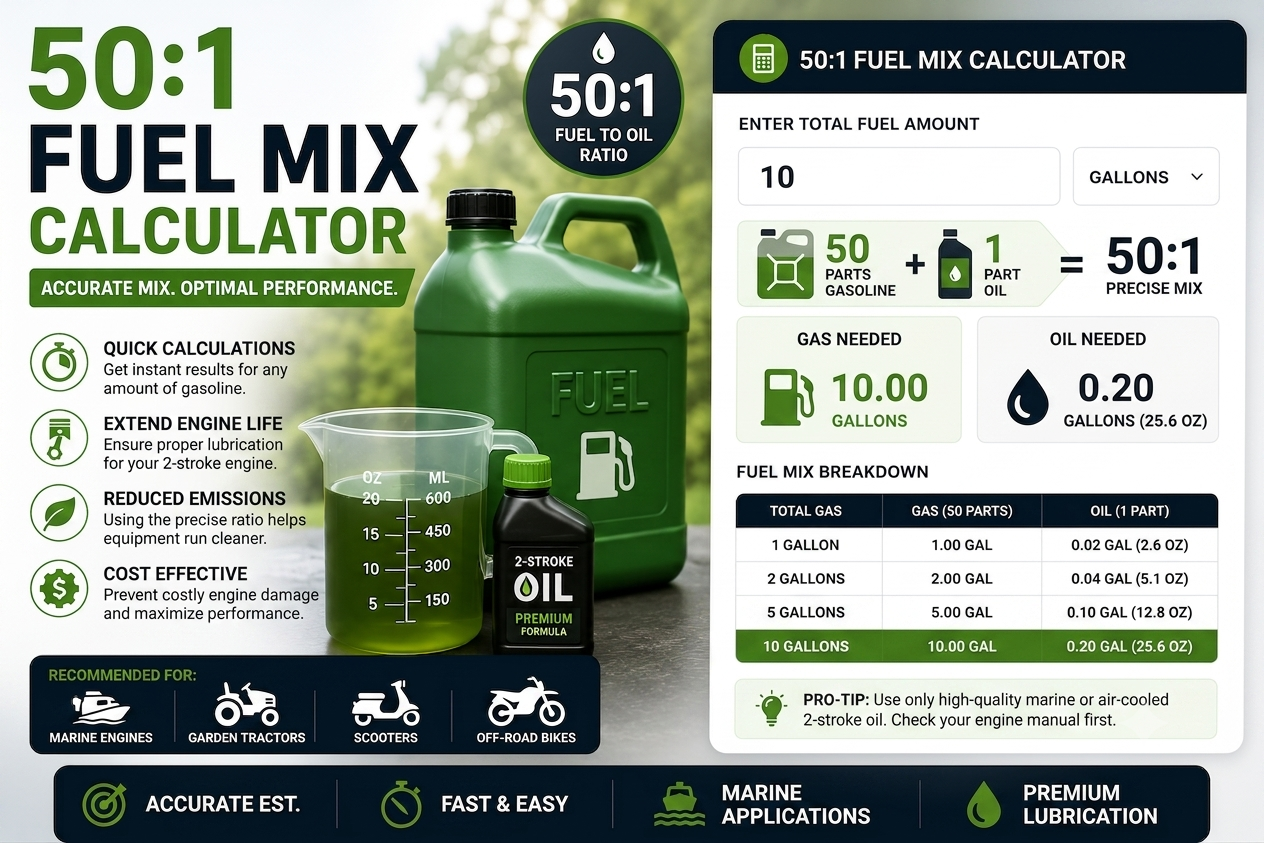
The 50:1 fuel mix is the most common 2-stroke premix ratio in use today — specified by Stihl, Husqvarna (newer models), and the vast majority of modern chainsaws, trimmers, blowers, and 2-cycle outdoor power equipment. Our free 50 to 1 Fuel Mix Calculator gives you the exact oil quantity for any amount of gasoline in gallons, liters, or fluid ounces — instantly.
At 50:1, you add 50 parts gasoline to 1 part 2-stroke oil. For one US gallon, that is 2.56 fluid ounces (75.7 mL) of oil — lean enough to burn cleanly in modern engines using quality synthetic oil, yet sufficient to protect bearings and cylinder walls under load. If your equipment manual says 50:1, this is your calculator.
Table of Contents
- 50:1 Fuel Mix Calculator (Free Tool)
- What Is a 50:1 Fuel Mix Ratio?
- How Much Oil for 50:1? Quick Reference
- How to Mix 50:1 Fuel Correctly
- Which Engines Use 50:1?
- 50:1 vs Other Mix Ratios
- Best 2-Stroke Oils for 50:1
- Why 50:1 Works with Synthetic Oil
- Common 50:1 Mixing Mistakes
- Frequently Asked Questions
⛽ 50:1 Fuel Mix Calculator
Select your preferred unit tab, enter the amount of gasoline you want to mix, and click Calculate to get the exact amount of 2-stroke oil needed for a 50:1 ratio.
| Gasoline | Oil (fl oz) | Oil (mL) | Oil (tsp) | Oil (tbsp) |
|---|
What Is a 50:1 Fuel Mix Ratio?
A 50:1 fuel mix ratio means combining 50 parts of gasoline with 1 part of 2-stroke oil. For every US gallon (128 fluid ounces) of gasoline, you add 2.56 fluid ounces (75.7 mL) of 2-stroke oil. At 50:1, the oil content is 1.96% of the total mixture volume — the leanest of the commonly used 2-stroke ratios, yet sufficient for modern engines using quality full-synthetic oil.
The 50:1 ratio became the industry standard through the 2000s and 2010s as full-synthetic 2-stroke oils became widely available. Synthetic oils provide superior lubrication at lower concentrations than conventional mineral oils — they coat and protect metal surfaces more effectively per milliliter, allowing manufacturers to specify leaner ratios without sacrificing engine longevity. The result is an engine that runs cleaner (less smoke, less carbon), has a longer-lasting spark plug, and produces slightly more power than the same engine running a richer mix.
How Much Oil for 50:1? Quick Reference
- 1 US gallon → 2.56 fl oz (75.7 mL) of 2-stroke oil
- ½ gallon → 1.28 fl oz (37.9 mL) of 2-stroke oil
- ¼ gallon → 0.64 fl oz (18.9 mL) of 2-stroke oil
- 2 gallons → 5.12 fl oz (151.4 mL) of 2-stroke oil
- 2.5 gallons → 6.40 fl oz (189.3 mL) of 2-stroke oil
- 5 gallons → 12.80 fl oz (378.5 mL) of 2-stroke oil
- 1 liter → 20 mL of 2-stroke oil
- 5 liters → 100 mL of 2-stroke oil
- 10 liters → 200 mL of 2-stroke oil
The 50:1 ratio has an extremely clean metric conversion: exactly 20 mL per liter. For metric users this is effortless — just multiply liters by 20 to get mL of oil. A 5-liter mix is exactly 100 mL; a 10-liter mix is exactly 200 mL. This simplicity makes 50:1 uniquely easy to measure in metric countries, which has contributed to its widespread global adoption.
How to Mix 50:1 Fuel Correctly
- Confirm 50:1 is your specified ratio: Check the owner’s manual, the label on the fuel cap, or the sticker on the air filter cover. Modern Stihl, Husqvarna, and Echo equipment commonly specify 50:1 with their branded synthetic oil.
- Choose a quality full-synthetic 2-stroke oil: At 50:1 the oil content is lower — using a high-quality synthetic oil matters more here than at richer ratios. Use an oil that explicitly states it is suitable for 50:1 use.
- Use a clean, dedicated fuel container: Label it “2-stroke 50:1” to prevent accidental use of straight gasoline in your 2-stroke equipment.
- Measure precisely: 2.56 fl oz per gallon is a non-round number. Use the measuring cap that came with your oil, or a graduated measuring cup. Most quality oil bottles include a cap calibrated for common volumes — check if yours has a 1-gallon or 2.5-gallon marking.
- Add the oil first: Pour measured 2-stroke oil into the empty container before adding any gasoline. This helps it mix thoroughly as the gasoline is added.
- Add fresh, quality gasoline: 87+ octane, no more than 30 days old. Maximum E10 (10% ethanol). Higher ethanol blends are not approved for most small-engine applications and can cause fuel system damage.
- Seal and shake: Cap tightly and shake for 30–60 seconds. The oil should fully disperse into the gasoline — the mixture should appear uniform.
- Label with date and ratio: Use within 30 days of mixing, or use a fuel stabilizer to extend shelf life to 1–2 years in a sealed container.
- Shake before each use: Brief separation can occur between uses. Always shake before filling your equipment.
Which Engines Use 50:1?
Stihl
Stihl specifies 50:1 with their HP Ultra or HP Super synthetic oils for the vast majority of their current product line. This includes chainsaws (MS series), string trimmers (FSA, FS series), blowers (BG, BR series), hedge trimmers, and pole saws. Older Stihl products manufactured before approximately 2003 specified 32:1 with their HP mineral oil. If your Stihl is from the last 15+ years with a current manual, 50:1 with Stihl branded synthetic is the correct specification.
Husqvarna (Newer Models)
Husqvarna updated many of their product specifications to 50:1 with the introduction of Husqvarna XP+ and HP synthetic oils. Husqvarna chainsaws, trimmers, and blowers from approximately 2010 onward commonly specify 50:1. Earlier Husqvarna models specified 40:1. Always check the specific model year manual — Husqvarna’s website maintains an online manual archive that is easy to search by model number.
Echo (with Red Armor Synthetic)
Echo allows 50:1 when using their Red Armor full-synthetic oil in equipment that was previously rated at 40:1 with Power Blend oil. This dual-ratio specification (40:1 with mineral/semi-synthetic, 50:1 with full-synthetic) is Echo’s approach to allowing customers to benefit from synthetic oil technology without redesigning engine clearances. Many Echo commercial trimmer and blower operators switch to Red Armor at 50:1 for reduced smoke and longer plug life.
Most Current Consumer Small-Engine Equipment
The vast majority of current-production 2-stroke consumer equipment — including Ryobi, Craftsman, Worx, Black+Decker, Troy-Bilt, and similar brands — specifies 50:1. As the default “universal” ratio for modern 2-stroke equipment, 50:1 is a reasonable starting point if you have equipment without a manual, provided you use quality synthetic oil. If the equipment is older (pre-2000) or from a brand that specified richer ratios, err toward 40:1.
Dirt Bikes and Recreational Equipment
Many modern 2-stroke dirt bikes, karts, and recreational powersports equipment specify ratios in the 32:1 to 50:1 range depending on application. High-performance 2-stroke engines used in motocross and kart racing often require specific pre-mix ratios specified by the engine builder — these can differ significantly from the OEM spec. Always follow the engine builder’s or manufacturer’s current specification for performance applications.
50:1 vs Other Mix Ratios
- 25:1 → 5.12 fl oz (151.4 mL) per gallon — exactly double the oil of 50:1. Only for engines specifically requiring it.
- 32:1 → 4.00 fl oz (118.3 mL) per gallon — 56% more oil than 50:1. Common in older equipment.
- 40:1 → 3.20 fl oz (94.6 mL) per gallon — 25% more oil than 50:1. Many Husqvarna and Echo older models.
- 50:1 → 2.56 fl oz (75.7 mL) per gallon — the modern standard. Leanest of the four common ratios.
Can you run 50:1 in an engine rated for 40:1 or 32:1? Only if the manufacturer explicitly allows it with a specific oil type. Running 50:1 in a 32:1 engine provides only 64% of the specified oil, which can significantly under-lubricate and damage the engine. Never assume a leaner mix is acceptable without manufacturer guidance.
Best 2-Stroke Oils for 50:1
- Stihl HP Ultra (full-synthetic): The benchmark for Stihl equipment. Clean-burning, low-ash, excellent protection at 50:1. Widely regarded as one of the best 2-stroke oils available.
- Husqvarna XP+ (full-synthetic): Husqvarna’s premium synthetic oil for 50:1 use. Formulated for their current equipment lineup. JASO FD certified.
- Echo Red Armor (full-synthetic): Echo’s flagship synthetic oil for 50:1. ISO-L-EGD and JASO FD certified. Excellent carbon resistance and long-term storage stability.
- Amsoil SABER Professional (full-synthetic): A highly regarded third-party option rated for ratios as lean as 100:1, though typically used at 50:1 or 80:1. Outstanding lubrication with virtually smoke-free combustion.
- Motul 800 2T (full-synthetic): Popular in powersports and competition applications. Full ester-based formula with exceptional lubrication at 50:1 and beyond.
- Briggs & Stratton 2-Cycle Oil: A budget-friendly option for consumer equipment. Works at 50:1 but does not match premium synthetics in cleanliness or long-term protection. Acceptable for light-use equipment.
Why 50:1 Works — The Role of Synthetic Oil
The widespread adoption of 50:1 as the modern standard ratio is directly tied to the development of quality full-synthetic 2-stroke oils. Here is why synthetic oil enables a leaner ratio without sacrificing protection:
Superior Film Strength
Full-synthetic base oils — typically polyol esters (POE) or polyalphaolefin (PAO) — form thicker, more tenacious lubricating films on metal surfaces than petroleum-based mineral oils. At the same concentration, synthetic oil provides measurably better protection against metal-to-metal contact. This is the fundamental reason 50:1 synthetic provides better protection than 50:1 mineral oil — and often comparable protection to 32:1 mineral oil.
Cleaner Combustion
Synthetic 2-stroke oils are formulated with low-ash additive packages — they burn more completely and leave fewer carbon deposits in the combustion chamber, exhaust port, and spark plug than mineral oils. This is why modern equipment running 50:1 synthetic typically has a much longer spark plug service interval and a cleaner exhaust port than vintage equipment running 32:1 mineral oil. Carbon buildup in the exhaust port is one of the primary causes of power loss in high-use 2-stroke equipment, and synthetic oil at 50:1 dramatically slows this process.
Better Thermal Stability
Synthetic oils maintain their lubricating properties across a wider temperature range than mineral oils. 2-stroke engines are air-cooled and can experience extreme operating temperatures — particularly in sustained high-load applications like professional chainsaw use, prolonged trimmer operation, or racing. Synthetic oil at 50:1 maintains adequate viscosity at these temperatures, preventing the oil film breakdown that would occur with mineral oil at the same lean ratio.
Common 50:1 Mixing Mistakes
- Using mineral oil at 50:1 in an engine designed for 50:1 with synthetic: If your engine was designed around 50:1 synthetic, using mineral oil at the same ratio under-lubricates the engine. Use the oil type specified — if the manual says “50:1 with Stihl HP Ultra,” use synthetic oil at 50:1, not a cheaper mineral oil at the same ratio.
- Measuring 2.56 fl oz as “2.5 fl oz”: The error is small (2.3%) but consistent. Over many tanks, running slightly lean accelerates wear. Most modern oil measuring caps have a 50:1 gallon line marked — use it.
- Using ethanol-blended fuel above E10: E15 and E85 fuels can damage rubber diaphragms in carburetors, degrade fuel lines, and cause phase separation in pre-mixed fuel. E10 is the maximum for most small 2-stroke engines.
- Storing pre-mixed 50:1 for months: Gasoline degrades, especially in partially filled containers where oxygen exposure is high. Mix only what you will use in 30 days, or add Sta-Bil or similar stabilizer at mixing time for longer storage.
- Running 50:1 in an older engine that requires 32:1: A vintage chainsaw or outboard that was designed for 32:1 mineral oil cannot safely run 50:1, even with synthetic oil. The engine’s seals, bearing clearances, and lubrication pathways were designed for a richer mix. Always match the ratio to the engine specification.
- Using 4-stroke oil: Even at 50:1, 4-stroke oil will not combust cleanly in a 2-stroke engine. It leaves heavy carbon deposits and will quickly destroy the engine. Only use oil labeled “2-stroke” or “2-cycle.”
Frequently Asked Questions
How much oil for 50:1 with 1 gallon of gas?
For 1 US gallon at 50:1, add 2.56 fl oz (75.7 mL) of 2-stroke oil. That is approximately 15.4 teaspoons or 5.1 tablespoons.
How much oil for 50:1 with 5 liters of gas?
For 5 liters at 50:1, add exactly 100 mL of 2-stroke oil. The formula is simple: multiply your liters by 20 to get the oil quantity in mL.
Is 50:1 safe for all 2-stroke engines?
No — 50:1 is only safe for engines that specify it. Engines designed for 32:1 or 40:1 require more oil. Running 50:1 in a 32:1 engine provides only 64% of the required lubrication, which can cause premature wear, overheating, and engine failure. Always use the ratio in your owner’s manual.
What is the best oil to use at 50:1?
For most equipment, the best choice is the manufacturer’s branded full-synthetic 2-stroke oil — Stihl HP Ultra, Husqvarna XP+, or Echo Red Armor as appropriate. If you prefer a third-party option, choose a JASO FD or ISO-L-EGD certified full-synthetic from a reputable brand like Amsoil SABER, Motul 800, or Maxima Formula K2. Avoid budget oils that only list API TC certification for 50:1 applications.
Can I mix different brands of 2-stroke oil at 50:1?
Mixing brands in the same container is not recommended, though it is unlikely to cause immediate engine damage if both oils are full-synthetic and JASO FD certified. The concern is additive incompatibility — different manufacturers use different additive packages, and mixing them can reduce their effectiveness. The better practice is to use a consistent single oil and finish one container before switching brands.
My equipment ran on 40:1 for years. Can I switch to 50:1 synthetic now?
If your manufacturer explicitly permits 50:1 with synthetic oil, yes — many do. Check the owner’s manual or the manufacturer’s website for your specific model. Some older equipment was designed around 40:1 mineral oil tolerances and switching to 50:1 synthetic may not provide adequate lubrication even with the better film strength of synthetic. When in doubt, stay with 40:1 using a quality synthetic oil — you still benefit from cleaner combustion and better protection without changing the ratio.
How long does 50:1 premixed fuel last?
Premixed 50:1 fuel should be used within 30 days for optimal performance. After 30 days, gasoline begins to oxidize, and ethanol in E10 fuel can absorb moisture, causing phase separation. Adding a quality fuel stabilizer (such as Sta-Bil 360° Protection) at mixing time can extend shelf life to 12–24 months in a sealed, topped-off container stored away from heat and sunlight. Pre-mixed fuel containers should always be kept sealed — partial containers with significant airspace degrade faster than full, sealed ones.