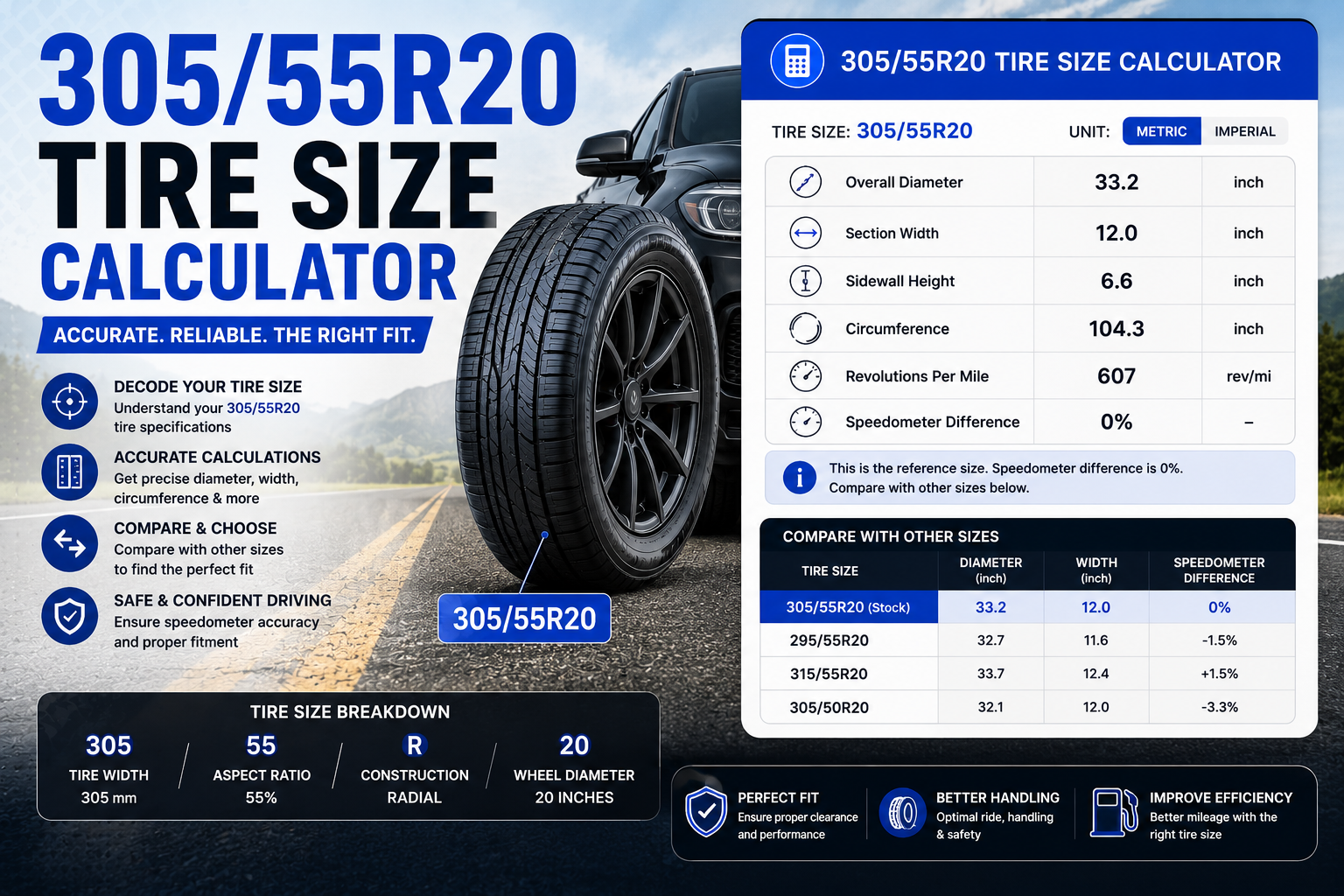
The 305/55R20 is one of the most popular light-truck and SUV tire sizes on the market — a wide-footprint, tall-sidewall tire that perfectly fits factory and lifted trucks, full-size SUVs, and performance off-road builds. Our free 305/55R20 Tire Size Calculator gives you every measurement you need: overall diameter, sidewall height, circumference, and revolutions per mile — all calculated instantly from the tire’s P-metric code.
Use the tabs below to view full 305/55R20 tire dimensions, compare it side-by-side against any alternative size, or calculate how much your speedometer reading changes if you switch to or from 305/55R20. Whether you’re planning a lift kit, swapping to aftermarket wheels, or simply verifying factory specs, this tool has everything you need.
Table of Contents
- 305/55R20 Tire Size Calculator (Free Tool)
- 305/55R20 Tire Specifications at a Glance
- How to Read a 305/55R20 Tire Size
- 305/55R20 Overall Diameter Explained
- 305/55R20 Rim Fitment & Wheel Requirements
- 305/55R20 vs Common Alternative Sizes
- Vehicles That Use 305/55R20 as OEM or Popular Fitment
- 305/55R20 and Lifted Trucks
- Load Rating and Speed Rating
- Best Tire Brands in 305/55R20
- Frequently Asked Questions
🔧 305/55R20 Tire Size Calculator
The calculator below is pre-loaded with the 305/55R20 tire size. Use the Dimensions tab to view exact specs, the Compare tab to see how it measures up against another size, or the Speedometer tab to calculate how a size change affects your speedometer reading.
| Measurement | Original | New Size | Difference |
|---|
305/55R20 Tire Specifications at a Glance
Here are the full calculated dimensions for a 305/55R20 tire based on the standard P-metric tire formula:
- Overall Diameter: 33.21 inches (843.5 mm)
- Sidewall Height: 6.60 inches (167.8 mm)
- Section Width: 12.01 inches (305 mm)
- Circumference: 104.35 inches (2.650 m)
- Revolutions per Mile: approx. 607
- Rim Diameter: 20 inches
- Minimum Rim Width: 8.5 inches (recommended)
- Maximum Rim Width: 11.0 inches (recommended)
The 305/55R20 has an overall diameter of 33.21 inches, which places it in the same class as many popular 33-inch off-road tires. This is a key fact for truck owners: a 305/55R20 is essentially a 33-inch tire on a 20-inch wheel, making it a factory or near-factory fitment for many full-size trucks and large SUVs.
How to Read a 305/55R20 Tire Size
The three-number code 305/55R20 follows the standard P-metric tire sizing system used throughout North America and internationally. Here is exactly what each part of the code means:
305 — Section Width in Millimeters
The first number, 305, is the tire’s section width in millimeters — measured from the widest point of the outer sidewall to the widest point of the inner sidewall when mounted on a properly sized rim and inflated to the recommended pressure. This does not mean the tire’s tread contact patch is 305 mm wide; the actual tread width is somewhat narrower. At 305 mm (approximately 12 inches), this is a wide tire — significantly wider than the 265 mm or 275 mm tires found on lighter-duty trucks and crossovers.
55 — Aspect Ratio (Sidewall Height as % of Width)
The second number, 55, is the aspect ratio — the sidewall height expressed as a percentage of the section width. For a 305/55R20:
Sidewall height = 305 mm × 55% = 167.75 mm (approximately 6.60 inches)
A 55-series tire has a moderately tall sidewall — taller than the 45 or 35-series tires found on performance cars, but shorter than the 65 or 70-series tires on older or more utilitarian trucks. This height provides a good balance between on-road ride comfort (the sidewall flexes to absorb bumps) and handling precision. For off-road use, taller sidewalls also provide more potential for airing down to improve traction on soft terrain.
R — Radial Construction
The letter R indicates radial tire construction. Virtually all modern passenger and light-truck tires are radial — the internal cords run radially from bead to bead, perpendicular to the direction of travel. Radial construction provides better fuel economy, heat dissipation, tread life, and ride quality compared to older bias-ply construction. If you see a “B” instead of an “R,” that indicates bias-ply or belted bias construction, which is now only found in specialty applications like vintage vehicles and certain trailers.
20 — Rim Diameter in Inches
The final number, 20, is the wheel (rim) diameter in inches that the tire is designed to fit. A 305/55R20 fits a 20-inch diameter wheel. This is now one of the most common wheel sizes for full-size trucks and SUVs, offered as standard equipment on many Ram 1500, Ford F-150, Chevrolet Silverado, GMC Sierra, Toyota Tundra, and similar vehicles. Using a tire with a rim diameter that does not match your wheel is not possible — the bead diameters must match exactly.
305/55R20 Overall Diameter Explained
The overall diameter of a 305/55R20 tire is 33.21 inches. This is calculated using the standard formula:
Diameter = (Rim diameter in mm) + (2 × Sidewall height in mm)
= (20 × 25.4) + (2 × 167.75)
= 508 + 335.5
= 843.5 mm = 33.21 inches
Why does diameter matter so much? Several reasons:
- Speedometer calibration: Your vehicle’s speedometer and odometer are calibrated to the original tire’s circumference. A larger diameter tire means more distance traveled per revolution, so your speedometer reads low. A smaller diameter means fewer inches per revolution, so your speedometer reads high.
- Ground clearance: A larger-diameter tire raises your vehicle’s ride height. Going from a 31-inch to a 33-inch tire adds approximately 1 inch of ground clearance (half the diameter difference on each side).
- Wheel well clearance: Tires that are too large in diameter will rub on the wheel well liner, suspension components, or frame — especially when turning or during suspension compression. Always verify clearance before sizing up.
- Gear ratio effect: A larger tire effectively raises your final drive ratio, reducing your engine’s effective torque at the wheels. This can negatively affect towing capacity, acceleration, and fuel economy unless compensated with a regear.
- ADAS calibration: Modern vehicles with forward collision warning, adaptive cruise control, and lane departure systems rely on wheel speed sensors and tire diameter data. A significant tire size change may require dealer recalibration of these systems.
The 33.21-inch diameter of the 305/55R20 is very close to a true “33-inch tire,” which is why this size is popular for light off-road builds — it provides meaningful ground clearance without requiring a lift kit on most trucks.
305/55R20 Rim Fitment & Wheel Requirements
The recommended rim width range for a 305/55R20 tire is 8.5 to 11.0 inches, with the optimal rim width being 9.0 to 10.0 inches. Here is how rim width affects the tire:
- Too narrow a rim (below 8.5″): The sidewalls bow inward, reducing the tire’s footprint and stability. Handling suffers and the tire may not seat correctly on the bead.
- Optimal rim width (9″–10″): The tire sits at its designed section width, providing the full 305 mm measurement and correct sidewall geometry.
- Wider rim (10″–11″): The tire’s section width increases slightly and the sidewall becomes more upright, which can improve handling but reduces sidewall flexibility — relevant for off-road applications where sidewall flex is desirable.
- Too wide a rim (above 11″): The sidewall stretches unnaturally (“stretched” fitment). This is sometimes done for aesthetic purposes on show trucks and stance builds, but it can compromise safety, handling, and load capacity.
Beyond width, you also need to verify wheel offset and backspacing when fitting 305/55R20 tires. A wide tire like the 305 requires adequate backspacing clearance between the inner tire sidewall and the suspension/frame components, and sufficient outer clearance between the outer sidewall and the fender. Most factory 20-inch wheels on trucks that specify this size come with appropriate offset, but if you are fitting aftermarket wheels, verify offset carefully — a wheel with too much negative offset will push the tire outward and may cause fender rubbing.
305/55R20 vs Common Alternative Sizes
If you’re considering a size change, here’s how 305/55R20 compares to the most popular alternatives:
305/55R20 vs 295/55R20
The 295/55R20 is 10 mm narrower (11.61″ vs 12.01″ section width) but nearly the same height — its overall diameter is 32.82 inches vs 33.21 inches for the 305. The diameter difference is only 0.39 inches (about 1.2%) — well within the safe ±3% window. Speedometer error is minimal. The 295/55R20 is slightly easier to fit in tight wheel wells and is available from more manufacturers, but the 305/55R20 offers a marginally wider contact patch and taller sidewall.
305/55R20 vs 275/55R20
The 275/55R20 is 30 mm narrower and has a shorter sidewall — overall diameter of 32.05 inches vs 33.21 inches. The diameter difference is 1.16 inches (3.5%), which causes a noticeable speedometer error of about 3.5%. If your vehicle was originally fitted with 275/55R20 and you switch to 305/55R20, your speedometer will read about 3.5 mph low at 60 mph. This is borderline for a swap without recalibration.
305/55R20 vs 33×12.50R20
The 33×12.50R20 is a flotation tire size commonly used on lifted trucks. Its overall diameter is approximately 33.02 inches — nearly identical to the 305/55R20 (33.21″). However, the 33×12.50R20 is significantly wider: its 12.50-inch (317.5 mm) section width is wider than the 305 mm of the 305/55R20. The flotation size is typically more aggressive in tread pattern and better suited to off-road use, while the 305/55R20 is more common as an OEM or mild all-terrain fitment.
305/55R20 vs 305/50R20
The 305/50R20 has the same width (305 mm) but a shorter 50-series sidewall — overall diameter of 32.01 inches vs 33.21″. That’s a 1.2-inch diameter difference (3.7%). Switching from 305/55R20 to 305/50R20 lowers the vehicle by approximately 0.6 inches and makes the speedometer read high. The 305/50R20 has a sportier appearance with a less prominent sidewall, common on performance trucks and premium SUVs.
305/55R20 vs 305/60R20
The 305/60R20 has the same width but a taller 60-series sidewall — overall diameter of 34.43 inches vs 33.21″. That’s a 1.22-inch diameter increase (3.7%). This size is popular for light off-road builds because it provides more ground clearance without requiring a lift kit. However, the larger diameter may cause wheel well rubbing, especially at full steering lock, on vehicles not specifically fitted for this size.
Vehicles That Use 305/55R20 as OEM or Popular Fitment
The 305/55R20 is either factory-spec or an extremely common fitment on the following vehicles:
- Ford F-150 Raptor (2010–present, various trim levels) — the Raptor’s wider front track and Baja-tuned suspension were specifically designed around wide 305-series tires.
- Ram 1500 TRX — the supercharged TRX uses 35-inch tires from the factory, but 305/55R20 is a common alternative fitment on standard Ram 1500 4×4 models with 20-inch wheels.
- Chevrolet Silverado 1500 Z71 / Trail Boss — many 2019+ Silverado Z71 and Trail Boss trims with 20-inch wheels accept 305/55R20 as an OEM-equivalent or slight upgrade.
- GMC Sierra 1500 AT4 — similar to the Silverado, AT4 models with 20-inch wheels are a natural fitment for 305/55R20.
- Toyota Tundra TRD Pro — the 18-inch-wheel TRD Pro uses 275/65R18, but 20-inch Tundra builds commonly run 305/55R20.
- Jeep Gladiator Rubicon (with aftermarket 20-inch wheels) — the factory Gladiator runs 33-inch tires on 17-inch wheels, but 20-inch builds commonly land on 305/55R20.
- Ford Expedition / Lincoln Navigator (high-trim levels) — some factory configurations use 275/55R20 or 285/50R20, with 305/55R20 a common enthusiast upgrade.
- Cadillac Escalade / Chevy Suburban / GMC Yukon XL — full-size body-on-frame SUVs with large wheel wells commonly see 305/55R20 fitments as enthusiast upgrades from factory 275 or 285-series tires.
305/55R20 and Lifted Trucks
One of the most common questions about 305/55R20 tires is: do I need a lift to run them? The answer depends on your specific vehicle, but in many cases, the answer is no — or only a minimal leveling kit is needed.
Because the 305/55R20 has an overall diameter of only 33.21 inches, most full-size trucks that originally came with tires in the 31–32 inch diameter range can fit 305/55R20 with little to no modification. Vehicles that originally came with 305/55R20 from the factory obviously need no changes at all.
For trucks that need clearance for this size, here are general guidelines:
- No lift (stock): Most factory 305/55R20 vehicles fit this size with no modification. Some trucks originally fitted with narrower 275 or 285-width tires may experience minor fender rubbing at full steering lock with the 305 width.
- 1.5″–2″ leveling kit: Resolves most front-end rubbing issues and allows clean fitment of 305/55R20 on trucks not originally factory-fitted with this size.
- 2″–4″ lift: Provides generous clearance for 305/55R20 and typically allows upsizing to 305/60R20 or 305/65R20 if desired.
- Wheel spacers: If rubbing occurs on the inner suspension components rather than the fender, wheel spacers (typically 1″–1.5″) move the tire outward for clearance — but verify structural adequacy before using spacers on the street.
If you’re running 305/55R20 on a lifted truck, also remember to check at full steering lock in both directions, at full suspension compression (bounce the vehicle or have someone stand on the bumper), and with the recommended tire pressure — overinflated tires can be wider than correctly inflated tires.
Load Rating and Speed Rating for 305/55R20
The full tire size designation you see on the sidewall includes more than just the dimensional code. A complete 305/55R20 specification looks like: 305/55R20 121/118S or 305/55R20 116T, depending on the specific tire and its intended application. Here’s what those extra numbers mean:
Load Index
The load index is a number that corresponds to the maximum weight a single tire can support when properly inflated. Common load indices for 305/55R20 tires include:
- 116 = 2,756 lbs per tire
- 118 = 2,910 lbs per tire
- 121 = 3,197 lbs per tire
- 123 = 3,417 lbs per tire
For light-truck applications, you may see a dual load index such as 121/118 — the first number is the load capacity when the tire is used as a single (like on a front axle), and the second number applies to dual-rear-wheel configurations where two tires share the load per side.
Always verify that the total load rating of your four tires (combined) exceeds your vehicle’s maximum loaded weight (GVWR). For towing and hauling applications, select a 305/55R20 with a higher load index to maintain a safety margin.
Speed Rating
The speed rating letter indicates the maximum sustained speed the tire is designed to handle. Common speed ratings for 305/55R20 tires include:
- S = up to 112 mph (180 km/h) — typical for all-terrain and light truck tires
- T = up to 118 mph (190 km/h) — common for highway and all-season truck tires
- H = up to 130 mph (210 km/h) — performance-oriented all-season tires
The speed rating does not mean you should drive at that speed continuously — it means the tire has been tested and certified to handle that speed under specific conditions. For most light truck and SUV applications, an S or T speed rating is completely appropriate. Do not install a tire with a lower speed rating than the original equipment specification without understanding the implications.
Best Tire Brands in 305/55R20
The 305/55R20 size is widely available from most major tire manufacturers. Here are some of the most popular options across different categories:
All-Terrain (AT) Tires in 305/55R20
- BFGoodrich All-Terrain T/A KO2 — one of the most popular all-terrain tires in any size. The KO2 offers outstanding traction on mud, gravel, and light snow, with excellent highway manners and a long tread life warranty. Widely available in 305/55R20.
- Falken Wildpeak AT3W — known for its aggressive looks, quiet highway ride, and strong performance in wet conditions and light snow. The 3PMSF (Three Peak Mountain Snowflake) rating makes it a genuine all-weather choice.
- Cooper Discoverer AT3 XLT — excellent value at-price traction with good towing stability and a comfortable highway ride. Popular on working trucks that need reliability without the premium price.
- Nitto Terra Grappler G2 — a balanced all-terrain with an attractive tread pattern popular in the truck and SUV enthusiast community. Strong on-road performance with capable light off-road traction.
- Toyo Open Country AT III — Toyo’s third-generation all-terrain offering, with improved wet traction, reduced road noise, and 3PMSF certification compared to its predecessors.
Mud-Terrain (MT) Tires in 305/55R20
- BFGoodrich Mud-Terrain T/A KM3 — the industry benchmark for mud-terrain performance. Aggressive, self-cleaning tread design with excellent sidewall protection for rock crawling.
- Nitto Trail Grappler MT — offers a balance between mud-terrain capability and highway manners that is unusual in this category. Quieter than most MTs and available in 305/55R20.
- Toyo Open Country MT — a proven mud-terrain with heavy-duty construction and strong off-road traction. Popular on work trucks and weekend wheelers alike.
Highway/All-Season Tires in 305/55R20
- Michelin LTX M/S2 — the gold standard for highway light truck tires. Outstanding tread life, smooth and quiet ride, and solid wet-weather performance. Ideal for daily drivers that prioritize comfort and longevity over off-road capability.
- Continental TerrainContact H/T — a capable all-season highway tire with above-average wet traction ratings and a comfortable ride quality.
- Goodyear Wrangler All-Terrain Adventure with Kevlar — incorporates Kevlar-reinforced construction for improved puncture resistance, with solid all-terrain traction in a highway-friendly package.
Frequently Asked Questions About 305/55R20 Tires
What is the diameter of a 305/55R20 tire?
The overall diameter of a 305/55R20 tire is 33.21 inches (843.5 mm). This is calculated as the rim diameter (20″ × 25.4 = 508 mm) plus twice the sidewall height (2 × 167.75 mm = 335.5 mm), totaling 843.5 mm. The 305/55R20 is effectively a 33-inch tire on a 20-inch wheel.
What rim width do I need for 305/55R20?
The recommended rim width range for a 305/55R20 tire is 8.5 to 11.0 inches, with the optimal width being 9.0 to 10.0 inches. Most factory 20-inch truck wheels fall within this range. Always check the specific tire manufacturer’s fitment chart, as recommendations can vary slightly between tire lines.
Is 305/55R20 the same as 33×12?
Not exactly, but they are very close in overall diameter. A 305/55R20 has a diameter of 33.21 inches and a section width of 12.01 inches, so it is sometimes loosely called a “33×12” tire. However, a true 33×12.50R20 is wider (12.50″ vs 12.01″) and has a slightly smaller diameter (33.02″). The 305/55R20 and 33×12.50R20 are not identical but are close enough to be direct competitors in many applications.
Do I need a lift to run 305/55R20?
On vehicles that came with 305/55R20 from the factory, no lift is needed. On trucks that originally came with smaller tires, a 1.5″ to 2″ leveling kit is usually sufficient to fit 305/55R20 without rubbing. Always check fitment on your specific vehicle, as wheel well geometry varies significantly between models and years.
How many revolutions per mile is a 305/55R20?
A 305/55R20 tire completes approximately 607 revolutions per mile. This is based on the circumference of 104.35 inches (33.21 inches diameter × π), divided into 63,360 inches per mile. Your vehicle uses wheel speed sensor data to calculate speedometer and odometer readings, so changing tire size changes the accuracy of both.
What is the speedometer error if I switch from 275/55R20 to 305/55R20?
Switching from 275/55R20 (32.05″ diameter) to 305/55R20 (33.21″ diameter) results in a diameter increase of 1.16 inches — approximately 3.5% larger. This means your speedometer will read approximately 3.5% low. At an indicated 60 mph, you are actually traveling approximately 62.1 mph. At an indicated 70 mph, your actual speed is about 72.5 mph. A speedometer correction or ECU tune is recommended for this size change, especially since it slightly exceeds the commonly cited ±3% threshold for uncorrected use.
How wide is a 305/55R20 in inches?
The section width of a 305/55R20 is 305 mm, which equals approximately 12.01 inches. This is the measurement from outer sidewall to inner sidewall at the widest point. The actual tread contact width on the road surface is somewhat narrower — typically in the range of 9 to 10 inches depending on the specific tread design.