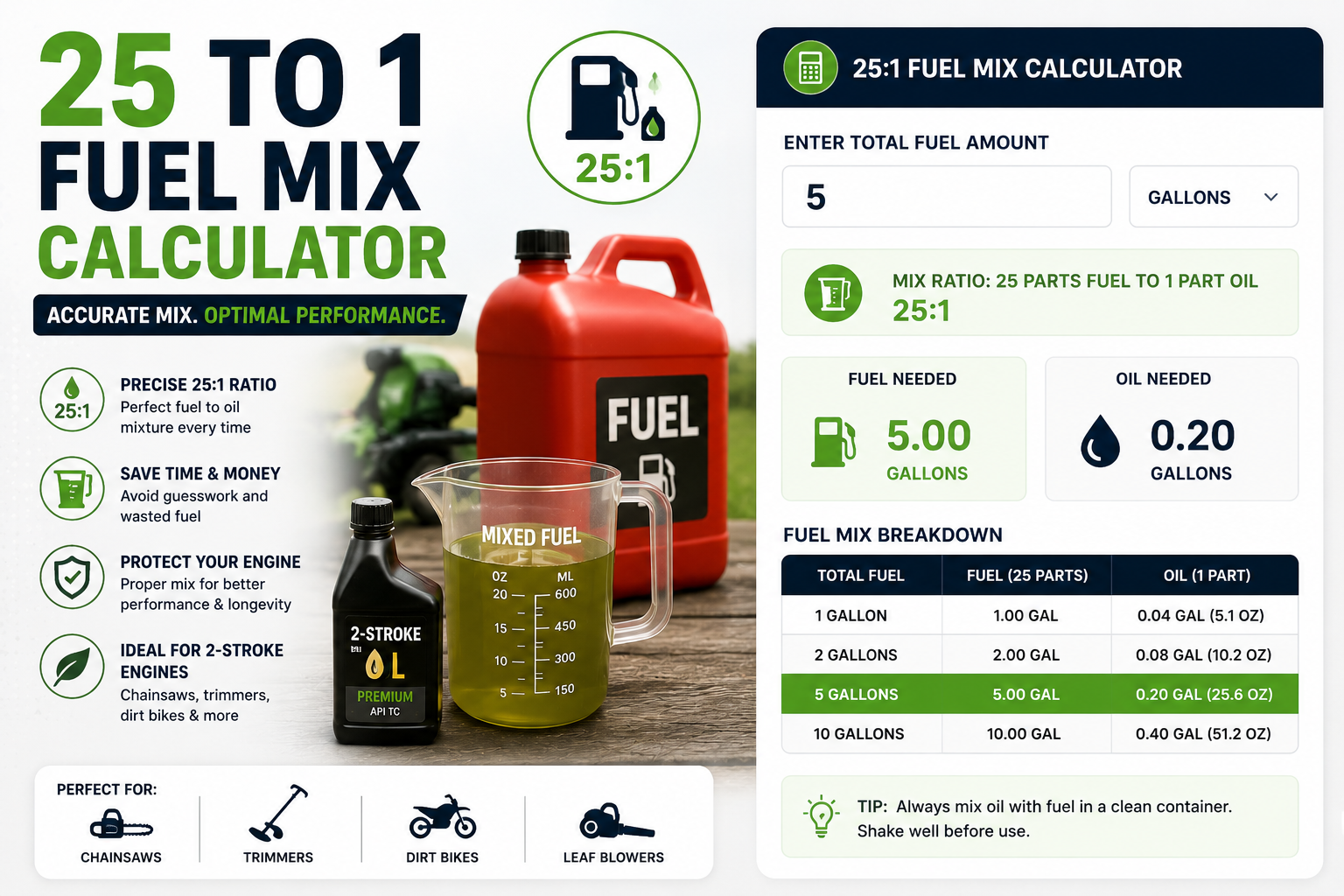
Need to mix fuel for a 2-stroke engine? Our free 25:1 Fuel Mix Calculator tells you exactly how much 2-stroke oil to add to any amount of gasoline — in gallons, liters, or fluid ounces. Enter your fuel amount, click Calculate, and you’re done. No charts to cross-reference, no guesswork.
A 25:1 ratio means 25 parts gasoline to 1 part 2-stroke oil. This rich mix is commonly specified for older chainsaws, certain outboard motors, and high-performance 2-stroke engines. Use the tabs below to calculate by gallons, liters, or fluid ounces — or pull up the quick reference chart.
Table of Contents
- 25:1 Fuel Mix Calculator (Free Tool)
- What Is a 25:1 Fuel Mix Ratio?
- How to Mix 25:1 Fuel Correctly
- Which Engines Use 25:1?
- 25:1 vs Other Mix Ratios
- Frequently Asked Questions
⛽ 25:1 Fuel Mix Calculator
Select your preferred unit tab, enter the amount of gasoline you want to mix, and click Calculate to get the exact amount of 2-stroke oil needed.
| Gasoline | Oil (fl oz) | Oil (mL) | Oil (tsp) | Oil (tbsp) |
|---|
What Is a 25:1 Fuel Mix Ratio?
A 25:1 fuel mix ratio means you are mixing 25 parts gasoline to every 1 part 2-stroke oil. Unlike 4-stroke engines — which have a dedicated oil reservoir — 2-stroke engines have no separate lubrication system. The oil must be premixed into the gasoline before it goes in the tank, so the engine lubricates itself from the fuel as it burns.
The number 25 represents how many parts of gasoline for each part of oil. The higher this number, the less oil per gallon — a 50:1 mix has half the oil content of a 25:1 mix. At 25:1, for every gallon of gasoline you add exactly 5.12 fl oz (151.4 mL) of 2-stroke oil. This is considered a rich mix — it provides generous lubrication for engines that run hot, have older tolerances, or are specifically designed to require it.
Using the wrong ratio damages engines. Too little oil (too lean) causes friction, overheating, and bearing seizure. Too much oil (too rich) causes carbon buildup, fouled spark plugs, and reduced power. Always use the ratio specified in your engine’s owner manual.
How to Mix 25:1 Fuel Correctly
- Verify your ratio: Confirm your engine manual specifies 25:1. Do not assume — the ratio varies between models and manufacturers.
- Use an approved fuel container: Never mix directly in the equipment’s fuel tank. Use a clean, sealed, approved gas can.
- Add oil first: Pour the measured 2-stroke oil into the empty container before the gasoline. This ensures thorough mixing.
- Use fresh, quality gasoline: 87+ octane. Avoid fuel older than 30 days or ethanol content above 10% (E10) unless your equipment specifically allows it.
- Use the correct 2-stroke oil: Only use oil labeled “2-stroke,” “2-cycle,” or “TC-W3” (for water-cooled engines). Never use 4-stroke motor oil.
- Shake to blend: Cap the container and shake gently for 30–60 seconds before fueling your equipment.
- Label and date: Mark your container with the ratio and mix date. Use within 30 days for best performance.
Which Engines Use a 25:1 Mix?
The 25:1 ratio is primarily specified by manufacturers for older or more demanding 2-stroke applications. Common examples include:
- Older chainsaws: Many pre-1990s Homelite, McCulloch, and older Poulan models specified 25:1.
- Outboard motors: Older 2-stroke outboards — particularly Mercury, Johnson, and Evinrude motors manufactured before the 1990s — often called for 25:1 or 50:1 depending on the break-in period.
- Break-in period: Some manufacturers require a richer 25:1 mix for the first few hours of operation on a new engine, then switch to 50:1 for normal running.
- Dirt bikes and mopeds: Vintage 2-stroke motorcycles and mopeds, particularly 1960s–1980s models, commonly specified 25:1 or 32:1.
- Small 2-cycle tools: Some older leaf blowers, string trimmers, and cultivators of 1980s–1990s vintage specify 25:1.
Always check your owner’s manual first. Modern equipment almost universally uses 50:1, but older machines vary significantly.
25:1 vs Other Mix Ratios — How Much Oil?
Here is how a 25:1 mix compares to other common 2-stroke ratios in terms of oil per US gallon of gasoline:
- 25:1 → 5.12 fl oz (151.4 mL) of oil per gallon — richest common mix
- 32:1 → 4.00 fl oz (118.3 mL) of oil per gallon
- 40:1 → 3.20 fl oz (94.6 mL) of oil per gallon
- 50:1 → 2.56 fl oz (75.7 mL) of oil per gallon — leanest common mix
The 25:1 ratio contains twice as much oil per gallon as the 50:1 ratio. Never use a 50:1 mix in an engine that specifies 25:1 — the reduced lubrication can cause rapid wear, overheating, and engine seizure.
Frequently Asked Questions
How much oil do I add for a 25:1 mix with 1 gallon of gas?
For 1 US gallon of gasoline at 25:1, add 5.12 fl oz of 2-stroke oil — that is approximately 151.4 mL, 30.7 teaspoons, or 10.2 tablespoons. Many technicians measure this as “just over 5 fluid ounces.”
How much oil for 25:1 with 5 liters of gas?
For 5 liters of gasoline at 25:1, add 200 mL of 2-stroke oil — that is exactly 1/5 of a liter, or about 6.76 fl oz. The math is simple: divide your fuel quantity (in mL) by 25 to get the oil quantity in mL.
Can I use synthetic 2-stroke oil at 25:1?
Yes — synthetic 2-stroke oil works at 25:1. If your engine manual specifies 25:1 regardless of oil type, use that ratio. Some manufacturers allow a slightly leaner mix with synthetic oil, but only if the manual specifically states this. When in doubt, follow the manual exactly.
What happens if I use too much oil in a 25:1 mix?
Excess oil causes heavy smoke, fouled spark plugs, and carbon deposits in the combustion chamber and exhaust port. Performance drops and long-term buildup can restrict the exhaust and cause power loss. The engine won’t seize immediately from too much oil, but it will run poorly. Drain and remix if you over-oiled.
Does the 25:1 ratio apply to both mineral and synthetic oil?
Yes, the ratio in your owner’s manual applies regardless of oil type unless the manual specifically states otherwise. Some manufacturers specify different ratios for mineral vs. synthetic — if yours does not, use the stated ratio with whichever oil type is recommended or approved.