Negotiating a used car price at a dealership doesn’t have to be intimidating! By arming yourself with thorough research, understanding your budget, and adopting a confident, patient approach, you can significantly improve your chances of securing a great deal. Focus on the “out-the-door” price, be prepared to walk away, and always keep your financial limits in mind.
Buying a used car can feel like stepping into a lion’s den, especially when it comes to negotiating the price at a dealership. Many people dread the process, feeling overwhelmed by slick sales tactics and complex financial jargon. But what if we told you it doesn’t have to be that way? What if you could walk into a dealership feeling confident, prepared, and ready to secure a fantastic deal on your next ride?
The truth is, mastering how to negotiate a used car price at a dealership is a skill anyone can learn. It’s less about being a ruthless haggler and more about being informed, patient, and clear about your boundaries. By understanding the dealer’s playbook and arming yourself with the right tools, you can transform a potentially stressful experience into a satisfying victory. This comprehensive guide will walk you through every step, from pre-dealership research to signing on the dotted line, ensuring you know exactly how to negotiate a used car price at a dealership effectively.
So, take a deep breath, get comfortable, and let’s demystify the art of car negotiation. By the end of this article, you’ll be equipped with the knowledge and confidence to approach any used car dealership and come out on top, saving money and driving away in the car you truly want.
Key Takeaways
- Do Your Homework: Before stepping foot in a dealership, research fair market values for your desired car and the true value of your trade-in. This knowledge is your ultimate power in how to negotiate a used car price at a dealership.
- Secure Pre-Approved Financing: Get your financing sorted through your bank or credit union *before* visiting. This gives you leverage and separates the car price negotiation from the loan terms.
- Focus on the “Out-the-Door” Price: Always negotiate the total price, including all fees, taxes, and add-ons, rather than just the monthly payment. This prevents dealers from hiding costs.
- Be Prepared to Walk Away: Your willingness to leave is your strongest negotiating tool. Don’t be afraid to use it if the deal isn’t right for you.
- Separate Trade-In and Purchase: Discuss your trade-in only after you’ve settled on the price for the car you’re buying. This prevents confusion and allows for clearer negotiation.
- Maintain a Calm and Confident Demeanor: Approach the negotiation process with a clear head, politeness, and unwavering confidence in your research and limits.
Quick Answers to Common Questions
Should I tell the dealership I have a trade-in immediately?
No, it’s generally best to keep your trade-in separate from the negotiation of the new-to-you car’s price. Discuss it only after you’ve agreed on the price of the used car you intend to buy.
What’s a good starting offer when negotiating?
A good starting offer is typically 10-20% below the dealer’s asking price, or slightly below the fair market value you’ve researched for the vehicle. This leaves room for negotiation.
Is it better to pay cash or finance a used car?
The best option depends on your financial situation. Paying cash avoids interest, but if you have a low-interest pre-approved loan, financing can preserve your cash for emergencies. Always negotiate the car price first, regardless of your payment method.
How long should a used car negotiation take?
A good negotiation can take anywhere from an hour to several hours, sometimes even spanning multiple days. Don’t rush the process; patience is a key component of success.
What if the salesperson won’t budge on price?
If the salesperson won’t budge after multiple rounds of negotiation and you’re confident your offer is fair, be prepared to walk away. Often, this is the most effective way to get them to reconsider or realize your seriousness.
📑 Table of Contents
- 1. Preparation is Your Secret Weapon: Research, Budget, and Financing
- 2. The Mindset and Strategy: Confidence, Patience, and Clarity
- 3. At the Dealership: Inspection, Test Drive, and Initial Contact
- 4. The Art of the Counter-Offer: Focusing on the “Out-the-Door” Price
- 5. Handling Objections, Tactics, and When to Walk Away
- 6. Sealing the Deal: Paperwork and Avoiding Pitfalls
1. Preparation is Your Secret Weapon: Research, Budget, and Financing
The most powerful tool you have when learning how to negotiate a used car price at a dealership isn’t charm or aggression; it’s information. Before you even set foot on a car lot, you need to arm yourself with extensive knowledge. This foundational work will empower you, set realistic expectations, and give you the confidence to stand firm.
Understand the Market Value of Your Desired Car
First things first: research the specific make, model, and year of the used car you’re interested in. Websites like Kelley Blue Book (KBB.com), Edmunds.com, and NADAguides.com are invaluable resources. They provide estimated market values based on condition, mileage, features, and your geographic location. Look for the “private party value” (the lowest) and the “dealer retail value” (the highest). Aim to negotiate closer to the private party value, or at least significantly below the initial asking price.
- Tip: Look at multiple listings for similar vehicles in your area. This will give you a real-world sense of current pricing trends and the range within which you should be negotiating.
- Example: If a dealer lists a 2018 Honda Civic EX for $18,500, and KBB shows its fair market range as $16,000-$17,500, you know their asking price is high.
Know the True Value of Your Trade-In
If you have a car to trade in, research its value thoroughly as well. Use the same websites (KBB, Edmunds) to get an estimate for its trade-in value. Be honest about its condition, mileage, and any damage. Dealers will always offer less than the private party value, as they need to recondition it and make a profit. Knowing this number gives you a baseline and prevents you from being low-balled too much. Remember, separating the trade-in negotiation from the car purchase negotiation is a crucial tactic in how to negotiate a used car price at a dealership.
Get Pre-Approved for Financing
This is arguably the most critical step in preparing to negotiate a used car price at a dealership. Walk into the dealership with a pre-approved loan from your bank or credit union. This does several things:
- Establishes Your Budget: You know exactly how much you can afford, and at what interest rate.
- Provides Leverage: You’re not reliant on the dealership’s financing, which often carries higher interest rates or hidden fees. They know you’re a serious buyer who can walk away if their offer isn’t competitive.
- Separates Negotiations: It allows you to focus purely on the vehicle price, not the monthly payment. Dealers love to talk monthly payments because they can extend the loan term or increase the interest rate to make a higher price seem affordable.
Even if the dealership offers a better rate (which they might, to earn your business), having a pre-approval in hand puts you in control. It’s a key strategy for how to negotiate a used car price at a dealership successfully.
2. The Mindset and Strategy: Confidence, Patience, and Clarity
Your mental approach is just as important as your research. Adopting the right mindset will help you navigate the negotiation process with composure and achieve your goals when you negotiate a used car price at a dealership.
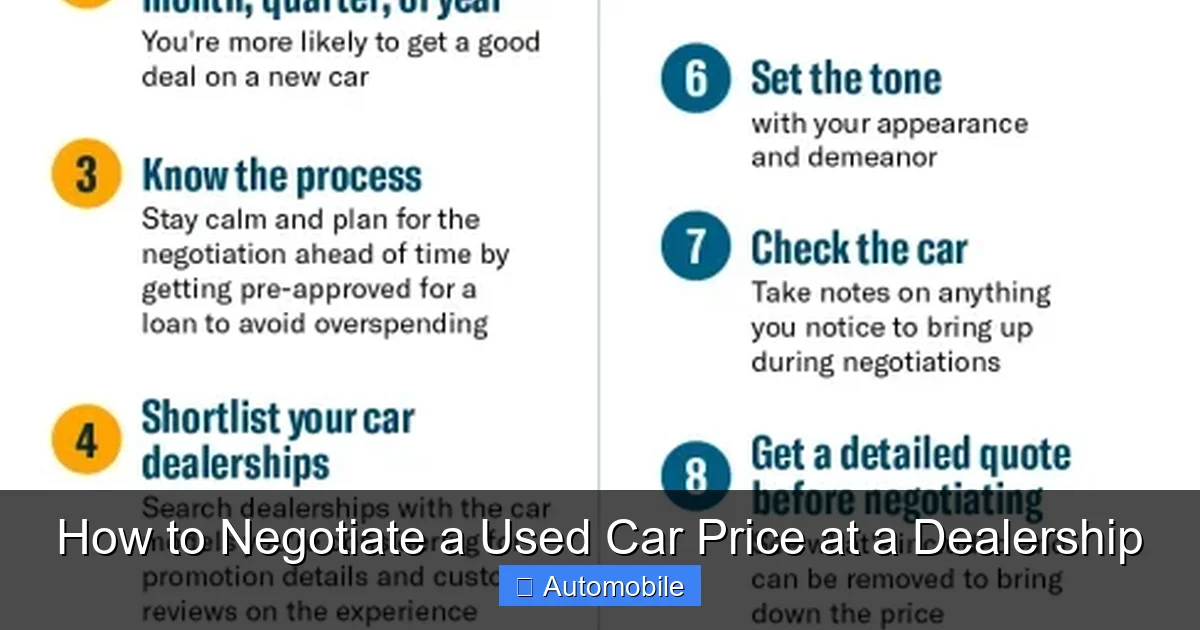
Visual guide about How to Negotiate a Used Car Price at a Dealership
Image source: automotivian.com
Cultivate Confidence and Patience
Salespeople are trained to read body language and exploit hesitation. Walk in with confidence, knowing your research. Don’t be afraid to take your time. There’s no rush. The car will likely still be there tomorrow, or another similar one will pop up. Patience is your ally. If you feel pressured or rushed, that’s a red flag. Remember, you’re in charge of your decision and your money.
Go Alone or Bring a Trusted Friend
If possible, avoid bringing children or anyone who might make you feel rushed or emotional. A trusted friend or family member can serve as an objective second pair of eyes and ears, helping you stick to your plan and spot potential issues. They can also act as a buffer, giving you a chance to consult before responding to an offer.
Separate Yourself from the Car
It’s easy to fall in love with a car, but emotional attachment can be a serious weakness in negotiation. Treat it like a commodity. Imagine it as just one of many cars available. This emotional detachment helps you make rational decisions and be willing to walk away if the deal isn’t right. This is a vital psychological tool for how to negotiate a used car price at a dealership.
3. At the Dealership: Inspection, Test Drive, and Initial Contact
Once you’ve done your homework and set your mindset, it’s time to visit the dealership. This phase is about gathering more information and solidifying your interest, without committing to anything yet.
Thorough Inspection and Test Drive
Before any serious talk about price, thoroughly inspect the car. Look for signs of damage, rust, mismatched paint, or poor repairs. Check all lights, tires, fluids, and interior features. Take it for a comprehensive test drive on various road types (city, highway, bumps). Listen for unusual noises, check the brakes, acceleration, and handling. Does it feel right to you?
- Consider a Pre-Purchase Inspection (PPI): If you’re seriously considering the car, arrange for an independent mechanic to perform a pre-purchase inspection. This small investment (typically $100-$200) can save you thousands by uncovering hidden issues. Make this a condition of your purchase.
Ask Pointed Questions
Engage with the salesperson, but direct the conversation. Ask about the car’s history (service records, previous owners, accident history via CarFax/AutoCheck reports). Inquire about any reconditioning they’ve done. “Why is this car being sold?” is a perfectly valid question. Don’t be afraid to poke and prod.
Don’t Discuss Your Trade-In or Financing Yet
This is crucial when you learn how to negotiate a used car price at a dealership. When asked if you have a trade-in or if you need financing, politely defer. Say something like, “I’m focusing on the price of this car right now; we can discuss those details later.” Or, “I’m pre-approved, but I’m open to seeing your options once we agree on the car’s price.” Separating these elements prevents the dealer from muddying the waters and making it harder to know what you’re actually paying for the car itself.
4. The Art of the Counter-Offer: Focusing on the “Out-the-Door” Price
Now, the real negotiation begins. This is where your research, patience, and resolve truly pay off. The goal here is to learn how to negotiate a used car price at a dealership by focusing on the total cost.
Identify the “Out-the-Door” Price
The dealer’s sticker price is just the starting point. You need to know the “out-the-door” price, which includes the car’s price, taxes, registration fees, documentation fees, and any other add-ons. Insist on seeing this full breakdown. Dealers often add “doc fees” (documentation fees) that can vary wildly by state and dealership – some are legitimate, others are inflated. Ask what they are and if they are negotiable (sometimes they are, sometimes they’re fixed by state law).
- Never negotiate on monthly payments. This is a common dealer trick. They can easily lower your monthly payment by extending the loan term, which means you pay more interest over time. Always, always, always negotiate the total purchase price of the car.
Make Your First Offer
Based on your research, make an initial offer that is significantly lower than the dealer’s asking price but still reasonable. A good rule of thumb is to offer 10-20% below the asking price, or slightly below your researched fair market value. Be prepared for them to counter-offer. Your first offer should create room for negotiation. For example, if the car is listed at $20,000 and your research says $17,000-$18,000 is fair, start at $16,000 or $16,500.
- Be firm but polite. State your offer clearly and explain that it’s based on your market research.
- Be prepared for back-and-forth. The salesperson will likely go to their manager with your offer, and come back with a slightly lower counter-offer than their original asking price, but still higher than yours.
Counter Their Counter-Offer
When they come back with a higher price, don’t immediately accept. Counter again, meeting them part-way, but always aiming to get closer to your target price. The negotiation is a dance. Move in small increments. For example, if you offered $16,000 on a $20,000 car, and they countered with $19,000, you might counter with $16,800 or $17,000. Each offer should be justified by your research or specific findings during your inspection.
- Stay focused on the “out-the-door” price. Reiterate that you are only interested in the total price, including all fees. Don’t let them divert your attention to monthly payments.
- Be prepared for multiple rounds. Good negotiation can take time, sometimes hours.
5. Handling Objections, Tactics, and When to Walk Away
Dealerships have well-rehearsed tactics designed to get you to pay more. Recognizing these and knowing when to use your ultimate leverage are key components of how to negotiate a used car price at a dealership effectively.
Recognize Common Sales Tactics
- “What do I need to do to earn your business today?”: This is a pressure tactic. Your answer should be, “Offer me the right price on the car.”
- The “Manager Special” or “Final Offer”: These are rarely the absolute final offers. There’s almost always a little more room.
- The “Walk Away” Test: A salesperson might feign going to their manager multiple times, or even bring out another salesperson or the manager themselves. They want to see if you’ll crack under pressure.
- The “Payment Packer”: As mentioned, focusing on monthly payments rather than total price. Stick to your guns.
- The “Trade-In Lowball”: Offering a ridiculously low amount for your trade-in. This is why you researched its value beforehand.
- “Added Value” Products: Extended warranties, paint protection, fabric protection, VIN etching. Most of these are high-profit items for the dealership and often not worth the cost. Politely decline.
Be Prepared to Walk Away
This is your ultimate power move. If you’ve made a fair offer based on your research and the dealership simply won’t meet you, be ready to walk out. Genuinely get up, thank them for their time, and head for the door. Often, as you’re leaving, they might suddenly find that “extra” room to meet your price. If they don’t, it means the deal wasn’t right for you anyway, and you saved yourself from overpaying. Remember, there are always other cars and other dealerships.
- Don’t bluff. Only use this tactic if you’re truly prepared to leave without the car.
- Reiterate your target price as you leave. Say, “If you can do it for [your target price] out-the-door, give me a call.”
6. Sealing the Deal: Paperwork and Avoiding Pitfalls
Congratulations, you’ve (hopefully) agreed on a price! But the negotiation isn’t over just yet. The final steps require careful attention to detail to ensure no last-minute surprises.
Review All Paperwork Meticulously
Once you’ve agreed on the out-the-door price, ask for a printed buyer’s order or sales contract. Read *every single line item* carefully. Ensure the agreed-upon price is reflected accurately, along with all taxes, fees, and no hidden charges or unwanted add-ons have mysteriously appeared. Compare it to your notes and your pre-approval figures.
- Watch out for “dealer prep” or “reconditioning” fees. These are often inflated or unnecessary. You’ve already negotiated the price; these should be included.
- Verify your interest rate and loan term. If you’re using dealership financing, ensure it matches what was verbally agreed upon.
- Confirm included features and warranties. Make sure anything promised (e.g., a specific trim level, a 30-day warranty) is documented.
Don’t Succumb to Last-Minute Pressure
The finance manager (the “F&I” manager) is the last line of defense for the dealership to make more profit. They will present you with extended warranties, gap insurance, service plans, and other add-ons. Most of these are highly profitable for the dealership and often overpriced. If you haven’t researched these in advance or don’t feel you need them, politely but firmly decline. You’ve already done the hard work learning how to negotiate a used car price at a dealership; don’t give back your savings now.
- Gap insurance: Only consider this if you have a high loan-to-value ratio and a lengthy loan term. You can often get it cheaper from your own insurance company.
- Extended warranties: Research third-party warranties if you want one; they can often be more flexible and affordable than dealer offerings.
Confirm Trade-In Details (If Applicable)
If you’re trading in a vehicle, ensure the agreed-upon trade-in value is clearly stated on the contract and accurately subtracted from the purchase price (or otherwise handled as agreed). Check that there are no additional fees related to your trade-in that weren’t discussed.
Take Your Time Signing
Never feel rushed to sign documents. If you have questions or something doesn’t look right, ask for clarification. If you’re uncomfortable, don’t sign. It’s your money, your decision, and your contract.
Learning how to negotiate a used car price at a dealership is a skill that empowers you to save significant money and feel good about your purchase. By approaching the process with thorough research, a clear budget, and unwavering confidence, you can navigate the dealership environment successfully. Remember, knowledge is power, patience is a virtue, and being prepared to walk away is your ultimate leverage. Good luck, and happy driving!
🎥 Related Video: Save THOUSANDS at Car Dealership. How to negotiate a car deal in 2024. The most important tip.
📺 The Car Guy Online
If this video helped you, please SHARE it with someone you think might benefit from it. This SINGLE tip has saved me thousands …
Frequently Asked Questions
How do I know if the price I’m offering is fair?
You know your offer is fair by doing thorough pre-purchase research using reputable sources like Kelley Blue Book, Edmunds, and NADAguides. Compare prices of similar vehicles in your area and consider the car’s condition and mileage. Your offer should be grounded in these data points.
What is a “documentation fee” and can I negotiate it?
A documentation fee (or “doc fee”) covers the cost of preparing and processing paperwork. While some states cap these fees, others don’t, allowing dealerships to charge varying amounts. You can certainly ask to negotiate it, but dealers are sometimes reluctant as it’s a fixed profit center for them; however, you can always ask them to reduce the car price to offset the fee.
Should I tell the dealership about my pre-approved financing?
Yes, but not immediately. Once you start serious price negotiation on the car itself, inform them you have pre-approved financing. This signals that you’re a serious buyer and gives you leverage, as you’re not dependent on their financing options.
What are some red flags to watch out for during negotiation?
Red flags include pressure tactics to buy immediately, refusing to show the “out-the-door” price breakdown, constant shifts to monthly payments, excessively high documentation fees, and a refusal to allow a pre-purchase inspection by an independent mechanic. Trust your gut if something feels off.
Is it better to negotiate at the end of the month or year?
Dealerships often have monthly, quarterly, and annual sales quotas. Visiting towards the end of these periods (e.g., the last few days of the month, or year-end in December) can sometimes give you more leverage, as sales teams may be more motivated to hit targets and clear inventory.
Should I discuss an extended warranty during the initial negotiation?
No, do not discuss an extended warranty or other add-ons until after you have agreed on the “out-the-door” price of the car itself. These are separate, high-profit items for the dealership, and discussing them early only complicates the primary negotiation for the vehicle’s price.