The McLaren F1, once priced around $1 million, has transcended mere transportation to become one of the most coveted and valuable collector cars in the world. Its unparalleled engineering, extreme rarity, and racing pedigree have fueled an astronomical rise in its market value, now consistently fetching tens of millions of dollars at auction. Understanding the McLaren F1 sports car price today means appreciating its status as a timeless automotive icon and a blue-chip investment.
When we talk about automotive legends, a few names always leap to mind. But perhaps none capture the imagination quite like the McLaren F1. It’s more than just a car; it’s a piece of history, a triumph of engineering, and a benchmark that redefined what a road car could be. And as with any legend, its value has soared far beyond its initial cost. So, let’s talk about the incredible journey of the McLaren F1 sports car price, from its groundbreaking debut to its current status as a multi-million-dollar masterpiece.
Imagine a car that was so far ahead of its time, so obsessively engineered, that it still holds its own against modern hypercars decades later. That’s the McLaren F1. Conceived by the brilliant mind of Gordon Murray, this vehicle wasn’t just built to be fast; it was built to be the ultimate driving machine, period. Its unique three-seat configuration, gold-lined engine bay, and uncompromising pursuit of lightweight performance captivated the world. But what started as an incredibly expensive dream machine for the privileged few has transformed into an almost unattainable automotive grail, with its price skyrocketing into the stratosphere.
You might be wondering, what makes this car so special that its value has climbed from a cool million to what could easily buy a private jet today? It’s a fascinating story of rarity, performance, provenance, and the insatiable desires of collectors. We’re not just talking about inflation here; we’re talking about an asset that has appreciated at a rate that would make most financial advisors blush. Let’s dive deep into the world of the McLaren F1 and explore every facet of its incredible value.
Key Takeaways
- Original Price: The McLaren F1 was launched in the early 1990s with an initial price tag of approximately $1 million USD (around £540,000 to £634,500 at the time), making it the most expensive production car of its era.
- Current Valuation: Today, the McLaren F1 sports car price typically ranges from $15 million to over $25 million USD, with some exceptional examples reaching beyond $27 million, making it one of the most valuable cars ever sold.
- Key Appreciation Drivers: Its phenomenal price appreciation is primarily due to extreme rarity (only 106 built, with just 64 road cars), groundbreaking performance, historic significance, iconic design, and the “Gordon Murray” factor.
- Investment-Grade Asset: The F1 is not just a car; it’s considered a blue-chip investment, often compared to fine art or rare artifacts, consistently outperforming many traditional investment categories.
- Provenance is Paramount: A car’s specific history, mileage, original condition, service records, and even the number of owners significantly impact its market value. Low-mileage, impeccably maintained examples with original components command the highest prices.
- Demand Outstrips Supply: The limited production run coupled with enduring global demand from ultra-high-net-worth collectors ensures that the McLaren F1 sports car price remains incredibly robust and likely to continue appreciating.
Quick Answers to Common Questions
What was the original McLaren F1 sports car price?
The original McLaren F1 sports car price was approximately $800,000 to $1 million USD when it launched in the early 1990s, making it the most expensive production car of its time.
How many McLaren F1 road cars were produced?
Only 64 road-legal McLaren F1 production cars were ever built, out of a total of 106 units across all variants (including race cars and prototypes).
What is the record sale price for a McLaren F1?
In 2021, an almost brand-new McLaren F1 (chassis #029) sold for $20.465 million at RM Sotheby’s. A McLaren F1 GTR ‘Longtail’ sold privately for $27.5 million in the same year.
What makes the McLaren F1 so expensive today?
Its extreme rarity (only 64 road cars), groundbreaking performance, historic significance, unparalleled engineering, and status as a “blue-chip” automotive investment all contribute to its astronomical value.
Is the McLaren F1 still the fastest naturally aspirated production car?
Yes, the McLaren F1 still holds the record as the fastest naturally aspirated production car, with a verified top speed of 240.1 mph (386.4 km/h).
📑 Table of Contents
- The Legend of the McLaren F1: Why it’s More Than Just a Car
- Understanding the Original McLaren F1 Sports Car Price
- The Astronomical Rise of McLaren F1 Sports Car Price
- Documenting Record-Breaking Sales
- Factors Influencing the McLaren F1 Sports Car Price Today
- Is the McLaren F1 Sports Car Price Sustainable? An Investment Perspective
- Conclusion
The Legend of the McLaren F1: Why it’s More Than Just a Car
Before we dissect the numbers behind the McLaren F1 sports car price, it’s crucial to understand *why* this car is so revered. Its reputation isn’t just hype; it’s built on a foundation of unparalleled innovation and pure driving exhilaration.
A Visionary Project
The McLaren F1 was born from a desire to create the definitive road car. Gordon Murray, along with a dedicated team at McLaren, set out to ignore traditional compromises. Every component was scrutinized for weight and efficiency. The result was a carbon-fiber monocoque chassis, a naturally aspirated V12 engine from BMW M (designed specifically for the F1), and an aerodynamic package that was revolutionary for its time. This commitment to perfection from day one laid the groundwork for its future collectibility.
Unmatched Performance for its Time
When it launched in 1992, the F1 instantly became the fastest production car in the world, hitting a top speed of 240.1 mph (386.4 km/h) with its rev limiter removed. This record stood for over a decade. Its 6.1-liter V12 engine produced 627 horsepower, propelling the lightweight F1 from 0-60 mph in just 3.2 seconds. These figures weren’t just impressive; they were mind-boggling, setting a new benchmark for supercars and captivating enthusiasts worldwide. The sheer performance made it an instant icon.
Exclusivity and Rarity
Exclusivity is a powerful driver of value, and the McLaren F1 is exclusivity personified. Only 106 units were ever built between 1992 and 1998 across all variants. Out of these, a mere 64 were road-legal production cars. This tiny production number meant that from the very beginning, owning a McLaren F1 was a privilege reserved for a select few. This inherent rarity is arguably the single biggest factor pushing the McLaren F1 sports car price to its astronomical levels today.
Understanding the Original McLaren F1 Sports Car Price
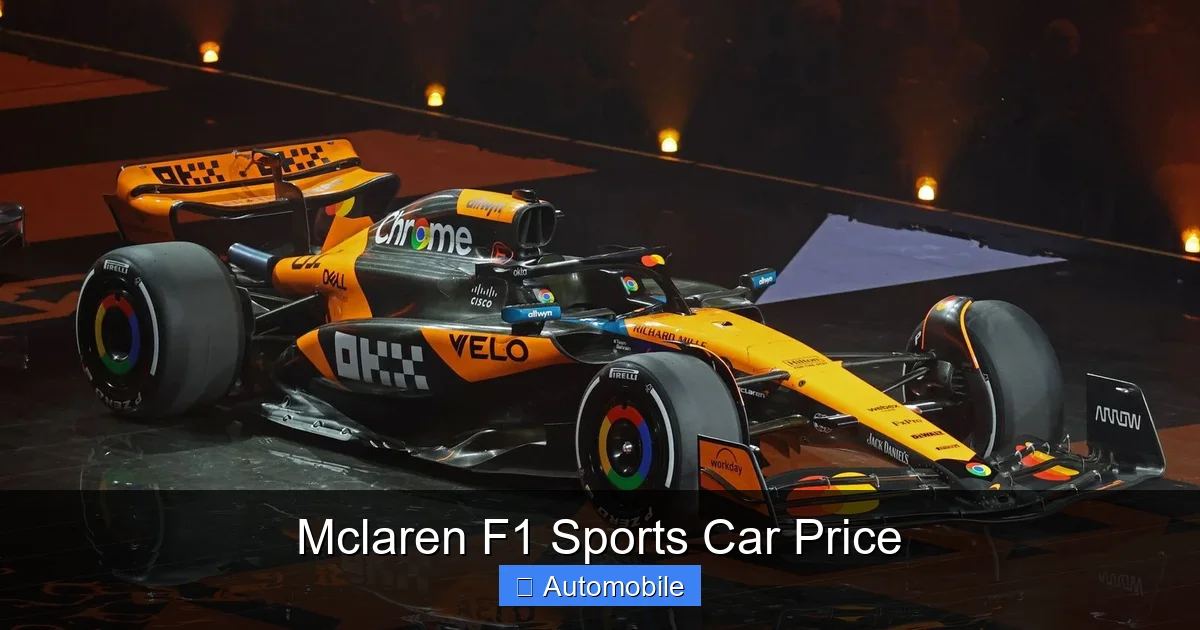
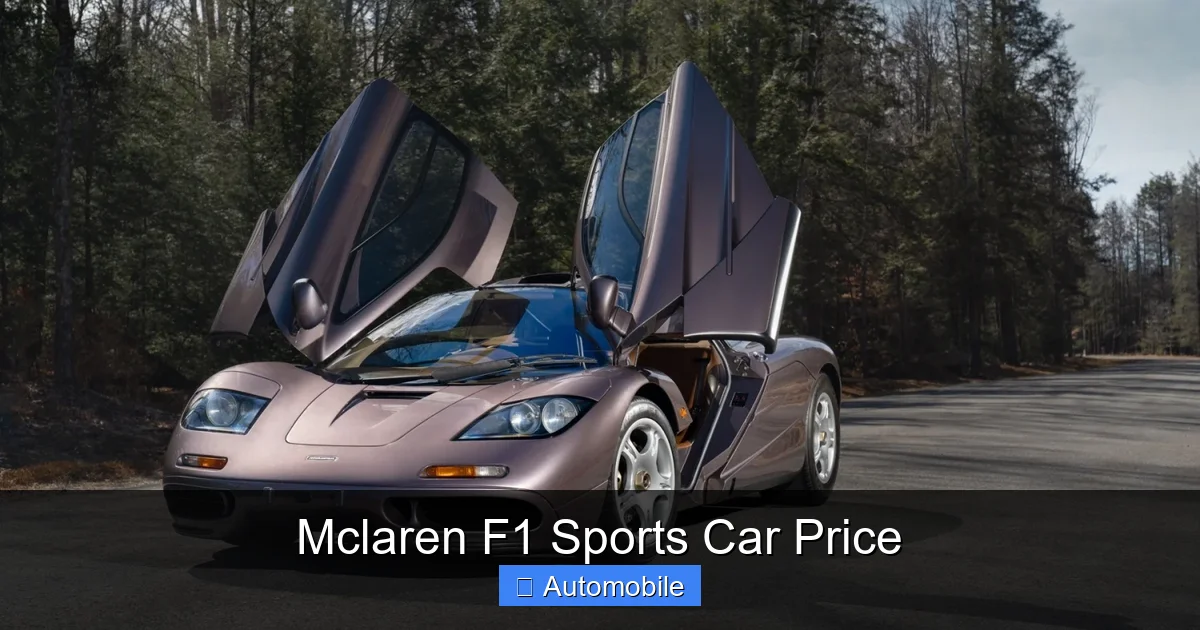
Visual guide about Mclaren F1 Sports Car Price
Image source: e0.365dm.com
To truly appreciate the current market value, we need to rewind to the early 1990s and look at its original asking price. Even then, it was an incredibly expensive machine.
The Cost of Perfection
When the McLaren F1 first became available to eager buyers, its price tag was around £540,000 to £634,500, depending on the exact specification and market. Converting this to US dollars at the time, we’re talking roughly $800,000 to $1 million USD. In the early 90s, this made the F1 the most expensive production car on sale, by a significant margin. To put that into perspective, a brand new Ferrari F40, another legendary supercar, was selling for around $400,000 at the same time. The F1 was in a league of its own, signaling its intent as a no-compromise, ultra-premium product.
What That Price Included
For that princely sum, buyers weren’t just getting a car; they were getting an experience. The purchase included a bespoke ownership program, specialized maintenance, and direct access to McLaren’s engineers. Each car was built to exacting standards, often tailored to the owner’s preferences. The price reflected the incredible investment in research and development, the exotic materials used, and the sheer man-hours dedicated to crafting each vehicle. This original high price point already established the F1 as a top-tier asset, not just another luxury car.
The Astronomical Rise of McLaren F1 Sports Car Price
Fast forward a couple of decades, and the original million-dollar price tag seems almost quaint. The F1 has appreciated in value at a rate that few could have predicted, becoming a cornerstone of any serious automotive collection.
Rarity and Limited Production
As mentioned, only 64 road-going F1s exist. This tiny number, combined with the fact that many are tucked away in private collections, means that opportunities to acquire one are exceedingly rare. When one does come to market, demand from a global pool of ultra-wealthy collectors is fierce, driving the McLaren F1 sports car price ever higher. It’s a classic supply-and-demand scenario, but on an epic scale.
Historic Significance and Pedigree
The F1 is an undisputed icon, often cited by automotive journalists and enthusiasts as one of the greatest cars ever made. It’s a seminal vehicle that pushed boundaries and influenced countless designs that followed. This historic importance ensures its place in the automotive hall of fame and makes it incredibly desirable. Owners aren’t just buying a car; they’re buying a piece of history and a legacy.
Performance Legacy and Engineering Marvel
Despite being over 30 years old, the F1’s performance figures are still staggering. Its naturally aspirated V12 engine offers a raw, unfiltered driving experience that modern turbocharged hybrids simply can’t replicate. The gold foil in the engine bay for heat reflection, the central driving position, and the bespoke toolbox that came with each car all contribute to its legendary status as an engineering marvel. These unique selling points are irreplaceable and contribute significantly to the high McLaren F1 sports car price.
The ‘Hypercar’ Investment Market
Over the past two decades, the market for rare and significant classic cars has exploded, transforming them into legitimate investment vehicles. The McLaren F1 sits at the very pinnacle of this market, often referred to as a “blue-chip” asset. Wealthy individuals and investment funds see these cars not just as passion purchases but as stable, appreciating assets that can diversify a portfolio. This institutional interest further inflates the market.
Provenance and Condition
For a car of this caliber, provenance (the documented history of ownership, maintenance, and originality) is paramount. A car with an unbroken chain of ownership, meticulous service records, very low mileage, and original paint and components will command a far higher McLaren F1 sports car price than one with a patchy history or significant modifications. Think of it like a rare stamp or a piece of art; its story and condition are crucial to its value.
Documenting Record-Breaking Sales
To truly grasp the current market for the McLaren F1, we need to look at some of the jaw-dropping sales figures that have made headlines. These aren’t just sales; they are market benchmarks.
Landmark Auctions and Private Sales
While many F1 sales happen privately, out of the public eye, whenever one appears at a major auction, it inevitably sets records. Here are a few notable examples:
- In 2013, McLaren F1 chassis #063 sold for approximately $10.5 million at auction.
- By 2017, McLaren F1 chassis #044 (a U.S.-spec example) sold for a staggering $15.62 million at Bonhams Quail Lodge auction.
- In 2021, RM Sotheby’s sold a virtually brand-new McLaren F1, chassis #029, with less than 250 miles on the odometer, for an astonishing $20.465 million. This car was in immaculate, original condition, still wearing its factory-fitted Goodyear Eagle F1 tires.
- Perhaps the most expensive publicly known sale was in 2021, when a rare McLaren F1 GTR ‘Longtail’ variant, chassis #025R, sold for $27.5 million in a private transaction, though road cars can also reach these heights depending on their history.
These figures clearly illustrate the meteoric rise in the McLaren F1 sports car price and show that demand for pristine examples is exceptionally strong.
GTR vs. Road Car Values
It’s worth noting that there are different variants of the F1, which can influence pricing. The “standard” road car (64 units) is the most common. Then there are the five F1 LMs (Le Mans), which are essentially road-legal versions of the GTR race cars, built to commemorate McLaren’s 1995 Le Mans victory. There are also the F1 GT “Longtails” (three examples), and the F1 GTR race cars (28 examples, some later converted for road use). Generally, the LMs and GTs, due to their even greater rarity and direct link to racing success, command even higher prices than the already astronomical McLaren F1 sports car price for the standard road car.
The Impact of Upgrades and Special Editions
Sometimes, a standard F1 can be upgraded with factory-approved “LM-spec” engines or aerodynamic packages, which can also boost its value, especially if done by McLaren Special Operations (MSO) and properly documented. These enhancements can make an already desirable car even more unique and potent, further solidifying its top-tier market position.
Factors Influencing the McLaren F1 Sports Car Price Today
While scarcity and legacy are major drivers, a host of specific factors contribute to the individual valuation of each McLaren F1 that comes to market.
Mileage and Usage History
For collectors, lower mileage almost always translates to a higher price. An F1 with under 1,000 miles is exceptionally rare and will fetch a premium. However, the definition of “low mileage” for an F1 can be relative; even a car with 10,000-20,000 miles, if impeccably maintained and with a well-documented history of usage, is still highly desirable. The goal for many collectors is originality and minimal wear.
Originality vs. Restoration
The highest value is almost always placed on cars that retain as much of their original condition as possible. This includes original paint, interior, engine components, and even tires (if they’ve been stored properly). While a full restoration by McLaren might be excellent for the car’s longevity, an F1 that has never been restored and is in pristine original condition is often seen as more valuable by top collectors. The integrity of its birth state is highly prized.
Maintenance Records and Service History
An extensive, complete, and verifiable service history from McLaren or recognized F1 specialists is critical. These cars require highly specialized and expensive maintenance. Demonstrating that the car has been properly cared for throughout its life, with all scheduled services and necessary repairs documented, provides immense confidence to potential buyers and directly impacts the McLaren F1 sports car price. Missing service records can significantly devalue a car.
Global Economic Climate and Collector Trends
The value of ultra-rare collectibles, including the F1, can be influenced by broader economic factors. A booming global economy tends to fuel the collector car market, while downturns can lead to slower growth or even slight dips (though the F1 has proven remarkably resilient). Furthermore, changing tastes and trends among the ultra-rich, though less impactful for a foundational icon like the F1, can also play a subtle role.
Is the McLaren F1 Sports Car Price Sustainable? An Investment Perspective
Given its stratospheric rise, it’s natural to wonder if the McLaren F1 sports car price can continue to climb. For most experts, the answer is a resounding yes, though perhaps not at the same exponential rate forever.
The Enduring Appeal
The F1 represents a pinnacle of automotive engineering and design that will likely never be replicated. It’s a naturally aspirated, pure analog driving machine from an era before complex electronics took over. This purity, combined with its stunning performance and timeless aesthetics, gives it an enduring appeal that transcends generations of car enthusiasts. Its legend only grows with time.
Comparison to Other Collectibles
The McLaren F1 is often discussed in the same breath as fine art, rare watches, or classic properties as an investment. These assets derive their value from rarity, historical significance, and desirability. The F1 checks all these boxes in spades. While no investment is truly “safe,” the F1 has demonstrated remarkable stability and appreciation, even during periods of economic uncertainty.
The Long-Term Value Proposition
For long-term investors and passionate collectors, the F1 remains a solid bet. Its position as the “ultimate driving machine” of its era, combined with its extreme rarity and unique story, ensures its place as a cornerstone of the automotive collector world. While short-term fluctuations are always possible in any market, the long-term trajectory for the McLaren F1 sports car price appears to be one of continued strength and growth. It’s a testament to a car that truly stands alone.
Conclusion
The McLaren F1 is not just a car; it’s a testament to human ingenuity, a masterpiece of engineering, and a cultural icon. Its journey from a million-dollar marvel to a multi-million-dollar legend is a fascinating story of rarity, performance, and unwavering demand. The McLaren F1 sports car price today reflects its unique place in history—a car that broke barriers, set records, and continues to captivate the hearts and minds of automotive enthusiasts and collectors worldwide. Owning one is more than just owning a car; it’s owning a piece of a truly unparalleled legacy, an investment that continues to accelerate in value, much like the car itself. Its legend, like its price, seems destined only to grow.
🎥 Related Video: The New McLaren #F1 Livery For 2024! 😍
📺 McLaren
The 2024 McLaren F1 livery has hit the boulevard at the McLaren Technology Centre! #McLaren #WhateverItTakes.
Frequently Asked Questions
Why is the McLaren F1 considered a “blue-chip” investment?
The McLaren F1 is regarded as a blue-chip investment because of its extreme rarity, enduring historical significance, and consistent appreciation in value over decades. It’s seen as a stable and valuable asset in the high-end collector market, similar to fine art.
Are there different versions of the McLaren F1, and how do they affect the price?
Yes, besides the standard road car, there are rarer variants like the F1 LM (Le Mans) and F1 GT “Longtail” models, as well as F1 GTR race cars. These rarer versions, especially the LMs and GTs, typically command even higher prices due to their enhanced performance and even greater exclusivity.
How does mileage affect the McLaren F1 sports car price?
For collector cars like the McLaren F1, lower mileage generally correlates with a higher price. Pristine, low-mileage examples with original components and minimal wear are highly sought after and can fetch significant premiums over cars with higher mileage or more extensive usage history.
What kind of maintenance does a McLaren F1 require, and how does it impact value?
The McLaren F1 requires highly specialized and expensive maintenance, often performed only by McLaren Special Operations (MSO) or approved specialists. A complete and verifiable service history is crucial, as it demonstrates meticulous care and greatly enhances the car’s value and desirability to potential buyers.
Are there any modern cars comparable to the McLaren F1 in terms of price appreciation?
While many modern hypercars are launched at high prices, few have shown the same exponential appreciation as the F1. Cars like the Ferrari LaFerrari, Porsche 918 Spyder, or McLaren P1 have seen significant increases, but the F1’s unique blend of rarity, historic impact, and analog purity places it in a league of its own for sustained value growth.
Can you still buy a brand new McLaren F1 today?
No, you cannot buy a brand new McLaren F1 today. Production ended in 1998, with only 106 units ever built. Any acquisition of a McLaren F1 now must be through the secondary market, typically from private collectors or specialized high-end classic car dealerships and auctions.